A ฿100 million counterfeit medicine empire is exposed after police raid hidden factories and a Bangkok delivery hub. Officers seize 1.4 million items and arrest nine workers, but the financiers directing nationwide sales are still being hunted today.
Thai police are hunting the financiers and masterminds behind a ฿100 million counterfeit medicine empire uncovered during four coordinated raids. The network operated from hidden Samut Sakhon factories and a Bangkok distribution point for up to two years. Officers arrested nine workers and seized 1.4 million items, including 37,000 finished bottles and packaging for vast further production. FDA tests found coloured, flavoured syrup without any active antihistamine inside bottles made to resemble registered Allergin medicine. Investigators are now tracing nationwide deliveries, warehouse leases and money flows as pharmacies face warnings over selling the dangerous fakes.
Thai police are hunting the financier behind a counterfeit medicine network linked to losses exceeding ฿100 million. Investigators also want those who directed production, secured warehouses and controlled nationwide deliveries. The operation reportedly ran for one to two years before police struck on September 22. However, its suspected financier and senior organisers remain outside police custody.
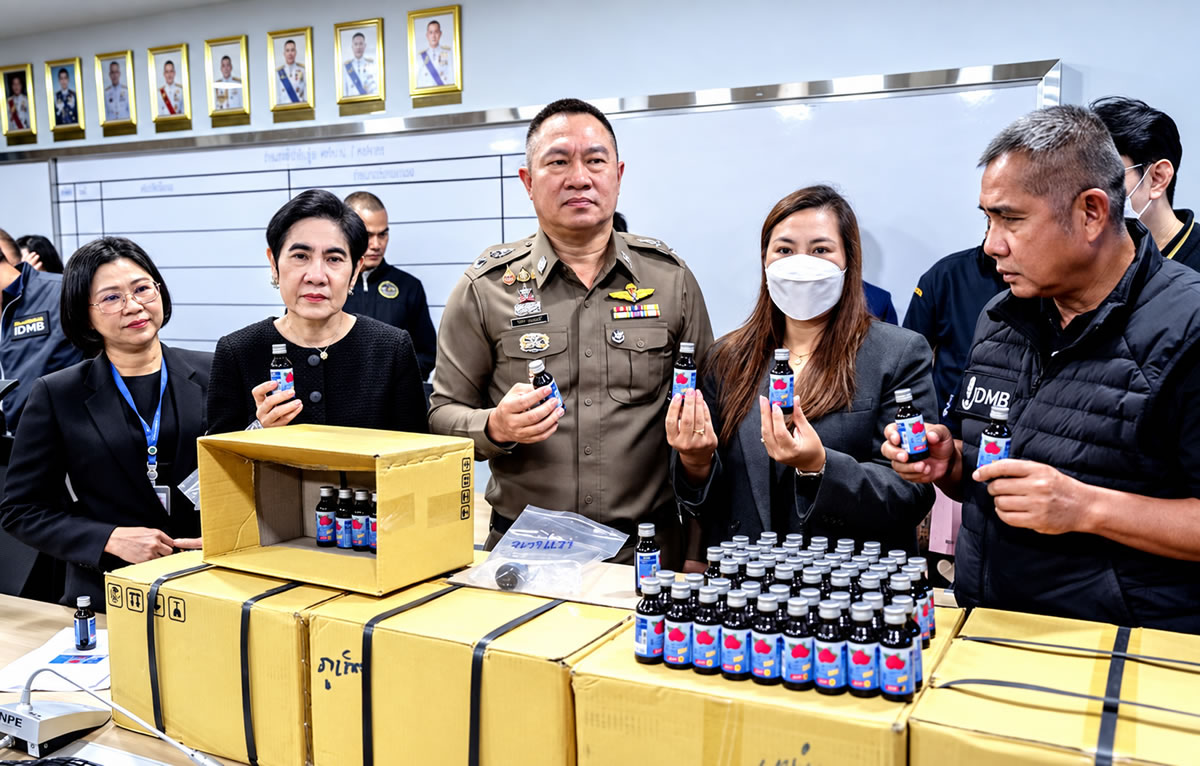
Officers searched four locations in Samut Sakhon and Bangkok. The sites handled separate stages of an industrial manufacturing and distribution system. In total, police and Food and Drug Administration officers seized more than 1.4 million items. The haul included finished products, machinery, ingredients, bottles, labels and caps.
More than 37,000 completed bottles of counterfeit Allergin Syrup were recovered. Officers also found 400,000 empty amber bottles and 850,000 copied silver caps. Alongside these, investigators seized over 150,000 counterfeit labels awaiting use. The packaging stocks revealed capacity for production far beyond the finished bottles found.
Bangkok police lead four-site operation after fake Allergin Syrup is traced from southern pharmacies
Police Maj Gen Pallop Aeromla, deputy Bangkok police commissioner, announced the operation’s results on September 23. Food and Drug Administration Secretary-General Supattra Boonserm joined the briefing. Police Maj Gen Chotiwat Luangwilai supervised the Metropolitan Police Bureau investigation. At operational level, Police Col Atchawasit Sriboonyamanon led the search teams.
Although Bangkok police led the case, both production plants stood outside the capital. They were concealed among rice fields in Na Khok, Mueang Samut Sakhon district. Separately, a Ban Phaeo property stored bottles, caps and labels. The final location served as a distribution point in Bangkok’s Bang Khun Thian district.
The investigation began after pharmacies found suspicious Allergin Syrup products, particularly in southern Thailand. In response, they contacted N&N Pharmaceutical, which produces the genuine registered medicine. Company personnel examined the bottles and traced information through the delivery system. They then passed their findings to metropolitan investigators and the FDA.
Police followed movements connected with the suspected products and their production materials. Subsequently, investigators identified a white enclosed pickup travelling towards a Na Khok warehouse. Officers watched the vehicle enter the property before moving in. Inside were two Myanmar men, aged 32 and 24.
Two drivers led police to isolated factories after accepting ฿500 to transport counterfeit medicine
The driver claimed that a friend had introduced him to the work. He said an unidentified person supplied the vehicle in Bangkok. Afterwards, somebody sent him coordinates for the Samut Sakhon collection point. Another vehicle was expected to receive the consignment following collection.
Each man was reportedly offered ฿500 for the journey. Both claimed they had never previously worked for the network. Yet investigators did not immediately accept their account. Instead, police searched the property and uncovered equipment linked to counterfeit medicine production.
That discovery led officers to another warehouse approximately 16 kilometres away. Police concluded that both Na Khok facilities belonged to the same production system. Notably, each building performed a different function. One prepared the liquid, while the other bottled and packaged it.
The first location was a large factory surrounded by rice fields. Its production area occupied a single-storey building inside the rural property. When police entered, nine workers were filling bottles with prepared liquid. Officers stopped the operation and secured the machinery, materials and finished stock.
Police sources identified eight workers as Myanmar nationals and one as a Lao national. By comparison, another official account described all nine as Myanmar nationals. The FDA’s bulletin did not resolve that difference. Nevertheless, police arrested all nine workers found inside.
Nine workers arrested as police uncover separate plants for bottling and preparing counterfeit syrup
Officers seized filling and packaging machinery from the building. They also recovered more than 100 blue drums containing prepared liquid. Nearby, large stocks of counterfeit caps and product labels were stored for use. Workers could fill, seal and label the bottles without leaving the site.
The second Na Khok site was a black, single-storey warehouse without a street number. Like the first factory, it stood amid rice fields. Inside, investigators found around ten boiling pots and more than 200 material containers. Police said the property served as the network’s preparation and mixing centre.
FDA inspectors found red liquid stored inside blue drums. In addition, officers discovered a clear liquid carrying a raspberry smell. Other materials included syrup, food colouring, motors and mixing paddles. The available ingredients could reportedly fill approximately 100,000 bottles.
Importantly, that estimate covered materials present during the raid. It excluded earlier products that may already have entered the market. The two rural factories therefore revealed the network’s operating sequence. Prepared liquid moved from the mixing site to the separate bottling plant.
Investigators also searched a packaging store in Ban Phaeo district. The property stood at 68/8, Moo 6, Yok Krabat subdistrict. There, officers found large quantities of empty amber bottles, silver caps and counterfeit labels. These materials could then be supplied to the Na Khok production line.
Packaging store and Bangkok distribution point reveal the scale and reach of nationwide operation
The silver screw caps carried the words “BA BESSY ARON”. According to the FDA, they copied marks belonging to N&N Pharmaceutical. Likewise, the seized labels carried the Allergin Syrup name and registered product information. The materials were prepared to give the bottles a commercial pharmaceutical appearance.
In Bangkok, police searched a distribution point inside Sinthawee Village. The property stood on Soi Anamai Ngam Charoen 19 in Tha Kham. Investigators found another pickup holding completed counterfeit Allergin Syrup products. The bottles were reportedly awaiting delivery to customers.
Police sources initially described approximately 40,000 bottles at the Bangkok property. Later, the FDA issued a consolidated total covering all four locations. Its count listed more than 37,000 completed bottles. Consequently, the two figures describe the same recovered stock and should not be combined.
The counterfeit labels displayed registration number 1A 271/62 and lot number L2607061. Meanwhile, the printed manufacturing date was July 31, 2026. The stated expiry date was July 30, 2028. Those copied details made the products resemble medicine from a registered manufacturer.
Counterfeit bottles copy genuine drug details but contain no active antihistamine ingredient at all
Furthermore, the counterfeiters attempted to reproduce the genuine product’s taste and appearance. They copied its name, registration information, caps and printed dates. A company representative identified a difference in the stickers’ colour. That variation helped distinguish suspicious bottles from genuine stock.
Police bulletins described the seized products as counterfeit cough and allergy medicine. More precisely, Allergin Syrup is a registered allergy treatment. The genuine product contains chlorpheniramine, an antihistamine used for allergy symptoms. Its formulation also contains flavoured and coloured syrup.
Crucially, FDA inspectors found no active medicinal ingredient in the material examined at the factory. The liquid did not contain the registered chlorpheniramine. Rather, investigators found sweetened syrup, colouring and flavouring. Workers poured that mixture into bottles carrying copied pharmaceutical labels.
The bottles therefore presented coloured syrup as a registered modern medicine. FDA officers also described the production premises as unhygienic. Moreover, neither factory was authorised to manufacture pharmaceutical products. The case includes both counterfeit production and manufacturing without a licence.
The FDA separately addressed the misuse of cough and allergy medicines in drinks called 4×100. Such mixtures are consumed for their intoxicating effects. Still, the agency did not report finding narcotics inside the counterfeit liquid. Nor did it directly connect the seized batch with 4×100 production.
Police trace nationwide deliveries, vehicles and suppliers as hunt for network organisers widens
Instead, the FDA’s inspection established that the copied medicine lacked its stated active ingredient. Its 4×100 remarks concerned a wider pattern of medicine misuse. The agency said such drinks were popular among some young people. It also linked their use with progression towards more dangerous drugs.
Investigators believe the network distributed counterfeit products throughout Thailand. Police estimate that the operation continued for one to two years. To date, officials have not released a complete list of provinces receiving the bottles. They have also not identified every pharmacy, seller or customer involved.
The southern discoveries provide one confirmed starting point for tracing earlier deliveries. At the same time, the Bangkok property exposes part of the distribution chain. The drivers’ statements have opened another inquiry into the network’s transport arrangements. Police are tracing who supplied their vehicle and issued the coordinates.
Investigators also want the person who arranged the transfer to another vehicle. In parallel, they are examining who recruited and paid the factory workers. The network required repeated supplies of bottles, caps, labels, syrup and colouring. It also needed machinery, vehicles and several separate properties.
Financial trail, warehouse leases and machinery purchases may expose the financier and directors
The warehouses provide further investigative leads. Officers want to identify who owned, leased or supplied the isolated premises. Equally, they are examining who financed rent, machinery and daily production. No suspected warehouse provider or financial backer has yet been publicly named.
Investigators estimated losses and wider impact above ฿100 million, or approximately S$3.8 million. At this stage, that remains an official estimate linked to the operation. It is not a confirmed calculation of sales income or seized stock. Police have disclosed no complete financial trail.
The nine arrested workers face proceedings under Thailand’s medicine and trademark laws. The accusations include counterfeiting another party’s registered trademark. They also cover possessing counterfeit-marked products for sale. Additionally, the case involves unlicensed production and the sale of counterfeit modern medicine.
Police cited Sections 108 and 110(1) of the Trademark Act. They also cited Sections 12, 72(1), 73, 101 and 117 of the Drug Act. Section 83 of the Criminal Code was invoked as well. The FDA said producing and selling counterfeit medicine could bring separate criminal penalties.
Police pursue financiers and organisers as FDA warns pharmacies against handling counterfeit medicine
Under the FDA’s account, unlicensed modern medicine production carries up to five years’ imprisonment. It also carries a maximum fine of ฿10,000. Trademark violations form another part of the proceedings. Further charges could follow as investigators identify those controlling the network.
The case now reaches far beyond workers caught beside the bottling machinery. Above all, police are seeking those who issued orders and financed the operation. They must also establish the scale of earlier production and locate previous recipients. Suppliers of bottles, caps and labels may provide additional evidence.
Chinese counterfeiting racket including engine oils working under the radar in Bangkok raided by police
Consumer products counterfeit racket smashed in Bangkok and Saraburi. Police warn of real health risks
Meanwhile, the FDA warned pharmacies against buying or selling counterfeit or unauthorised medicines. Participating shops could face criminal action and administrative penalties. As a further measure, implicated pharmacies could have their licences suspended immediately. Suspected products can be reported through the FDA’s 1556 hotline.
The raids closed the four known sections of the production and delivery system. Police seized workers, vehicles, machinery, liquids and enormous packaging stocks. However, the people controlling the money and orders remain the investigation’s principal targets. Their identities have not been publicly disclosed.
Join the Thai News forum, follow Thai Examiner on Facebook here
Follow Thai Examiner on Google here
Receive all our stories as they come out on Telegram here
Follow Thai Examiner here
Further reading:
Thailand and Cambodia face danger from ‘Dragon Head’ the Chinese mafia leader behind the scams
Cyber police and Money Laundering agency seek UK and US co-operation targeting Cambodian networks
United States, South Korea and United Kingdom act against Cambodian scam industry with Thai tie-ins
Ben Smith affair & allegations of links to Cambodian scam centres continues to rage in parliament
Defiant Rangsiman Rome warns he’s not just fighting a defamation case but for the future of Thailand
Ben Smith money fixer to the elite in Thailand lines up ฿100M defamation case against Rangsiman Rome