A deadly balcony collapse in Bangkok’s Talat Noi crushed one man and injured another as tonnes of concrete crashed onto Charoen Krung Road. Investigators are probing the disaster amid fresh fears over ageing shophouses across the capital.
A man was crushed to death and another injured when a concrete balcony ripped from an ageing building in Bangkok’s historic Talat Noi district on Saturday, triggering a frantic rescue operation beside Wat Traimit and renewing fears over the safety of the capital’s ageing shophouses. As firefighters battled unstable rubble to recover the victim’s body, investigators began probing what caused the sudden structural failure in an area packed with decades-old buildings vulnerable to corrosion, overloading and deterioration.
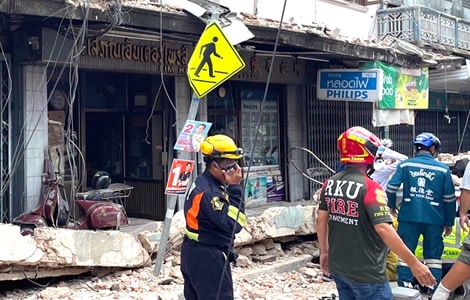
A concrete balcony tore away from an ageing Bangkok building on Saturday afternoon, killing one man and injuring another in a sudden collapse that sent heavy debris crashing onto a busy road.
The disaster struck at 4.52 pm in Talat Noi, Samphanthawong district. The building stood on Charoen Krung Road near Wat Traimit Witthayaram Worawihan. A Starbucks outlet on Rama IV Road was also nearby.
Witnesses suddenly saw a large section of the second-floor concrete break away. Seconds later, the slab slammed onto the street below.
Emergency crews race to collapse scene as rescuers search rubble for victims trapped underneath
As reports flooded in, the Erawan Emergency Medical Centre and Rama 199 Radio Centre coordinated an urgent response. Firefighters from Suan Mali Fire and Rescue Station raced to the scene. Emergency medical personnel from Klang Hospital were also dispatched.
By the time rescuers arrived, concrete rubble covered part of the roadway. Emergency workers quickly began searching for victims trapped beneath the debris.
One casualty was found alive. Rescue workers treated the injured person at the scene. Afterwards, paramedics transferred the victim to hospital.
Meanwhile, a second victim remained trapped under a huge concrete slab. In response, firefighters and volunteers launched a desperate recovery operation. Crews deployed cutting tools and rescue equipment while carefully removing debris piece by piece.
Despite those efforts, the trapped victim was found dead beneath the wreckage.
Man crushed beneath huge concrete slab as rescue operation unfolds in dangerous conditions
Officials later confirmed the deceased was a man crushed by the falling concrete. However, authorities did not immediately release his identity.
According to emergency records, the first alert reached the 199 emergency hotline at 4.52 pm. Minutes later, additional details emerged. As a result, more rescue resources were directed to the scene.
At 4.57pm, emergency crews reached the damaged building. By then, rescuers were already battling unstable concrete and dangerous conditions.
Photographs showed a massive section of reinforced concrete lying across the road. Nearby, firefighters and volunteers worked around the shattered debris field.
Notably, the fallen structure appeared to have detached from a second-floor balcony or awning. Consequently, rescue workers approached the site cautiously amid fears of further collapse.
Massive concrete section blocks roadway as officials assess risk of further structural failure
As operations intensified, crews focused on reaching the trapped victim. Heavy concrete sections had to be moved carefully to avoid triggering additional structural failures.
At approximately 5.20 pm, volunteers finally removed the dead man’s body from beneath the slab. Afterwards, the remains were transported to Central Hospital.
Separately, the Samphanthawong District Office issued an update through Facebook. Officials confirmed rescue workers had completed the recovery operation and transferred the victim to hospital.
Even then, emergency personnel remained at the location. Engineers and district officials began assessing damage to the structure. At the same time, investigators started gathering evidence.
Authorities have yet to determine exactly why the balcony collapsed.
Collapse revives concerns over ageing shophouses and decades-old buildings across Bangkok
The incident occurred in one of Bangkok’s oldest commercial districts. Talat Noi, Yaowarat and sections of Charoen Krung Road contain rows of ageing shophouses and mixed-use buildings dating back decades.
For many residents, the collapse revived concerns about the condition of older structures across the capital.
Historical records show that many reinforced concrete commercial buildings in Bangkok were constructed between 1957 and 1977. Consequently, large numbers are now between 40 and 60 years old.
Many of those buildings remain occupied. In addition, countless properties have been modified repeatedly over the years.
Engineers frequently identify structural fatigue as a major threat facing ageing buildings. Over time, moisture can seep into concrete. Eventually, the reinforcing steel inside begins to corrode.
As corrosion spreads, the steel expands. That process creates pressure within the concrete itself. Cracks then form and structural strength gradually declines.
Engineers warn that corrosion and structural fatigue can weaken ageing concrete over decades
Not surprisingly, balconies and awnings are often considered vulnerable.
Many older shophouses rely on cantilevered designs. These structures project outward without supporting columns. Therefore, their strength depends heavily on the condition of internal reinforcement.
If deterioration continues unchecked, failure can occur suddenly.
On another front, engineers often point to excessive loading. Some owners install water tanks, air-conditioning compressors or storage areas on ageing balconies. Others add walls or extensions years after construction.
As a consequence, structures designed decades ago may carry loads never anticipated by their original builders.
Maintenance also remains a critical issue. Many older buildings receive limited engineering inspections. In some cases, cracks and corrosion remain hidden for years.
Poor maintenance and excessive loading can increase pressure on ageing building structures
Furthermore, Bangkok’s tropical climate exposes buildings to constant heat, rain and humidity. Those conditions can accelerate deterioration.
As part of this broader picture, Samphanthawong district contains one of the city’s largest concentrations of historic commercial properties. Many stand shoulder to shoulder along narrow roads. Numerous buildings have accumulated additions and alterations over generations.
Elsewhere, similar building stock exists across several districts. Phra Nakhon contains many older commercial properties near Khao San Road and Sao Chingcha. Likewise, Pom Prap Sattru Phai features ageing structures in busy trading areas.
In parallel, Bang Rak, Yannawa and Pratunam also contain rows of older shophouses built during Bangkok’s rapid urban growth.
Investigators focus on the cause of the collapse as wider concerns grow over Bangkok’s infrastructure
Building regulations were different when many of these properties were constructed. Similarly, engineering calculations and construction techniques often differed from modern standards.
Even so, officials have not linked Saturday’s collapse to wider structural problems elsewhere in Bangkok.
Instead, investigators remain focused on the Charoen Krung building.
Bangkok engineers scrambled to repair another large sinkhole in the busy Bang Kapi area of the capital
Elusive China Railway Company Kingpin arrested in Bangkok over March 28 Chatuchak building collapse
Authorities have not disclosed the age of the structure involved. Nor have they revealed whether previous inspections identified concerns. Likewise, details about repairs or maintenance remain unknown.
For now, one man is dead and another injured after seconds of catastrophic failure in the heart of old Bangkok.
The collapse unfolded without warning. Now investigators face the task of establishing what caused the concrete structure to suddenly give way above one of the capital’s busiest historic districts.
Join the Thai News forum, follow Thai Examiner on Facebook here
Receive all our stories as they come out on Telegram here
Follow Thai Examiner here
Further reading:
Just another accident or disaster on Saturday as Thailand’s image abroad takes a battering this week
Italian Thai boss and 16 others arrested on Thursday charged with Auditor General building deaths
Arrested man linked with Chatuchak building collapse now tells police he is a Chinese state employee
Prime Minister orders arrests over the Chatuchak Auditor General building disaster within seven days
Chinese steel firm linked to Chatuchak disaster faces DSI probes. Minister cancels investment status
Storm clouds gathering over Chinese firm at the centre of the collapsed Chatuchak building disaster
US scan shows 50-60 human beings said to be in a hallway within the collapsed Chatuchak building