
Thai business leaders warn election populism risks a credit downgrade as growth in 2026 is set to slip below 2%. Public debt now nears its legal limit, budgets for 2027 may be stalled, and exports face US tariffs. Meanwhile, there are fears of political instability amid the worst economic outlook in decades.
Top Thai business leaders on Wednesday warned against populist policies being pushed in the 2026 General Election. Thailand goes to the polls on Sunday, February 8, with parties pitching stimulus measures and expanded welfare to win votes. However, the economy is weak and increasingly uncompetitive, and now sits on the edge of a potential credit rating downgrade. At the same time, high public debt is eroding the government’s ability to support growth. There is also widespread concern that the election could trigger renewed instability and delay budget disbursement, particularly in 2027.
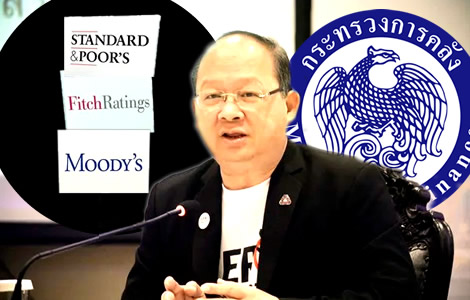
On Wednesday, Thai business leaders issued coordinated warnings as the 2026 General Election approaches. Their focus was on the economic impact of populist campaign policies. In particular, they highlighted risks to fiscal discipline.
At the same time, they warned of pressure on Thailand’s credit standing. These concerns were raised publicly and repeatedly.
Payong Srivanich, President of the Thai Bankers Association, spoke directly on the issue. On Wednesday, he said Thailand faces a credible risk of a sovereign credit rating downgrade. Specifically, he said the country is approaching a critical review point.
Warning that Thailand is nearing a sovereign credit rating review with downgrade risks no longer theoretical
Moreover, he said the current path leaves little margin for error. According to him, the risk is no longer theoretical.
Mr Payong explained that a downgrade would immediately raise borrowing costs. As a result, annual debt servicing expenses would increase. Consequently, fiscal space would tighten further. At the same time, future policy flexibility would decline. These effects would compound existing economic pressures.
He stressed that prevention is far easier than recovery. By contrast, he said managing the aftermath of a downgrade would be far more difficult. Therefore, he urged early and decisive action. In addition, he said, election-period policies must reflect fiscal constraints. According to him, credibility must be protected before it is lost.
Mr Payong acknowledged that stimulus measures remain necessary. However, he warned against isolated or short-term spending. Instead, he said stimulus must link to medium and long-term strategies. Otherwise, he said the impact would quickly dissipate. He compared such spending to resources absorbed without lasting effect.
He added that public resources are already limited. Therefore, spending decisions must be precise and targeted. Moreover, funds must support competitiveness and income generation. Without these links, he said, stimulus fails to deliver value. Consequently, fiscal risks increase rather than decline.
Limits of stimulus and shrinking fiscal space raise risks as public resources and competitiveness pressures
Mr Payong also addressed structural inefficiencies. According to him, producing goods without demand wastes capital. Similarly, services without users generate no returns. As a result, failure cycles repeat. Therefore, he emphasised regulatory reform and productivity improvement.
At the same time, he said competitiveness must be strengthened. In addition, unnecessary restrictions must be reduced. According to him, these issues remain unresolved. Consequently, long-term growth remains subdued. He described these problems as structural and persistent.
Parallel warnings came from the Joint Standing Committee on Commerce, Industry and Banking. The committee met on Wednesday to assess economic conditions. Following the meeting, it released its 2026 outlook. The assessment was cautious and detailed.
The committee said economic growth is expected to remain below 2% in 2026. Specifically, it projected growth between 1.6% and 2.0%. As a result, output would remain below potential. Moreover, recovery momentum would remain weak. The committee described the economy as constrained.
Business groups project Thai economic growth below two per cent in 2026 with a troubled outlook
Mr Kriengkrai Thianukul spoke after the meeting. He is the President of the Federation of Thai Industries. He also chairs the Joint Committee of the Three Private Sector Institutions. According to him, multiple risks are converging.
First, he cited domestic fiscal limitations. Then, he highlighted budget implementation delays. In particular, he warned of possible delays to the 2027 budget. As a result, investment momentum could weaken further. Meanwhile, public spending growth is slowing.
He referred to recent projections from the Fiscal Policy Office. These show a decline in government spending year on year. In particular, investment spending is falling. Consequently, the stimulus effect from public investment is diminishing. This trend was described as significant.
Moreover, he cited data from the Comptroller General’s Department. As of January 31, 2026, investment disbursement stood at 176 billion baht. That figure represents 21.57% of the annual investment budget. By comparison, the January target was 26%.
Budget delays and weak investment disbursement slow projects and undermine growth
Therefore, implementation delays are widening. As a result, government projects are progressing slowly. This directly affects growth outcomes. The committee said delayed investment undermines recovery. The issue remains unresolved.
External risks were also highlighted. In particular, geopolitical tensions remain elevated. Meanwhile, uncertainty over the United States trade policy persists. Since early 2026, global markets have shown volatility. Currency and gold markets have been especially affected.
The committee pointed to new US tariff measures. In 2026, at least nine tariff items face additional duties. Consequently, Thai exports worth $45 billion are affected. That figure represents 63% of Thailand’s exports to the US in 2025.
Despite these pressures, some sectors show resilience. In contrast, semiconductor exports are expected to grow strongly. The committee projected growth of 53% in that segment. However, this strength does not offset overall export weakness. Broad export contraction remains forecast.
US tariffs and geopolitical risks hit Thai exports despite strong semiconductor growth prospects
The committee reaffirmed its economic projections. GDP growth is forecast at 1.6% to 2.0% in 2026. Meanwhile, exports are expected to contract by 0.5% to 1.5%. At the same time, inflation is projected at 0.2% to 0.7%.
Political stability was repeatedly emphasised. Therefore, the committee called for a smooth post-election transition. In addition, it stressed continuity in economic policy. According to the committee, abrupt policy shifts damage confidence. Stability was described as essential for recovery.
Deregulation was also highlighted as a priority. In particular, the committee cited competitiveness challenges. Moreover, it stressed the need to integrate SMEs into the formal system. This would improve productivity and compliance. It would also strengthen domestic value chains.
Mr Kriengkrai referred to business upgrading. According to him, investment in capability supports resilience. In addition, he cited the “Reinvent Thailand” framework. This approach focuses on long-term competitiveness. The committee endorsed this direction.
Election populism and rising debt tighten fiscal space as long-term reform spending is sidelined now
However, concern over election policies dominated the discussion. The committee said most parties emphasise short-term stimulus measures. These policies require very large budgets. Moreover, they exceed spending on structural reform. Long-term income creation is often absent.
Mr Kriengkrai addressed fiscal limits directly. As of December 2025, public debt stood at 66.09% of GDP. This level is close to the legal ceiling. The ceiling is set at 70% under the State Fiscal and Financial Disciplines Act 2018.
Therefore, fiscal space is narrowing rapidly. As a result, policy choices are increasingly constrained. Mr Kriengkrai said these limits must be recognised. He warned against unrealistic spending commitments. Legal thresholds restrict flexibility.
The committee outlined future policy priorities. First, it cited long-term growth strategies. Second, it emphasised efficient use of fiscal resources. Third, it highlighted productivity improvement. These elements were described as interdependent.
Productivity technology and innovation flagged as core drivers for revenue resilience and future growth
Technology and innovation were also stressed. In addition, entrepreneurial capability was highlighted. According to the committee, these factors create new revenue streams. Without them, growth remains fragile. Structural resilience depends on these investments.
Financial stability concerns were also raised. Mr Kriengkrai thanked the Ministry of Finance and the Bank of Thailand. He cited measures regulating online gold trading. These measures reduced volatility in the baht. The committee welcomed the intervention.
However, he said further coordination is required. In particular, agencies must strengthen monitoring systems. Data integration must improve. Regulatory loopholes must be closed. Digital asset trading was cited as a remaining risk.
Later that day, Mr Payong reiterated his warning. Again, he stressed the importance of maintaining the credit rating. He said a downgrade would deepen economic strain. Therefore, prevention remains critical. He urged full government attention.
Final warning urges full government focus on protecting credit rating as election uncertainty deepens
He repeated that stimulus should continue cautiously. However, he stressed linkage to competitiveness and income creation. Without that, he said benefits disappear quickly. Fiscal discipline remains under scrutiny.
Both leaders pointed to unresolved structural problems. These issues require medium and long-term solutions. They cannot be resolved quickly. As the election nears, scrutiny is intensifying. The warnings were clear and consistent.
Business chiefs warn of worst year for the economy in 30 years. Vietnam on track to overtake Thailand
One of Thailand’s top business entrepreneurs calls for a halt to the economic rot and a new digital age
At the same time, there is additional anxiety that the election result may, in turn, spark further political instability. The kingdom’s chronic lack of capacity to modernise and deal with the challenges before the economy has been blamed by many analysts squarely on public upheavals, particularly since the 2006 coup d’état that ousted Prime Minister Thaksin Shinawatra and, afterwards in 2014, a government formed in 2011 by his sister Yingluck Shinawatra.
Join the Thai News forum, follow Thai Examiner on Facebook here
Receive all our stories as they come out on Telegram here
Follow Thai Examiner here
Further reading:
Thailand’s days of GDP growth in excess of 5% may be a thing of the past as it has grown too old
Cabinet in pension move as the number of working Thais to over 60s is set to half in 20 years
Thailand’s new move to boost the birth rate and fight the negative impact of an ageing population
Denmark and Thailand seek economic partnership and face the same challenge – demographics
Thailand’s new move to boost the birth rate and fight the negative impact of an ageing population