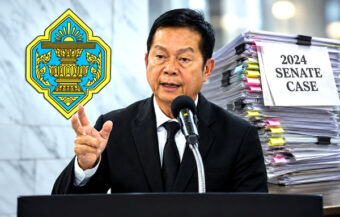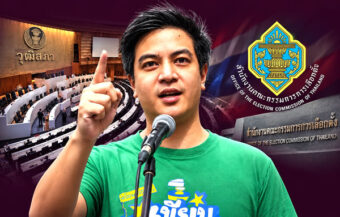
Senate election chaos deepens as a leaked video, alleged vote-fixing and Surat Thani money trails pile pressure on Senate President Mongkol Surasajja. With 229 people under scrutiny, the Election Commission faces growing demands to send Thailand’s biggest election rigging case to court.
A leaked Senate election video, allegations of organised voting and money trails linked to a Surat Thani business group have transformed a growing political controversy into one of Thailand’s most closely watched investigations. People’s Party deputy leader Parit Wacharasindhu is demanding answers from Senate President Mongkol Surasajja while questioning how key evidence was handled by the Election Commission and the Department of Special Investigation. With 229 individuals under scrutiny, banking records under examination and claims of coordinated candidate activity, the case now poses a critical test for authorities as they decide whether allegations of Senate collusion, or in effect a rigged 2024 election, will ultimately be put before the courts.
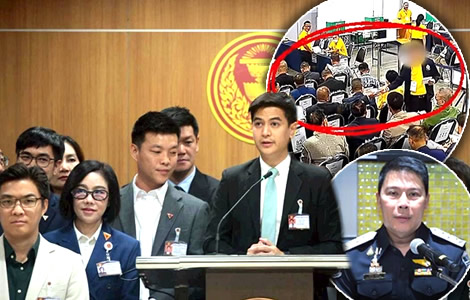
People’s Party deputy leader Parit Wacharasindhu has intensified pressure on Senate President Mongkol Surasajja as scrutiny of the Senate election investigation gathers momentum.
What began as questions over a leaked video clip has expanded into allegations of organised voting, coordinated candidate movements and financial links stretching into Surat Thani province. At the same time, fresh questions have emerged over how evidence was handled by both the Election Commission (EC) and the Department of Special Investigation (DSI).
Speaking at Parliament on June 17, Parit said he remained perplexed by Mongkol’s refusal to answer questions about the footage. The issue, he argued, was straightforward. He said the Senate President simply needed to confirm whether he was the individual shown in the clip.
Mongkol faces mounting pressure as Parit demands an answer over identity in leaked Senate election clip
“Mr. Mongkol should know best; he only needed to answer yes or no,” Parit said. Yet no direct response has been forthcoming. As a result, Parit suggested the silence itself had become significant. “Sometimes, not answering is a form of answer in itself,” he said.
The dispute centres on footage first released last weekend. The video allegedly shows an EC commissioner collecting documents from Senate candidates during the national selection process. It also appears to show candidates being warned about voting conduct.
However, Parit insists the clip represents only a small part of the available evidence. According to him, investigators possess additional documents, voting records and financial information that paint a much broader picture of events surrounding the Senate election.
Notably, Parit said several key questions remain unresolved. He wants confirmation of the identity of the candidate shown in the footage. He also wants clarification regarding the documents collected that day.
In addition, he wants to know who prepared those documents and what information they contained. Despite repeated requests, he said neither the EC nor Mongkol has provided satisfactory explanations. Consequently, scrutiny of both institutions continues to intensify.
Leaked footage and seized documents raise fresh questions over conduct during Senate selection
A central point of contention involves the voting slips seen in the video. The EC has maintained that candidates recording numbers to avoid forgetting them is not unlawful. Parit does not dispute that explanation.
Instead, he questions the conduct of officials visible in the footage. If the documents were insignificant, he asks why they were collected. Equally, why were candidates warned? More importantly, what happened to those documents afterwards? According to Parit, those questions remain unanswered. He argues that the actions of EC officials suggest they identified something requiring closer examination.
As part of this, Parit has repeatedly referred to evidence gathered by Investigation Committee 26. The committee is conducting a joint inquiry involving the EC and the DSI. According to him, investigators have obtained voting papers displaying repeated numerical patterns. The same candidate numbers allegedly appeared across multiple ballots.
Furthermore, he claims mathematical analysis suggests such outcomes could not have occurred naturally. Instead, he argues the patterns point towards organised coordination among participants. If supported by investigators, such findings would strengthen allegations that voting was managed through a structured process.
Voting slips and repeated number patterns emerge as key evidence in the Senate collusion inquiry
On another front, Parit claims the evidence extends beyond voting records. He says investigators have gathered information concerning pre-election meetings and organised candidate movements.
According to him, the case file contains material relating to travel arrangements and payments. He also alleges investigators are examining financial links between individuals accused in the case. Therefore, the controversy has moved far beyond questions about ballot papers. Increasingly, attention is focused on whether a wider network operated behind the scenes during the Senate selection process.
Particular attention is now being directed towards Surat Thani province. According to Parit, information recently submitted to the opposition whip contains evidence of financial trails originating there. He said investigators are expected to examine that material first.
The evidence allegedly points to a group of investors who provided support to various individuals. Those individuals, he claims, include serving senators, political team members and MPs in the province. Although he did not identify the investors publicly, Parit described the financial information as significant. He urged investigators to examine every transaction carefully and establish whether irregularities occurred.
Financial trails from Surat Thani investors draw scrutiny as the Senate probe widens further
Separately, Parit called for close scrutiny of the EC’s handling of the investigation. He said confidence in the process depends on transparency and consistency. He also warned against any action that could obstruct the judicial process.
The comments reflected growing concern among opposition figures about how the investigation will proceed as decision deadlines approach.
The issue gained fresh momentum this week following comments from DSI Director-General Yutthana Praedam. The DSI chief confirmed investigators never questioned EC officials regarding the events shown in the video.
According to Yutthana, reserve senators who submitted evidence to investigators did not identify the officials appearing in the footage. Consequently, no EC officials were called as witnesses in the criminal conspiracy and money laundering investigation. That disclosure immediately generated further questions regarding the scope of earlier inquiries.
DSI confirms Election Commission officials were never questioned over leaked video events
In response, Parit questioned whether the events shown in the video were included in any official investigation file. He also asked whether the documents collected on the day were ever examined. Furthermore, he wants to know whether questions arising from the footage were formally incorporated into the investigation.
So far, he said, there has been little clarity. He specifically questioned whether Committee 26 had included those events in its records and whether investigators pursued the matter fully.
Meanwhile, the wider Senate collusion investigation continues to advance. The case involves 229 individuals identified through the work of Investigation Committee 26. According to Parit, the committee previously concluded there was sufficient evidence to support court proceedings involving at least that number.
Therefore, he argues any decision not to proceed would require a detailed explanation. The scale of the investigation has made it one of the most closely watched political cases currently facing the EC.
Election Commission faces pressure as Senate probe involving 229 people moves closer to a decision
Under the law, the Commission must reach a decision within 90 days of formal deliberations. Accordingly, attention is increasingly focused on its next steps. Parit warned against any attempt to delay proceedings or prevent cases from reaching the courts.
He said the public would closely monitor how the EC handles the evidence already collected and whether all individuals identified by investigators receive equal treatment.
Parit also raised concerns about what happens if some cases proceed while others do not. In that scenario, he said questions would inevitably arise regarding the basis for differing decisions. Specifically, observers would want to know whether distinctions reflected the strength of the evidence or the status of the individuals involved. That concern formed the basis of one of his sharpest criticisms.
To describe the situation, Parit used the phrase “50 Shades of Blue.” He said there was concern that some figures associated with the broader blue political network could face different treatment. According to his argument, individuals viewed as representing a lighter shade of blue might find themselves before the courts.
Others perceived as closer to centres of influence might avoid similar outcomes. He stressed that any such distinction would require a convincing explanation from investigators and regulators.
Parit warns against selective action and questions the differing treatment within the broader blue network
The controversy has also become entangled with wider political disputes. Earlier, critics accused Parit of attempting to create what they called an “orange regime.” He rejected those allegations. Instead, he said he was carrying out his responsibilities as a Member of Parliament.
His role, he argued, was to scrutinise the source and exercise of state power. If evidence suggested power had been obtained improperly, he said Parliament had a duty to examine the matter.
During a briefing on June 16, Parit outlined several major issues he believes are attracting public attention. The Senate collusion case featured prominently among them. He also referenced petitions concerning the National Anti-Corruption Commission’s handling of the stock concealment case involving former Transport Minister Saksayam Chidchob.
In parallel, he pointed to controversy surrounding leaked Line messages discussing assistance for the “blue line.” He additionally cited concerns regarding the TH-AI Passport project and its transparency. Nevertheless, he made clear that the Senate investigation remains his immediate focus.
Senate collusion case dominates agenda as Parit rejects claims of creating an orange regime
Parit has repeatedly sought answers from EC commissioner Thitichat Nuchanat, who appears in the leaked footage. According to him, the commissioner can be seen collecting documents and warning candidates.
Therefore, he wants to know exactly what was written on those papers. He also wants clarification regarding any subsequent investigation. Likewise, he wants to know whether the matter was discussed by all seven EC commissioners and whether further action was considered.
The location of the documents remains another unresolved issue. Parit has repeatedly asked where the papers are now and whether they were linked to other evidence. He argues that if the material was important enough to be collected, it should also have been important enough to be investigated thoroughly. To date, he says no comprehensive explanation has been provided.
At the same time, he continues to press Mongkol directly. Parit said the candidate numbers visible in the footage point towards the Senate President. He also cited similarities in physical appearance.
As a result, he believes Mongkol is uniquely placed to settle the matter. “Mr. Mongkol simply needed to answer yes or no,” he said. He has also sought clarification regarding what document was submitted that day and whether it was prepared independently or as part of a wider process.
Questions over seized documents and candidate lists keep pressure on the EC and Mongkol growing
“If it’s a prepared vote sheet, is it one that Mr. Mongkol wrote down himself to avoid forgetting which candidate to choose, or is it a sheet jointly prepared with others to influence the selection of various individuals?” Parit asked.
He added: “Therefore, can the Senate President confidently confirm that he was not part of a process involving the exchange of votes, money, or shared benefits?” According to Parit, those questions remain unanswered.
For its part, the DSI says its criminal investigation remains active. Yutthana confirmed that prosecutors ordered additional investigative work before any final decision. Much of that work concerns banking information.
Investigators are continuing to gather financial evidence and examine transactions linked to the case. Notably, no additional summonses have been issued to the eight suspects already identified by investigators.
Banking evidence remains central as DSI continues expanding the Senate collusion investigation
Yutthana also confirmed a critical procedural point. The DSI cannot finalise its criminal case until the EC reaches its own decision. The Special Prosecutor’s Office has instructed investigators to incorporate the EC’s findings into the final case file.
Therefore, regardless of whether the Commission clears all 229 individuals or pursues only some, those conclusions must become part of the DSI record before prosecutors can move forward.
Finally, an internal DSI report revealed another complication. Because witnesses shown in the video were not originally identified as EC officials, the footage was never included in the DSI’s criminal file.
Powerful video evidence raises the stakes for under fire Election Commission in Senate collusion call
Election Commission to decide finally on 2024 Senate allegations after panel moved to clear all involved
However, officials acknowledged the clip may already form part of the separate Senate collusion inquiry conducted by Committee 26. That distinction has become another focal point for Parit, who argues investigators must explain how evidence was handled and why material appears in one investigation but not another.
For now, the pressure continues to build. The EC faces a statutory deadline. The DSI continues collecting banking evidence. Meanwhile, Mongkol remains at the centre of questions surrounding the leaked footage. As events unfold, decisions expected in the coming weeks may determine whether allegations involving organised voting, financial support networks and money trails from Surat Thani ultimately receive judicial examination.
Join the Thai News forum, follow Thai Examiner on Facebook here
Receive all our stories as they come out on Telegram here
Follow Thai Examiner here
Further reading:
Opposition and People’s Party leader attacks ‘blue regime’ on the 12th anniversary of the 2014 coup
Thammasat University legal scholar and 1992 protest leader warns another coup cannot be ruled out
Senate allegations growing in strength as powerful investigation gets underway. 7,000 people tracked