Thailand’s auto industry suffers two harsh years of falling output and factory exits, but Ford’s takeover of Suzuki’s Rayong plant marks a turning point, injecting fresh investment, restoring capacity and reshaping the sector amid EV disruption and policy battles.
Ford’s announcement this week that it will take over the former Suzuki production facilities adjacent to its Rayong plant is a significant boost for Thailand’s traditional ICE (internal combustion engine) manufacturing sector. The move marks the culmination of a major expansion of Ford’s Thai operations, backed by a ฿133 billion, or $3.9 billion, investment. It comes after two difficult years for the industry in 2024 and 2025, including a sharp 20% collapse in automobile production in 2024. The downturn has been driven by tighter regulations in foreign export markets and disruption linked to the shift toward electric vehicles.
Thailand’s automotive sector has faced sustained pressure over the past two years, with manufacturing and sales declining in both 2024 and 2025. Overall, the downturn reflected structural strain across domestic and export markets.
In particular, tighter regulations in key export destinations reduced output. At the same time, parts of the industry struggled to adjust to the transition toward electric vehicles. As a result, supply chains and production planning were disrupted.
In 2024, vehicle manufacturing fell by 20%, marking one of the sharpest annual contractions in recent years. Meanwhile, confidence across the sector weakened as orders slowed. The decline continued into 2025. For the first eight months of that year, output dropped by a further 5%. Consequently, Thailand’s automotive industry entered a second consecutive year of contraction.
Stabilisation emerges late in 2025 as sales recover, EV output rises and policymakers confront industry
However, conditions began to stabilise toward the end of 2025. In the final months, vehicle sales rebounded across several segments. As a result, overall production for the full year finished just 1.5% lower than the previous year. This improvement followed prolonged weakness earlier in the period and signalled a partial recovery in demand.
At the same time, the market structure started to shift. During the second half of 2025, electric vehicle manufacturing increased noticeably. Likewise, EV sales rose as the segment gained wider acceptance. Consequently, electric models secured a clearer place within Thailand’s automotive market after years of uneven adoption.
Meanwhile, policy awareness evolved during the downturn. In late 2024 and early 2025, the former Pheu Thai government acknowledged the growing difficulties facing the industry. In particular, traditional automotive manufacturers faced pressure from falling output and rising compliance costs. As export conditions tightened, several firms reassessed their long-term presence in Thailand.
As a result, industry restructuring accelerated. In mid-2024, Subaru and Suzuki announced major operational changes. Both companies halted vehicle manufacturing in Thailand. Instead, they shifted to distribution and service-based models. Consequently, domestic production capacity contracted further at the height of the industry’s crisis.
Ford moves to acquire former Suzuki Rayong plant, expanding its footprint beside existing plant
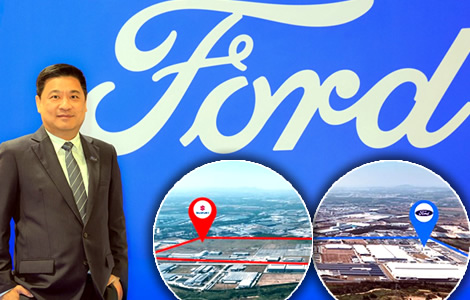
Against this backdrop, Ford’s latest investment has drawn attention. Just days ago, Ford Thailand confirmed the acquisition of the former Suzuki assembly plant in Rayong province. The facility is located directly adjacent to Ford’s existing operations. Suzuki had previously ceased manufacturing at the site, which was originally constructed in 2012.
Now, Ford’s acquisition significantly expands its industrial footprint in Rayong. Moreover, the plant sits next to Ford’s FTM facility and within a designated free trade zone. As a result, the location offers logistical and operational advantages. These include improved efficiency and greater production flexibility.
The newly acquired site covers more than 412.5 rai, or approximately 165.4 hectares. In addition, the total building area measures about 65,000 square meters. Consequently, the scale allows for potential integration into Ford’s broader manufacturing system in Thailand.
Ford confirmed the transaction on January 22, 2026. At the time, Managing Director Mr. Rattakarn Jutasan described the acquisition as significant. According to him, Ford is entering its 30th year of operations in Thailand. Therefore, the purchase carries both operational and strategic importance.
Ford marks 30 years in Thailand as management frames acquisition as long term commitment
Furthermore, Mr. Rattakarn stated that the former Suzuki plant is a high-potential, technologically advanced facility. He said the acquisition demonstrates Ford’s long-term commitment to Thailand. In addition, it supports the company’s sustainable growth strategy and regional manufacturing plans.
Currently, Ford’s FTM and Auto Alliance Thailand plants form the core of its regional production network. Together, they manufacture the Ford Ranger pickup and Ford Everest SUV. These vehicles supply both domestic and export markets. Over time, Ford has invested more than 133 billion baht, or about US$3.9 billion, in Thailand.
Following the acquisition, Ford plans to evaluate how the new site can be integrated. Initially, the company will assess operational alignment with existing facilities. At the same time, it will analyze the plant’s potential role in future production plans. As a result, decisions will be implemented in stages.
Moreover, the site’s proximity to existing plants offers clear efficiency gains. For example, shared infrastructure becomes possible. Likewise, the free trade zone location enhances export-oriented manufacturing flexibility.
Ford stresses ecosystem role as Thailand debates EV policy, excise duties and future of cars
Ford also referenced its broader role within Thailand’s automotive ecosystem. Over the years, the company has supported industry development both inside and outside the Eastern Economic Corridor. This has included building a comprehensive industrial network spanning suppliers, logistics, and workforce development.
Thaksin wants higher excise duties on EV cars that are simply assembled in Thailand by Chinese firms
Minister suggests Thailand must be cautious about penalising traditional combustion engine cars
Thailand’s EV car vision buckles as World markets and canny drivers at home take stock of what is on offer
In addition, Ford stated it is ready to support government policies that encourage long-term investment. These policies focus on advanced manufacturing and higher-value technologies. At the same time, Ford emphasised upgrading workforce skills through modern technology. Consequently, the company linked workforce development to national production and export goals.
The Rayong acquisition stands out amid recent industry contraction. Unlike earlier exits, it adds capacity rather than removing it. As Thailand’s automotive sector continues to adjust, Ford’s expansion represents one of the most significant recent developments in the industry.
Join the Thai News forum, follow Thai Examiner on Facebook here
Receive all our stories as they come out on Telegram here
Follow Thai Examiner here
Further reading:
Thaksin wants higher excise duties on EV cars that are simply assembled in Thailand by Chinese firms
EV sector crisis as Chinese firms are trapped between lack of demand and government tax penalties
Thailand changes tack as EV revolution turns into a damp squib with warehouses full of unsold cars
Top Thai insurer says no more new policies for EV cars. Later, it emphasised renewals case by case
Lack of coherence in government policy is the root cause of Thailand’s massive economic problems
Disturbing questions that must be confronted over Thailand’s reeling economy are China and EV cars
First-quarter GDP growth surprises analysts based on higher tourism and consumer spending growth