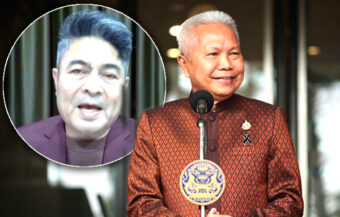
Bhumjaithai’s landslide win shifts focus to Thailand’s weak economy, as economists warn PM Anutin faces slow growth, rising debt, ageing demographics and fading ASEAN rank despite steady investor interest.
As Prime Minister Anutin Charnvirakul prepares for his second cabinet and first full term, a leading Thai economist warns that arresting the economy’s decline must begin immediately. Thanawat Pholvichai of the University of the Thai Chamber of Commerce said interest from technology firms and Thailand’s ASEAN position are critical levers the government must grasp to drive redevelopment. Meanwhile, a senior banker sharply criticised political parties pushing debt write-offs. Piti Tantakasem, chief executive of TMBThanachart Bank, said Thailand’s household debt crisis requires proper diagnosis and action on root causes, not quick fixes.

Sunday’s decisive election victory for the Bhumjaithai Party has intensified scrutiny of Thailand’s economic condition. As a result, economists and analysts have shifted focus from coalition arithmetic to structural weaknesses.
At the centre of this scrutiny stands incoming Prime Minister Anutin Charnvirakul. His party’s win has created expectations of stability, yet it has also raised questions about economic direction.
Unlike most rivals, the Bhumjaithai Party ran a tightly defined campaign. In particular, it emphasised security and stable governance. Moreover, it submitted only eight policy proposals to the Election Commission. By contrast, other parties advanced expansive platforms centred on stimulus, welfare, and debt relief. Consequently, the narrow policy scope has heightened uncertainty about how the new government will address economic constraints.
Economist warns of delayed government and global news exposing decades of economic stasis
Before the election, concerns were already being articulated. Thanawat Pholvichai anticipated a new government by May or June 2026. He serves as Rector and Chairman of the Advisory Board at the Centre for Economic and Business Forecasting. The centre operates under the University of the Thai Chamber of Commerce. At that time, he warned of risks linked to delayed government formation.
Specifically, Mr Thanawat highlighted potential delays in budget disbursement. Additionally, he warned about damage to international confidence. Those concerns were reinforced shortly before the election. In particular, a Financial Times article described Thailand as the “sick man of Asia.” The article appeared only days before voters went to the polls.
Importantly, the Financial Times report drew on interviews with economic experts in Bangkok. According to those sources, Thailand has endured decades of economic stasis. Moreover, they cited repeated resistance by conservative power structures. As a result, reformist governments failed to sustain policy momentum. Structural problems were left unresolved.
Mr Thanawat said the article amplified existing negative perceptions. Furthermore, he warned that Thailand’s regional position continues to weaken. Meanwhile, neighbouring economies have posted stronger and more consistent growth. Consequently, Thailand’s relative standing within Southeast Asia has eroded.
Thailand slips in ASEAN rankings as rivals grow faster and business warns stimulus failed to lift growth
Historically, Thailand ranked among ASEAN’s leading economies. However, that position has steadily declined. According to Mr Thanawat, Thailand lost its place as ASEAN’s second-largest economy to Singapore two years ago. It now ranks third. At the same time, competitors continue to close the gap.
Business leaders have reinforced these warnings. In their assessment, repeated stimulus measures have not addressed underlying weaknesses. Likewise, they argue that cash handouts have failed to lift productivity. Instead, growth momentum has softened further over time. As a result, confidence has remained fragile.
Against this backdrop, voter expectations remain sharply focused on immediate pressures. The Centre for Economic and Business Forecasting released a nationwide survey before the 2026 election. The survey captured public expectations of the next government. First, respondents prioritised reducing the cost of living. Closely behind was controlling prices.
Voters demand lower living costs as surveys show modest growth driven by campaign spending and tourism
Next, voters cited solving economic problems and increasing incomes. Finally, reforming the civil service and reducing corruption followed. These priorities underscore public concern about economic strain. At the same time, they highlight limited tolerance for prolonged stagnation.
Meanwhile, election activity itself has injected liquidity into the economy. Mr Thanawat estimated campaign-related spending at 40 to 60 billion baht. Therefore, short-term economic support has already occurred. Based on this activity, the centre projects modest near-term growth.
Specifically, it forecasts economic growth of 1.5 to 2.0 per cent in the first quarter of 2026. Moreover, tourism remains a stabilising factor. If tourism activity remains strong, growth may stay above 2 per cent this year. However, the margin remains narrow.
Politically, activity has been elevated throughout the year. According to Mr Thanawat, coalition formation will depend on declared party intentions. Therefore, the final vote distribution will shape the size and stability of the government. He expects the cabinet to be finalised within one month.
Rate cut prospects and delayed fiscal measures shape fragile confidence under new government
Furthermore, he expects economic stimulus measures to be announced by May or June. On monetary policy, attention has turned to the central bank. Mr Thanawat said the Monetary Policy Committee may cut interest rates at least once. This could occur at the April meeting or after government formation.
Meanwhile, fiscal measures are expected later in the year. Specifically, adjustments to the national and investment budgets may emerge in the third quarter of 2026. As a result, economic effects are likely to appear in the fourth quarter.
International comparisons continue to influence sentiment. Recently, Thailand has been portrayed as shifting from a “fifth tiger” to a “coma patient.” Mr Thanawat acknowledged that weak growth underpins these labels. However, he said the language has damaged international confidence.
Nevertheless, he reported continued interest from technology investors. In particular, firms see ASEAN as a relatively safe haven amid trade wars and global conflicts. Thailand, he said, benefits from established legal and physical infrastructure. Electricity and water systems remain reliable.
Investor inflows persist but weak growth forecasts and ageing demographics threaten Thailand’s outlook
As evidence, Mr Thanawat cited Board of Investment data. In 2025, BOI promotion approvals reached their highest level on record. Therefore, Thailand continues to attract capital despite subdued growth. However, long-term projections remain constrained.
The International Monetary Fund forecasts Thailand’s economy will grow by less than 3 per cent annually over the next five years. This contrasts sharply with the national strategy targeting 5 per cent growth. Since the COVID-19 pandemic, growth has remained below 3 per cent.
Moreover, government agencies project growth of only 2.2 per cent by 2027. Consequently, recovery remains incomplete. These figures explain shifting regional rankings. If Thailand grows below 3 per cent, Malaysia could overtake it within five years.
Similarly, Vietnam’s sustained growth of 5 to 7 per cent could see it surpass Thailand within 10 to 15 years. Meanwhile, the Philippines continues to post strong expansion. As a result, Thailand could fall to sixth place within two decades.
Mr Thanawat attributed weak growth to structural constraints. One major factor is demographics. Thailand’s death rate now exceeds its birth rate. Consequently, the population is ageing rapidly. Labour shortages have emerged across multiple sectors.
Debt relief promises face banker and researcher pushback over fiscal risks and unresolved household debt
As a result, Thailand increasingly relies on foreign workers. Moreover, a shrinking population raises concerns for investors. They question who future production will serve. Therefore, Mr Thanawat said Thailand must adapt its economic structure.
In particular, he said Thailand needs to function as a manufacturing and distribution hub. Workforce composition also presents challenges. Thailand faces shortages in science, technology, engineering, and mathematics skills. At the same time, high-technology manufacturing has lagged.
Household debt adds another layer of strain. During the campaign, many parties promoted debt relief. However, bankers have warned of limits. Piti Tantakasem, chief executive of TMBThanachart Bank, described household debt as a structural problem.
According to Mr Piti, household debt cannot be resolved through fiscal spending alone. He said taxpayer-funded write-offs fail to address root causes. Nevertheless, debt relief featured prominently in party platforms. Proposals included write-offs, moratoriums, and debt transfers to state banks.
Banker warns debt write-offs and buybacks ignore root causes, while parties push costly welfare plans
Some parties also proposed debt buyback schemes and expanded welfare. In most cases, these plans rely on large public budgets. Mr Piti said many proposals misunderstand debt dynamics. He compared them to treatment without diagnosis.
Household debt varies widely by borrower. Income levels, loan purposes, and repayment capacity differ. Therefore, uniform solutions are unlikely to succeed. He argued that effective resolution requires systemic reform across lenders and borrowers.
Business warns populist economic policies are not what the Thai economy needs to address its problems
Ford boosts industry confidence in the ICE (Internal Combustion Engine) sector with Suzuki site purchase
Top level Thai delegation at Davos came home Friday with 500 billion in economic investment pledges
Independent researchers have echoed these warnings. The Thailand Development Research Institute reviewed campaign policies. It warned of heavy fiscal burdens and weakened market discipline. Some debt relief plans risk encouraging excessive risk-taking.
Together, these assessments present a consistent picture. Thailand faces slow growth, demographic pressure, high household debt, and declining regional rank. Following the election, these issues have returned to the centre of attention as a new government prepares to take office.
Join the Thai News forum, follow Thai Examiner on Facebook here
Receive all our stories as they come out on Telegram here
Follow Thai Examiner here
Further reading:
Thailand’s days of GDP growth in excess of 5% may be a thing of the past as it has grown too old
Cabinet in pension move as the number of working Thais to over 60s is set to half in 20 years
Thailand’s new move to boost the birth rate and fight the negative impact of an ageing population
Denmark and Thailand seek economic partnership and face the same challenge – demographics
Thailand’s new move to boost the birth rate and fight the negative impact of an ageing population