Election week drama as People’s Party leader Nattapong and two MPs face Criminal Court over energy remarks, posting bail in a defamation case filed by Gulf Group seeking ฿300 million in damages, as campaigning enters its final stretch.
People’s Party leader and prime ministerial candidate Nattapong Ruangpanyawut appeared at the Criminal Court on Monday with two former party-list MPs. The trio posted bail in a criminal defamation case brought by Gulf Energy, one of Thailand’s largest companies. The case stems from statements made by the MPs in 2024 and 2025, including remarks during a no-confidence motion against the former Pheu Thai Party government. The three face civil claims totalling ฿300 million and potential further court action, as the case proceeds under criminal law.
In the final week of Thailand’s General Election campaign, senior figures from the People’s Party appeared at the Criminal Court in Bangkok. The timing was notable, as campaigning had entered its decisive phase nationwide.
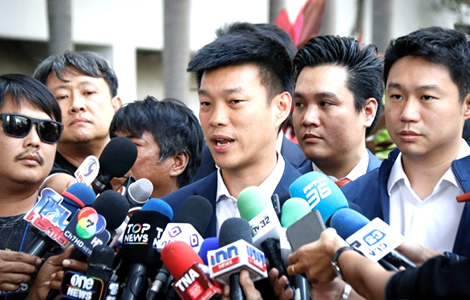
At the centre of the court appearance was People’s Party leader and prime ministerial candidate Nattapong Ruangpanyawut. Alongside him were former party-list MPs Woraphop Wiriyaroj and Suphachot Chaiyasat. Together, they attended court to arrange bail after the Criminal Court accepted a criminal defamation case against them.
The case was filed by a company within the Gulf Group. Gulf is one of Thailand’s leading energy companies and a major electricity producer. It also holds extensive interests in infrastructure and digital services.
Suit over energy price criticism seeks penalties and ฿300 million damages from three politicians
As a result, the lawsuit immediately drew attention beyond routine legal reporting. The plaintiff is seeking both criminal penalties and civil damages. In total, the damages claimed amount to 300 million baht. Each defendant faces a civil claim of 100 million baht.
The origin of the case lies in public statements made during 2024 and 2025. Specifically, the dispute centres on comments about electricity prices and government energy policy. According to the plaintiff, these comments caused reputational harm. Gulf claims its business interests were damaged as a result. Consequently, the company initiated legal action under Thailand’s defamation laws.
In Nattapong’s case, the complaint stems from a press conference held in October 2024. At that event, the People’s Party addressed rising electricity prices. Moreover, it criticised the government’s electricity procurement arrangements.
The party argued that pricing structures were unfair to consumers. It also called for reform of the national energy framework. These statements form the basis of the criminal defamation charge against him.
Press conference remarks on electricity prices and procurement reforms form basis of defamation case
By contrast, the cases against Woraphop and Suphachot arise from parliamentary proceedings. Their remarks were made during debates in the House of Representatives. In particular, both spoke during a no-confidence motion against then Prime Minister Paetongtarn Shinawatra.
That debate focused heavily on energy pricing and procurement policy. According to Gulf, those parliamentary criticisms crossed into defamation. As a result, separate cases were filed against both MPs.
Although related in substance, the three cases are procedurally distinct. Each concerns different statements made in different settings. However, all are being handled by the Criminal Court. Previously, the court held a preliminary hearing in August 2025. Following that hearing, the court ruled that the cases should proceed. Therefore, the court formally accepted the complaints.
Once the cases were accepted, court appearances became mandatory. Consequently, bail arrangements were required. On February 2, 2026, the three defendants attended the Criminal Court on Ratchadaphisek Road. They submitted bail applications in advance of their scheduled hearings. The case is registered as No. 1035/2568. The appearance occurred amid ongoing nationwide campaign events.
Criminal Court schedules hearings and accepts bail applications as the election campaign continues
The court has scheduled hearings on separate dates. Nattapong’s hearing is set for February 16, 2026, at 9:00 a.m. Suphachot’s hearing will follow at 1:00 p.m. on the same day. Woraphop’s hearing is scheduled for May 11, 2026, at 9:00 a.m. These hearings will address the criminal defamation charges. Civil claims will proceed in parallel.
At the courthouse, Nattapong spoke briefly to reporters. The purpose of the visit was to process bail applications. He confirmed that the court had already accepted the cases. Therefore, the bail process followed standard legal procedure. Importantly, he stated that none of the defendants intended to flee. He pointed to the ongoing election campaign as evidence.
Moreover, he said public campaigning demonstrated cooperation with the court. He expressed confidence that the judicial process would be fair.
However, he declined to disclose details of the bail collateral. He said disclosure could affect the case. Nevertheless, he confirmed that all collateral was personal. He added that court conditions had not yet been issued.
Nattapong says case will not affect campaign. Confirms parliamentary immunity not invoked
At the same time, Nattapong stressed that the lawsuit was separate from the election campaign. It would not distract him from political activities. Campaigning would continue as planned. He also addressed concerns about candidate eligibility.
According to him, legal counsel had confirmed the charge was not a serious offence. Therefore, it would not affect election qualifications.
Additionally, he stated that parliamentary immunity would not be used. If the cases proceed after the election, immunity would not be invoked. He said all three defendants were prepared to explain the facts openly. He emphasised that transparency was important. These remarks were made outside the courtroom.
Outside the Criminal Court, a large group of supporters gathered. Reporters observed many wearing orange clothing. Orange is associated with the People’s Party and its predecessor movements. Supporters brought orange garlands as a sign of encouragement. As Nattapong arrived, the crowd cheered loudly. They shouted slogans calling him “Prime Minister Teng,” using his nickname.
Supporters gather at Criminal Court with orange symbols as party leader arrives seeking bail
Meanwhile, supporters approached him for photographs. Some embraced him briefly. The scene unfolded directly in front of the court building. Police were present, although no incidents were reported. The gathering highlighted the public attention surrounding the case.
Afterwards, Nattapong answered further questions. Firstly, he was clear that the lawsuit did not intimidate him or his colleagues. He reiterated that legal defence and campaigning were separate matters. Significantly, the party’s policy direction would remain unchanged. In particular, he reaffirmed the party’s focus on energy reform.
Nattapong stated that the People’s Party would continue addressing electricity prices. He said this commitment would remain even if the party formed a government. However, he did not outline specific policy mechanisms. Instead, he repeated that reform remained a central platform issue. He said legal pressure would not alter that stance.
During questioning, he also addressed election administration concerns. He spoke about advance voting outside constituencies held on February 1. According to him, problems were reported at several polling stations. He said the party was reviewing the situation. He added that legal action was being considered.
Party reviews advance voting problems and possible legal action over election administration failures
However, he said any action would depend on evidence of intentional misconduct. If wrongdoing was deliberate, legal steps would follow. He said voters had been forced to protect their own rights. He criticised the election preparation by the Election Commission. According to him, planning could certainly have been better.
Moreover, he raised concerns about ballot handling. Mr. Nattapong or ‘Teng’ referred to possible discrepancies involving district ballots. The People’s Party leader said there were questions about ballots being sent incorrectly. He said the party was awaiting a clear explanation from the Election Commission. Notably, he insisted that apologies alone would not resolve procedural failures.
He also commented on upcoming campaign events. He said he was not concerned about a planned rally in Suphan Buri. Preparations, he said, were complete. He referenced the 2023 election results. At that time, the Move Forward Party performed strongly in Suphan Buri. He suggested that support remained significant.
Later, he commented on opinion polling. Teng noted multiple polls showed rising support for the People’s Party. He described the increase as rapid. Certainly, party members were confident as the campaign entered its final days. These remarks were made in response to reporters’ questions.
Case proceeds under Thai defamation system, allowing civil damages and criminal complaints
The legal case itself reflects Thailand’s defamation framework. Under Thai law, defamation can be pursued criminally and civilly. Plaintiffs may seek fines, imprisonment, or damages. Private companies may file criminal complaints. Courts decide whether such cases should proceed.
In this instance, the Criminal Court accepted the complaint. However, the court has not ruled on the merits. The defendants’ statements were made in political contexts. Some occurred during a party press conference. Others were delivered during parliamentary debate. The substance of those remarks has yet to be assessed.
The plaintiff, Gulf Development Public Company Limited, is a major corporate group. Formerly known as Gulf Energy Development PCL, it rebranded in 2025. The change followed its amalgamation with Intouch Holdings. The new name reflects a broader business scope.
Gulf Development is one of Thailand’s largest holding companies. Its operations span energy, infrastructure, and digital sectors. In energy, it operates large gas-fired power plants. It also invests in renewable projects, including solar, wind, and hydro. These projects extend beyond Thailand to Vietnam and Europe.
In infrastructure, the company invests in major national projects. These include the expansion of Laem Chabang Port. They also include intercity motorway developments. In the digital sector, Gulf holds strategic stakes. It is a major shareholder in Advanced Info Service, Thailand’s leading mobile operator. It also holds shares in Thaicom, a satellite operator.
Gulf Development expands beyond energy into infrastructure, telecoms and regulated digital assets
Additionally, Gulf has entered digital asset markets. Through a partnership with Binance, it launched Binance TH. The exchange operates under Thai regulation. Gulf Development is listed on the Stock Exchange of Thailand under the ticker GULF. It is included in indices such as SET50 and MSCI Thailand.
The company’s founder and chief executive is Sarath Ratanavadi. He is the largest shareholder. He is also among Thailand’s wealthiest individuals. Financially, the company has reported strong performance. Profits have been driven by energy operations. Dividend income from telecommunications has also contributed.
Rangsiman Rome sued for ฿100M by Deputy Prime Minister Thamanat Prompow for defamation
Australian’s bizarre case draws world attention to archaic and abused Thai criminal defamation law
Against this backdrop, the defamation case continues through the courts. Bail applications have been submitted. Court conditions remain pending. Hearings are scheduled through mid-2026. Meanwhile, the General Election campaign continues nationwide.
The case, of course, further highlights the draconian nature of Thailand’s defamation laws. In particular, it shows the limits of parliamentary privilege in Thailand. The protection accorded to elected representatives is quite limited, in contrast, for instance, to Western democracies. This is despite the pledge by the defendants not to invoke parliamentary privilege and to deliberately confront the substance of the case.
Join the Thai News forum, follow Thai Examiner on Facebook here
Receive all our stories as they come out on Telegram here
Follow Thai Examiner here
Further reading:
Rangsiman Rome sued for ฿100M by Deputy Prime Minister Thamanat Prompow for defamation
High powered, secretive meeting chaired by PM agrees robust action against Cambodian networks