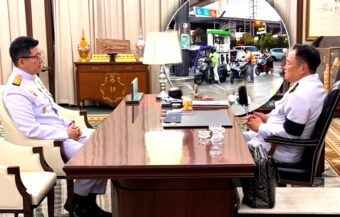
Baht sinks 6% since Feb 28 war, now at ฿32.79, with forecasts of a slide to ฿35 if conflict drags on. Bank of Thailand warns 2026 growth could weaken as oil shocks, shipping disruptions and rising energy costs push inflation risks and shake Thailand’s economic outlook.
The Thai baht has weakened 6% since the war with Iran broke out on February 28 and is forecast to fall to ฿35 against the US dollar if the conflict continues. A Friday briefing by the Kasikorn Research Centre and the Bank of Thailand made clear that if fighting lasts another month or two, Thailand’s 2026 GDP growth could drop well below 1%, possibly as low as 0.5%. Undoubtedly, the conflict has already ushered in shifts in the geopolitical outlook. For now, the government in Bangkok can only watch as the world order of the past 50 years begins to shatter.

The Thai baht stood at ฿32.79 against the US dollar on Saturday. However, the currency has weakened sharply in recent weeks. In fact, it has fallen 6% since the war began on February 28. Meanwhile, analysts and officials are tracking further declines closely.
On Friday, Kasikorn Research Centre warned the currency could weaken further if the conflict continues. Specifically, the centre projected the baht could slide toward ฿35 per dollar. As a result, currency volatility is expected to remain elevated across markets. According to the research centre, movements in energy prices remain the main driver behind the shift.
At the same time, the Bank of Thailand addressed the situation during a Friday afternoon briefing. During the session, officials outlined rising risks to the economy.
Central bank warns prolonged conflict could weaken Thailand’s growth outlook for 2026
Notably, Chayawadee Chai-Anant spoke on behalf of the central bank. She serves as Assistant Governor for Corporate Relations at the Bank of Thailand. She warned that the conflict could damage economic growth if it lasts for months.
Consequently, GDP growth in 2026 could weaken significantly under prolonged conditions. Therefore, the central bank is reviewing forecasts and preparing possible revisions. In response, officials indicated the 2026 GDP growth target may be cut.
Meanwhile, the bank continues monitoring the baht’s value closely. However, officials said there is no direct way to control inflation caused by oil shocks. Instead, those price increases move through the economy over time.
As a result, inflation pressure could build gradually across sectors. At present, the Bank of Thailand sees increased downside risks compared with earlier forecasts. Although monthly economic indicators have not yet fully captured the impact, risks are rising. Therefore, the bank is reassessing data and reviewing projections carefully.
Rising energy costs and global slowdown begin to spread across the Thai economy and foreign tourism
According to the Bank of Thailand, the Middle East conflict is affecting Thailand through several channels. First, energy costs are rising due to higher oil prices. As a result, authorities are tracking how much of that cost reaches consumers.
If businesses cannot absorb higher costs, prices may increase. In addition, global economic conditions are shifting under the same pressures. Consequently, slower economic activity could emerge across several regions. At the same time, Thailand’s tourism sector could face secondary effects from higher travel costs and disruptions.
Previously, the Monetary Policy Committee projected GDP growth of 1.5%. That estimate was released on December 17, 2025. However, officials now acknowledge higher uncertainty surrounding the outlook.
Therefore, actual growth could fall below earlier expectations. Still, the exact level remains difficult to determine at this stage. Because uncertainty remains high, the central bank has prepared two scenarios. Each scenario depends on how long the conflict lasts and how energy markets respond. Accordingly, policymakers are reviewing both paths carefully.
Bank of Thailand outlines scenarios based on conflict duration and impact on oil prices and shipping flows
First, the best-case scenario assumes a quicker resolution to the conflict. In this case, the war ends by the first quarter of 2026. Then shipping through the Strait of Hormuz begins to ease. As a result, oil prices are expected to stabilise near $80 per barrel on average.
Under that outcome, pressure on Thailand’s economy would remain more limited. However, officials stressed that this scenario depends on conditions improving relatively soon.
The base case scenario, however, presents a longer disruption. In this situation, the conflict might end in the first half of the year. Yet the economic effects would extend into the second half. Specifically, damage to infrastructure could delay recovery.
This differs from the Russia-Ukraine conflict in key ways. In that case, infrastructure was not directly affected in the same manner. Therefore, rebuilding and recovery could take longer in the current conflict. As a result, economic pressure could persist well into the year.
Base case scenario sees higher oil prices, persistent shipping disruptions and prolonged economic pressure
Under the base case scenario, oil prices could average around $100 per barrel. Meanwhile, shipping disruptions may continue through the second half of the year. Consequently, global supply chains would remain under pressure.
At the same time, energy costs would stay elevated across many sectors. During the briefing, officials also discussed how policy may respond. Chayawadee said supply-driven inflation requires careful interpretation. For example, energy price increases stem from external shocks. Therefore, interest rates cannot directly address those supply constraints.
However, the central bank still retains policy tools if conditions shift. If inflation spreads into demand or long-term expectations, action may follow. In that case, interest rate adjustments could be considered. For now, officials continue monitoring developments and incoming data.
The bank also referred to earlier policy experience. During the Russia-Ukraine conflict, interest rates were not raised rapidly. Instead, policymakers assessed the situation over time before acting.
Currency volatility rises as central bank intervenes to stabilise markets and support business operations
Meanwhile, currency volatility remains another major concern for officials. According to the Bank of Thailand, fluctuations have reached about 9%. This level is higher than recent historical ranges. However, it has not yet reached a record high.
Therefore, the central bank has intervened to manage currency movements. Officials said intervention has occurred during both appreciation and depreciation periods. The main objective is stability for businesses operating in Thailand. Consequently, companies can continue setting prices and managing costs with fewer disruptions.
At the same time, the bank is monitoring financial activity linked to currency trading. Authorities aim to prevent further market stress during volatility. In addition, officials want to support normal economic operations while uncertainty continues.
Kasikorn Research Centre has provided further analysis of the conflict’s economic impact. It expects the war to last around two months in its most likely scenario. If that occurs, global crude oil prices could rise further. As a result, the baht would face renewed downward pressure.
Baht volatility increases sharply while depreciation deepens across regional currency markets
Burin Adulwattana, chief economist at the research centre, outlined the currency trend. He said the conflict has already affected the baht’s performance. Specifically, volatility and depreciation have both increased this year.
Year to date, the baht has fluctuated by around 9%. Last year, the range remained between 7.5% and 8%. Consequently, currency swings have intensified compared with previous periods. In addition, the baht has weakened about 4% against the dollar so far. As a result, it ranks as the region’s second-weakest currency after the South Korean won.
Amid these pressures, analysts have revised growth expectations for Thailand. According to Kasikorn Research Centre, GDP growth could fall by about 0.5 percentage points. This estimate reflects the centre’s most likely scenario.
Rising energy prices remain the central factor behind the revision. Moreover, the conflict has triggered a sharp surge in global energy prices. The increase followed disruptions near the Strait of Hormuz shipping routes. Consequently, supply chains across multiple industries have come under strain.
Trade disruptions, rising travel costs and a stronger dollar add pressure across Thai and regional markets
In turn, shortages may develop in petrochemical raw materials. Meanwhile, global food prices could also face upward pressure. Analysts said these effects may appear over the coming months. Therefore, several sectors are monitoring supply conditions closely.
The conflict has also disrupted trade and travel across the region. Flights have decreased as routes are adjusted or suspended. At the same time, travel costs have increased due to longer or restricted routes. As a result, tourism and logistics may face operational challenges.
On the financial front, the US dollar has strengthened against Asian currencies. This shift has created additional pressure on regional markets. For Thailand, the effect is particularly significant due to energy imports. Therefore, a stronger dollar increases import costs and financial strain. It can also weigh on capital markets and economic activity. Meanwhile, inflation risks are increasing as energy prices remain high.
Kasikorn Research Centre also raised concerns about stagflation risks in the global economy. That scenario combines slower growth with higher inflation levels. According to analysts, such conditions could pressure central banks worldwide.
Forecasts warn that prolonged tensions and high oil prices could slow growth and lift inflation risks
Consequently, monetary policy easing could be delayed in several countries. Burin said these pressures may limit or postpone interest rate cuts. In some cases, central banks may slow plans for monetary easing. This could include the Bank of Thailand if conditions worsen further.
Further projections were provided by Nattaporn Triratanasirikul at the research centre. She serves as deputy managing director of the organisation. According to her assessment, Thai economic growth could decline by 0.2 to 0.7 percentage points.
As a result, full-year growth may reach around 1.9%. This projection assumes tensions involving Iran continue for some time. It also assumes possible supply disruptions in the Strait of Hormuz. Specifically, disruptions could last between one and three months.
During that period, crude oil prices would remain elevated above earlier expectations. Meanwhile, the 2026 annual average could reach between $75 and $90 per barrel. Consequently, cost pressures would continue affecting the economy throughout the year. The research centre also outlined a more severe scenario.
In this case, oil prices exceeded $130 per barrel for more than three months. If that occurs, inflation risks would rise sharply in Thailand. As a result, headline inflation could exceed the Bank of Thailand’s 3% target range. At the same time, economic growth in 2026 could stagnate.
Inflation pressures rise while fiscal limits constrain subsidies and force closer monitoring of energy costs
Nattaporn said inflation pressure is already emerging in Thailand. Rising energy costs are the main driver behind the trend. However, broader economic effects are still developing.
According to her assessment, the real sector impact may become clearer in the second quarter. She also noted limits on government intervention under current fiscal conditions. Fiscal space is tighter than during the Russia-Ukraine conflict period. Therefore, broad energy subsidies are harder to sustain now.
Thai economy feels the stress as US Israeli War on Iran continues with 2 key Iranian leaders just killed
Iran War brings Thailand closer to the United States on trade and energy as it secures critical supplies
Still, some targeted measures may remain necessary in certain cases. According to the research centre, support could focus on specific groups. It could also target defined price levels and limited time frames.
Analysts said such steps could address immediate pressure more precisely. For now, authorities continue monitoring developments closely. Currency movements remain under constant review by policymakers.
Oil prices and shipping disruptions are also key indicators. Meanwhile, officials are waiting for more economic data. Ultimately, the course of the conflict, in particular its duration, will shape Thailand’s economic outlook. At the same time, there is a possibility that an altered geopolitical order may be left in its wake. However, right now, no one can accurately predict what comes next.
The Middle East war undoubtedly has the potential to shatter the political balance of power that has existed, certainly in the Middle East, for the last fifty years. It has also forced the Thai government to examine its energy policies.
Join the Thai News forum, follow Thai Examiner on Facebook here
Receive all our stories as they come out on Telegram here
Follow Thai Examiner here
Further reading:
Anxiety about oil supplies and prices as economic growth in 2026 now dependent on the US Iran War
US Ambassador Seán O’ Neill briefed Prime Minister Anutin Charnvirakul at Government House on War
Visa waivers, discounted hotel stays and 2,000 baht a person per day for stranded tourists announced