Horse power returns as Lampang police deploy carriage patrols for Songkran, boosting visibility, cutting fuel use, and securing tourist zones as officers ride century-old carriages through key city routes under a new safety and security plan.
Innovative Thai police in the northern province of Lampang have unveiled a direct response to the energy crisis. During the annual Songkran holiday, police will deploy carriage patrols powered by old-fashioned horsepower. The patrols are not a PR exercise, as officers completed training in handling carriages and horses before this week’s launch. The new horse-drawn patrols are being introduced in a tourist city known for retaining horse-drawn carriages as a working form of public transport.
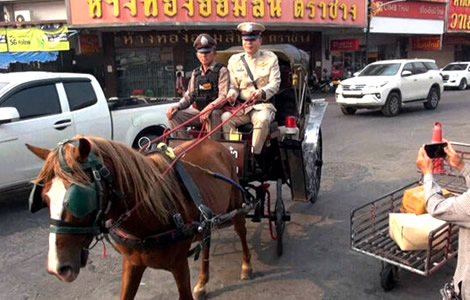
Police in Lampang have introduced horse-drawn carriage patrols for the Songkran period, with the initiative formally announced on 8 April 2026. Specifically, the programme is led by Muang Lampang Police Station and integrates traditional transport into active policing duties.
Traditionally, patrols rely on cars and motorcycles; however, carriage units now operate alongside them. As a result, police expand patrol coverage while reducing fuel consumption during a period of high energy prices.
Moreover, the initiative targets core policing objectives during the holiday. Officers are tasked with maintaining order, protecting lives and property, and strengthening tourist confidence.
Carriage patrol deployment expands across key routes and economic zones to boost visibility during festival
At the same time, patrol visibility is being increased across high-traffic areas. Consequently, carriage units are deployed on key routes, including Boonyawat Road and Thip Chang Road, as well as central economic zones. In addition, officers will monitor sensitive locations such as gold shops, commercial premises, and major tourist sites. Therefore, patrol coverage is concentrated where risks typically rise during festival periods.
Before deployment, selected officers completed specialised training with the Lampang Carriage Association. Notably, the training focused on horse handling, carriage control, and operational coordination.
As a result, officers were certified before entering active duty. Meanwhile, carriage patrols are integrated into existing structures. They operate as supplementary units and, in some areas, replace motorised patrols. Consequently, fuel use is reduced without altering overall patrol capacity. At the same time, all units continue to coordinate through standard police communication systems.
Operational readiness was tested in advance. Thanee Tanjankul, deputy superintendent for prevention and suppression, personally conducted field trials. He also led officers during initial operations. As a result, the system was verified before full deployment.
Senior police confirm carriage patrols align with provincial security policy for Songkran operations
The senior police officer confirmed the initiative follows policy direction from Phumiphan Nawatrakulpisut, the provincial police chief. Specifically, the directive focuses on strengthening security during Songkran. Therefore, carriage patrols form part of a broader operational plan for the holiday period.
In parallel, officers assigned to carriage units wear traditional-style police uniforms. This reflects Lampang’s distinct identity while maintaining an official presence.
Notably, Lampang remains the only province in Thailand where horse-drawn carriages still operate for tourism. Therefore, the initiative builds directly on an established local system. At the same time, the visible use of carriages aligns with visitor expectations during the festival.
Historically, horse-drawn carriages have been part of Lampang’s transport system since the reign of King Chulalongkorn. In 1915, they served as a primary means of transport between provinces. Specifically, routes connected Lampang with Chiang Mai, Chiang Rai, and Phrae. As a result, carriages supported interprovincial travel before the expansion of motorised transport. However, while carriages disappeared elsewhere, Lampang preserved the tradition.
Historic carriage system supports modern policing as legacy transport adapts to security roles
Subsequently, the Lampang Carriage Association was formally established in 1952 to regulate operations. Today, that legacy supports both tourism and policing functions. Therefore, the current initiative merges historical practice with modern enforcement needs.
During Songkran, visitor numbers are expected to increase significantly. Consequently, police presence is being expanded across key zones. Meanwhile, carriage patrols provide a highly visible deterrent and support rapid response capabilities.
Police confirmed the programme is now active, with carriage units deployed across designated routes. In addition, conventional patrols continue without interruption. No incidents linked to the new patrol method have been reported. However, authorities will monitor performance throughout the festival period.
As a result, adjustments will be made if required to maintain safety and effectiveness. Overall, the operation introduces a non-motorised patrol option while maintaining standard policing objectives, including crime prevention and public security.
Lampang’s long-standing horse carriage tradition continues to define city identity and tourism appeal
Lampang has been famous for its horse-drawn taxis and public transportation services for over a hundred years. The unique nature of the capital, with a population of approximately sixty thousand people at the centre of a provincial population, makes it a popular tourist spot for both Thai and international tourists each year.
In Lampang, horse-drawn carriages remain in active use and now support the new police patrol operations. The city, widely known as Muang Rot Ma, continues to operate Thailand’s only functioning carriage system.
Historically, this system dates back to around 1916. At that time, carriages were introduced by local elites, including Chao Boonyawat Wongmanit, alongside influence from Burmese teak traders. Initially, they operated as a primary mode of transport across the city. Moreover, they developed alongside early railway expansion and regional trade activity. As a result, carriages became central to daily movement and logistics in the area.
Surviving carriage network enables immediate police deployment using established tourist transport routes
However, with the expansion of motorised transport, their role declined across most regions. In contrast, Lampang preserved the system while other provinces abandoned it. Consequently, the carriage became a defining feature of the city.
Oil and energy crisis deepens in Thailand as Prime Minister Anutin shows off new EV car to reporters
Well-known French expat dies in Lampang after suffering a diabetic episode while driving near home
Today, approximately 100 carriages continue to operate across central districts. Meanwhile, they are primarily used for tourism rather than daily commuting. Routes include key locations such as Kad Kong Ta Walking Street.
Therefore, these established routes now support police patrol deployment during the festival period. Officers operate along the same paths previously used for tourist transport.
At the same time, carriage production continues locally using traditional methods. Units are built with wooden spokes or iron wheels. As a result, the system remains fully functional and self-sustained. Consequently, the police patrol initiative relies on an existing transport network rather than new infrastructure. Moreover, apart from training for officers, this allowed for the immediate deployment without additional construction or procurement.
Join the Thai News forum, follow Thai Examiner on Facebook here
Receive all our stories as they come out on Telegram here
Follow Thai Examiner here
Further reading:
Oil and energy crisis deepens in Thailand as Prime Minister Anutin shows off new EV car to reporters
Anxiety about oil supplies and prices as economic growth in 2026 now dependent on the US Iran War
US Ambassador Seán O’ Neill briefed Prime Minister Anutin Charnvirakul at Government House on War
Visa waivers, discounted hotel stays and 2,000 baht a person per day for stranded tourists announced
Liquidity crisis or shortage of cash on the ground is shrinking Thailand’s economic growth prospects