Top tourism body ATTA warns Thai-Cambodian conflict and caretaker government paralysis are rattling foreign tourist confidence, as visitors question safety in Pattaya and Udon Thani, budgets stall, private aid plans freeze as arrivals slide 10%.
A leading tourism industry body has raised concern over the Thai-Cambodian conflict and its impact on Thailand’s foreign tourism industry, with the Association of Thai Travel Agents (ATTA) saying in recent days that foreign tourists visiting Udon Thani and Pattaya are voicing concern about military clashes along Thailand’s long border with Cambodia, a conflict now making international headlines and expected to influence how foreign tourists decide where to holiday, while ATTA Secretary-General Mr. Adit Chairattanannon also warned that the dissolution of parliament and the presence of a caretaker government could negatively affect planning and budget preparation for foreign tourism in the period ahead.
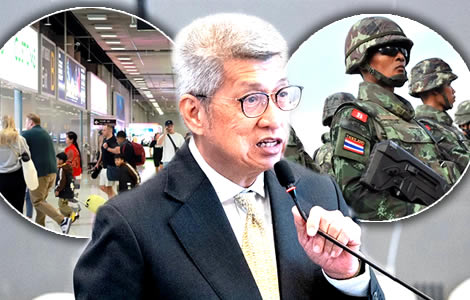
The Association of Thai Travel Agents has raised fresh concerns over the caretaker government’s handling of the border war with Cambodia. Specifically, the group questioned the government’s capacity to act decisively. As a result, tourism confidence is showing signs of strain.
At the center of the concern is the ongoing Thai-Cambodian conflict. According to ATTA, the caretaker administration has limited authority. Therefore, its ability to resolve cross-border tensions remains uncertain. Meanwhile, delays are already affecting perceptions abroad.
In addition, ATTA reports growing unease among foreign tourists. In particular, independent travellers are reassessing travel plans. Consequently, questions about safety are becoming more frequent.
Concerns grow as border conflict and caretaker limits strain confidence among foreign tourists abroad
For example, British tourists have sought clarification on distances and risk. One British traveller asked whether fighting could spread to Pattaya. Notably, Pattaya lies roughly 400 kilometres from the conflict area. Even so, the inquiry reflects wider uncertainty.
Moreover, ATTA said such concerns are not isolated. Instead, they highlight how distant conflicts shape traveller behaviour. As a result, perception is becoming as influential as reality. Especially, as independent travellers react quickly to regional instability.
At the same time, Chinese tourism developments have raised additional questions. Recently, charter flights from China arrived in Udon Thani province. This marked the first time such flights served the area. However, the proximity to the conflict caused concern.
According to ATTA, Chinese tour operators are seeking reassurance. Specifically, they want confirmation that routes and destinations remain unaffected. Consequently, hesitation could limit expansion plans. This comes despite efforts to diversify entry points.
It comes with Thailand’s foreign tourism already in crisis. For instance, figures released this week show a 9.8% fall in visitors to Thailand compared to 2024.
Uncertainty over safety and proximity to fighting weighs on British and Chinese tourists’ decision making
Furthermore, ATTA said uncertainty risks undermining new market initiatives. In many cases, emerging destinations rely on early confidence. Therefore, any doubt can slow momentum quickly.
Meanwhile, ATTA pointed to the role of the Tourism Authority of Thailand. The association said TAT must intensify public communication. In particular, it should clearly identify safe and accessible destinations. Otherwise, confusion may spread.
Additionally, ATTA stressed that silence carries its own risk. Without clear messaging, tourists may assume nationwide disruption. As a result, cancellations could increase unnecessarily. This risk is higher during political transitions.
Turning to domestic politics, parliament was recently dissolved. According to ATTA, the move followed democratic procedures. For comparison, similar processes occur in Italy and Japan. Nonetheless, operational impacts remain significant.
Parliament dissolution raises risks of disruption to tourism planning, funding cycles and administration
Mr. Adit Chairattanannon, ATTA Secretary-General, addressed the issue directly. He said dissolution itself is not the problem. Instead, the disruption to governance is the concern. Consequently, administrative delays are expected.
In particular, Mr. Adit highlighted risks to fiscal planning. Preparation of the 2027 annual budget could be delayed. This is because elections and government formation take time. Therefore, early fiscal year disbursement is uncertain.
Moreover, many tourism programs depend on timely funding. If budgets stall, initiatives may pause. As a result, market stimulation efforts could weaken. This timing issue worries industry operators.
At the same time, ATTA raised concerns about private sector proposals. These proposals were previously submitted to the Prime Minister. They focused on tourism support and recovery. However, their status is now uncertain.
According to ATTA, caretaker governments face funding constraints. In particular, access to the central emergency reserve fund is restricted. Therefore, some measures cannot proceed. This includes market promotion initiatives.
Caretaker government limits threaten private sector tourism proposals and access to emergency funding
Additionally, ATTA noted a pattern of past delays. Similar proposals were previously stalled. Consequently, the association fears repetition. Without approval, planned measures may lapse again.
Moreover, the proposals require swift execution. Many are time-sensitive. As a result, delays reduce their effectiveness. This impacts operators across the tourism supply chain.
ATTA said the private sector proposals were operational in nature. They addressed immediate market conditions. However, without government backing, implementation is unlikely. This leaves businesses exposed.
Furthermore, the association warned that prolonged uncertainty compounds risk. Border tensions add one layer of concern. Political transition adds another. Together, they affect traveller confidence.
In addition, ATTA said independent travellers are the most reactive. They monitor the news closely. Therefore, even limited clashes can influence decisions. This sensitivity affects booking patterns.
Rising traveler inquiries highlight anxiety over distance, safety, and government response to border conflict
Meanwhile, tour operators report increased inquiries. Questions focus on distance and safety. For example, travellers ask whether conflicts could spread. Such questions reflect anxiety, not proximity.
At the same time, ATTA emphasised that most destinations remain unaffected. However, clarity is required. Without official reassurance, assumptions prevail. This damages demand.
Looking again at Chinese tourism, ATTA said expectations were high. Charter flights signalled renewed interest. Yet, uncertainty threatens follow-through. As a result, growth could stall.
Moreover, regional diversification depends on stability. Udon Thani represents a strategic gateway. Therefore, perceptions matter greatly. Any doubt can redirect traffic elsewhere.
ATTA also noted that caretaker governments operate under legal limits. Policy flexibility is reduced. Consequently, response times slow. This affects crisis management.
Political constraints and diplomatic uncertainty add pressure to an already weakened foreign tourism outlook
Additionally, diplomatic engagement may face constraints. Border resolution often requires decisive action. Under caretaker rules, options narrow. This prolongs uncertainty.
ATTA did not speculate on political outcomes. Instead, it focused on immediate impacts. The association stressed operational realities. These realities affect bookings, routes and investment.
Confusion after Trump’s 20 minute phone call with PM Anutin. US side claimed a ceasefire was agreed
Thailand’s foreign tourism sector in crisis as visitor decline accelerates. 9.8% fewer arrivals than 2024
Furthermore, ATTA said tourism depends on predictability. Stability underpins planning cycles. When uncertainty rises, confidence drops. This pattern is well established. As a result, ATTA continues to monitor developments closely. In particular, it is tracking traveller sentiment and operator feedback. Meanwhile, industry players remain cautious.
Join the Thai News forum, follow Thai Examiner on Facebook here
Receive all our stories as they come out on Telegram here
Follow Thai Examiner here
Further reading:
Confusion after Trump’s 20 minute phone call with PM Anutin. US side claimed a ceasefire was agreed