Thailand moves to activate 2026 free trade deals while the crucial US tariff pact hangs in the balance amid threatened political turmoil. EFTA rollout set to begin, EU talks continue without a deadline and the US-Thai deal awaits finalisation and ratification as exports target 3%.
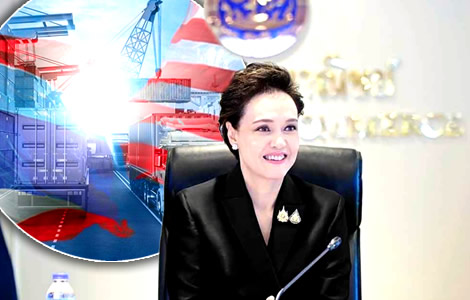
Minister of Commerce Suphajee Suthumpun on Thursday said a US–Thai trade deal would be concluded by July. Hopes are rising that Thailand could match or surpass its 2026 export record. However, business leaders want the deal finalised and ratified without delay. A caretaker government cannot do that. The pact is viewed as a linchpin of the country’s export-driven economy.
The Ministry of Commerce is preparing to activate several free trade agreements signed in 2025. Officials confirmed the move as part of a broader trade strategy. The agreements were concluded earlier this year. Now, implementation is the priority.
In particular, a key agreement involves the European Free Trade Association. EFTA was established in 1960. It promotes free trade and economic integration among its members. Currently, it comprises Iceland, Liechtenstein, Norway, and Switzerland.
Notably, EFTA operates alongside the European Union. However, it remains institutionally separate from the EU. Nevertheless, its members participate in the European Single Market. Specifically, this occurs through the European Economic Area framework. In addition, EFTA states also take part in the Schengen area.
Ministry prioritises EFTA activation as cornerstone of 2026 trade strategy and expansion drive
Accordingly, the Ministry views the EFTA agreement as strategically important. Officials said activation will proceed in phases. Meanwhile, administrative and regulatory processes are underway. So far, timelines have not been publicly specified.
At the same time, negotiations between Thailand and the European Union remain ongoing. Talks have continued through successive administrations. Previously, under the Pheu Thai Party government, there were expectations of a deal by the end of 2025. However, that deadline passed without a conclusion.
Nevertheless, negotiations with the EU remain active. So far, no revised completion date has been announced. Both sides continue discussions on market access. In parallel, they are addressing regulatory alignment. As a result, the outcome remains uncertain.
Meanwhile, attention in Bangkok has focused on the proposed United States–Thailand trade pact. The agreement would lock in the existing 19 per cent tariff rate. Business groups are monitoring developments closely. However, Government approval remains a central concern. At this time, a key concern is the February 8 General Election being nullified.
Political uncertainty and election fallout cloud the ratification of the United States trade pact
In short, this would throw Thailand into unprecedented turmoil and extort the caretaker government, which does not have the power to ratify the key treaty. There is still concern about the attitude of a Bhumjaithai Party government towards the US treaty.
This stems from a perceived readiness of Prime Minister Anutin Charnvirakul to tear up the pact at the height of Thai-Cambodian tensions in November 2025.
In addition, there are also concerns about the Bhumjaithai-led government’s emphasis on barter pacts with countries such as China and Russia. Business leaders are also concerned about the value of the baht and its unexplained links to gold prices. The United States placed Thailand back on a watchlist for currency manipulation in January.
Certainly, there is uneasiness that Thailand has not yet ratified its trade deal with its largest market. Cambodia, for instance, has already finalised its pact eliminating tariffs on all US imports. Meanwhile, Vietnam hopes to finalise its pact shortly.
United States tariff shifts and aluminium rollback reshape outlook for Thai exporters
In the meantime, in recent months, there have been signs of policy shifts in the United States. In particular, attention has centred on tariff duties on aluminium. Recently, these duties were rolled back. The move aimed to ease inflationary pressures in the United States.
Consequently, Thai exporters have taken note. Likewise, trade analysts in Bangkok have assessed the implications. However, the broader framework of U.S.–Thailand trade remains under review. So far, finalisation of the pact has not been confirmed.
There are fears that an extended political crisis or even a renewed border conflict with Cambodia could further delay or even derail the pact in certain circumstances.
Despite uncertainty over formal agreements, Thailand’s exports to the United States remain robust. Export volumes have held firm. Moreover, trade flows have not shown a significant contraction. Therefore, current performance remains stable.
NESDC projects 3 per cent export growth for 2026 amid volatile global conditions
This week, the National Economic and Social Development Council released updated projections. The NESDC said exports in 2026 may expand by 3 per cent compared with 2025. Notably, the estimate comes amid global economic uncertainty.
If achieved, the growth would be significant. However, projections for 2026 have been cautious. External demand conditions remain mixed. In addition, currency fluctuations continue to affect competitiveness. At the same time, geopolitical tensions influence trade flows.
Officials stressed that it is still early in the year. Therefore, data remains preliminary. Export performance will depend on market access. Moreover, it will hinge on external demand. Ultimately, developments in major economies will be decisive.
Against this backdrop, the Government has identified access to world markets as a priority. Maintaining existing trade routes is central to the strategy. Furthermore, improving market access through formal agreements is seen as essential.
Activation of signed deals and US ART Text talks anchor Thailand’s 2026 trade agenda
Accordingly, the activation of signed free trade agreements forms part of this approach. In particular, the EFTA agreement stands out due to its scope. The four EFTA states represent high-income markets. Moreover, they maintain established regulatory systems.
So far, officials have not detailed sector-specific impacts. However, exporters are assessing potential gains in goods and services trade. Meanwhile, the Ministry said implementation mechanisms are being prepared.
In parallel, the Ministry is moving to finalise a reciprocal tariff arrangement with the United States. Officials hope to conclude the deal in July. The talks concern the Thailand–U.S. Tariff Agreement, known as the ART Text.
On February 19, 2026, Commerce Minister Suphajee Suthumpun provided an update. She said Thailand continues negotiations with the United States. However, several issues remain unresolved. Both sides have differing needs and expectations.
Government formation and policy approvals key to concluding Thailand–US tariff deal
In addition, some matters require policy-level approval. Certain points also require formal Government endorsement. Therefore, the timeframe depends on Thailand’s Government formation. Nevertheless, both sides want a conclusion as soon as possible.
Earlier, on February 12, Thailand and the United States held discussions at the Director-General level. During that meeting, the United States congratulated Thailand on its successful elections. Furthermore, it expressed expectations that the new Government would form as scheduled.
Subsequently, the Ministry stated it would expedite negotiations. The aim is to reach a mutually beneficial conclusion by July. However, officials have not disclosed the remaining points of disagreement.
Importantly, the United States has indicated no objection if Thailand proposes a list of goods for exemption from retaliatory tariffs. The proposal would fall under Annexe 3 of an Executive Order issued on September 5, 2025. In addition, Thailand may submit other proposals before negotiations conclude.
US exemption conditions and the Malaysian example show benefits not automatic after deal signing
However, acceptance of Thailand’s proposals will depend on the final outcome. The United States applies different conditions based on each negotiation. Therefore, exemptions are not automatic.
Moreover, Thailand and other countries will not immediately benefit from the proposed exemptions. Instead, the United States sets specific implementation conditions. These conditions vary by agreement and country.
For example, Malaysia has completed negotiations with the United States. However, it will receive exemption rights only 60 days after the ART Text takes effect under Malaysian law. In addition, Malaysia must notify the United States formally.
Consequently, Malaysian exports under Annexe 3 remain subject to normal retaliatory duties. Thus, procedural steps determine actual benefits. Thai officials are factoring these requirements into current negotiations.
Reciprocal tariff talks unfold amid political tension and competing economic priorities
Overall, the reciprocal tariff discussions unfold amid a broader trade push. On one front, Thailand is activating signed agreements. On the other hand, it is negotiating new ones. In each case, market access remains central.
Thrilled with the result. PM set to lead a government focused on stability and security. Barter trade in focus
New government urged to deal with economic decline headon. Grasp technology investors and fight debt
Trade expert warns the government on barter deals with China being pursued by the Commerce Ministry
Top Commerce Ministry official warns that any US trade deal must wait for new parliament and cabinet
Meanwhile, exports to the United States continue to perform steadily. The NESDC’s 3 per cent projection offers a measurable benchmark. However, whether that target is met will depend on global demand. It will also depend on domestic policy execution.
For now, the Ministry’s focus is direct. Signed agreements are moving toward enforcement. Negotiated agreements are advancing through talks. Consequently, trade policy remains central to the Government’s economic agenda in 2026.
Join the Thai News forum, follow Thai Examiner on Facebook here
Receive all our stories as they come out on Telegram here
Follow Thai Examiner here
Further reading:
Trade expert warns the government on barter deals with China being pursued by the Commerce Ministry
Top Commerce Ministry official warns that any US trade deal must wait for new parliament and cabinet
Asean Summit on Monday and Tuesday seen by United States as pivotal to restoring border peace
War to continue says PM Anutin. Dismisses President Trump’s ceasefire talk as a ‘misunderstanding’
Confusion after Trump’s 20 minute phone call with PM Anutin. US side claimed a ceasefire was agreed