People’s Party declares political war on the Bhumjaithai-led government, admitting it was wrong to back PM Anutin as it seizes on the Senate collusion scandal, corruption allegations and polluted rivers to rally public support.
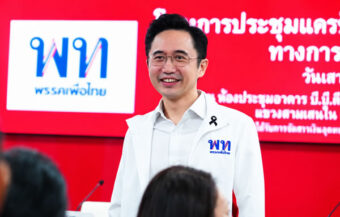
The People’s Party has launched its strongest attack yet on Prime Minister Anutin Charnvirakul’s government, publicly admitting it made a “gigantic mistake” by helping put him in office as it seeks to harness growing public unease over the widening Senate collusion investigation, a scandal increasingly linked to the Bhumjaithai Party. Setting out what amounts to a new political strategy, party leader Nattapong Ruangpanyawut accused the government of failing on corruption and cross-border pollution, pledged sustained parliamentary pressure and left open the prospect of a future no-confidence motion should the Senate investigation deepen the crisis facing the coalition.
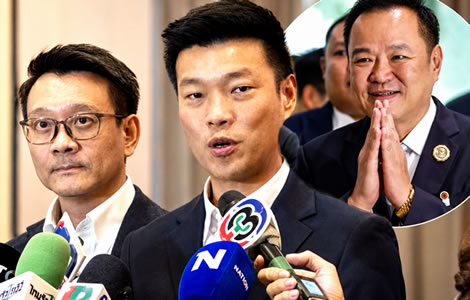
The People’s Party launched its strongest political attack yet on Prime Minister Anutin Charnvirakul’s government on Sunday. Simultaneously, senior party figures admitted they had made a gigantic political mistake.
They apologised for supporting Mr Anutin’s election as prime minister in September last year. Together, the developments marked a decisive shift in the opposition’s strategy and tone.
Rather than defending last year’s decision, senior members openly accepted responsibility for it. They acknowledged that supporting Mr Anutin had been the wrong choice.
The apology represented the clearest effort yet to distance the party from the political realignment that produced the current administration. It also reflected growing confidence that the opposition now holds the political initiative.
People’s Party admits backing Anutin was a mistake before launching its strongest offensive anew
In parallel, People’s Party leader Nattapong Ruangpanyawut turned his attention to the government’s record. He delivered one of his sharpest speeches since the Bhumjaithai-led coalition took office.
He argued that recent events had vindicated the party’s reversal. According to Mr Nattapong, the administration now faces mounting questions over integrity, competence and accountability.
He identified two issues as central to the People’s Party’s campaign. The first was what he described as a growing succession of corruption scandals. The second was the government’s response to pollution affecting rivers flowing into Thailand. He said both issues exposed serious weaknesses within the present administration.
Notably, Mr Nattapong linked the corruption controversies to Bhumjaithai’s period in office. He also connected them to the party’s control of the powerful Interior Ministry. He argued that the accumulation of scandals had steadily eroded public confidence. Each new controversy, he said, had intensified concerns about political influence within government.
Nattapong targets corruption scandals and Interior Ministry as pressure builds on the government
Among those cases, Mr Nattapong singled out the 2024 Senate collusion scandal. He described it as one of the defining political controversies facing the country.
According to him, the investigation had confirmed public concerns about links involving figures associated with the ruling party. He argued that the continuing revelations had become impossible for ministers to ignore.
The opposition leader said the Senate case extended beyond a single investigation. Instead, he presented it as a broader test of political accountability. He maintained that every new disclosure had weakened confidence in the government. Consequently, he argued the administration faced increasing difficulty defending its overall record.
As part of this, Mr Nattapong promised that the People’s Party would intensify parliamentary scrutiny. He said ministers should expect sustained questioning over corruption allegations. Every available parliamentary mechanism, he added, would be used to demand answers. The opposition, he insisted, would not allow the issues to disappear from public attention.
Senate collusion case becomes a key focus as Nattapong promises sustained parliamentary pressure
He also confirmed that a vote of no confidence remained under active consideration. Although he announced no timetable, he deliberately kept the option alive. He said the opposition would continue assessing developments as further information emerged. Future parliamentary action, he indicated, would depend on the scale of new revelations.
In response, Mr Nattapong suggested the coalition itself could eventually face serious political pressure. He argued that the cumulative weight of recent controversies had created a new political landscape.
According to him, the scale of emerging revelations could ultimately threaten the stability of the Bhumjaithai-led government. Parliament, he stressed, would become the principal arena for that contest.
Separately, Mr Nattapong turned to what he described as another major government failure. He sharply criticised ministers over pollution and poisoning affecting Thailand’s rivers. According to him, industrial operators near the Thai border with links to China had caused significant environmental damage. He argued that the government’s response had been slow and inadequate.
No-confidence threat grows as opposition broadens attack to polluted rivers near the Thai border
The People’s Party leader said ministers had failed to demonstrate sufficient urgency. Communities affected by polluted waterways, he argued, continued waiting for decisive action. He maintained that the issue demanded far stronger government leadership. Instead, he accused the administration of allowing the problem to persist.
On another front, Mr Nattapong voiced support for the recent protest outside the Chinese Embassy in Bangkok. Demonstrators gathered to highlight the cross-border pollution issue. They also called for stronger action to address the contamination. Mr Nattapong said those concerns were justified and deserved sustained attention.
He then disclosed that the People’s Party had been communicating directly with Chinese authorities. According to Mr Nattapong, the party has encouraged officials in China to take action to help resolve the problem. He contrasted those efforts with what he described as the Thai government’s limited response. He argued that stronger engagement remained essential.
People’s Party backs embassy protest and urges Chinese action over cross-border river pollution crisis
Equally important, Mr Nattapong linked the environmental issue with broader questions of government performance. He argued that both corruption scandals and polluted rivers reflected administrative failures.
In his view, each issue illustrated weaknesses in leadership and decision-making. That comparison became a central theme of his address.
Throughout the speech, Mr Nattapong repeatedly returned to accountability. Ministers, he argued, must answer for decisions taken under the current administration. Parliament, he added, has a responsibility to examine matters affecting public confidence. The People’s Party, he said, intended to ensure that scrutiny continued.
For that reason, he pledged a sustained parliamentary campaign against the government. Opposition MPs would continue questioning ministers at every opportunity. They would also pursue issues linked to corruption investigations and environmental management. The objective, he said, was to maintain constant pressure on the administration.
Public apology reinforces tougher opposition strategy against Anutin and Bhumjaithai-led coalition
Meanwhile, the public apology from senior party figures reinforced the broader political message. It acknowledged that supporting Mr Anutin’s leadership last September had been a serious error.
It also demonstrated that the party was prepared to reassess one of its most significant political decisions. That admission gave added weight to Sunday’s wider offensive.
Opposition and witnesses call for Senate collusion case to go to court as Election Commission decides on huge case
Police raid and search the home of former Phuket deputy governor in widening corruption investigation
Taken together, the apology and Mr Nattapong’s speech marked a clear political turning point for the People’s Party. The party accepted responsibility for its previous support of Mr Anutin.
At the same time, it outlined a far more aggressive strategy against the government. Corruption investigations, the 2024 Senate collusion scandal, parliamentary scrutiny and cross-border river pollution will now form the centre of that campaign.
Mr Nattapong made clear that the People’s Party intends to keep those issues at the forefront of Thailand’s political agenda in the months ahead.
Join the Thai News forum, follow Thai Examiner on Facebook here
Receive all our stories as they come out on Telegram here
Follow Thai Examiner here
Further reading:
Opposition and People’s Party leader attacks ‘blue regime’ on the 12th anniversary of the 2014 coup
Thammasat University legal scholar and 1992 protest leader warns another coup cannot be ruled out