
Hundreds of EV owners could get their day in court without paying legal costs after Thailand moved towards unprecedented action against one manufacturer. A total of 683 complaints have triggered the government’s toughest consumer protection crackdown yet.
Thailand’s electric vehicle revolution is revealing its downside, as soaring consumer complaints push the government towards unprecedented legal action against manufacturers. With 683 complaints now lodged against one EV maker, hundreds of cases moving towards court and regulators investigating repair delays, warranty disputes, after-sales service and vehicle fires, officials are signalling that Thailand’s record-breaking EV market can no longer expand without stronger consumer protection and closer scrutiny.
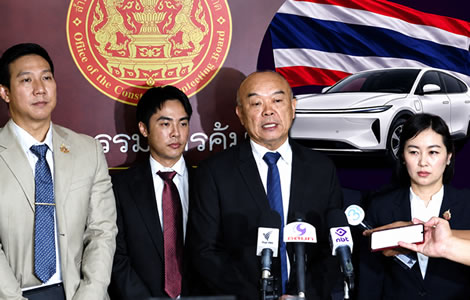
Thailand’s consumer protection authorities have stepped up scrutiny of complaints involving electric vehicles, with the government declaring it is prepared to sue on behalf of affected consumers.
The move would spare motorists the cost of pursuing legal action themselves. Officials say the intervention reflects mounting concern as complaints continue rising alongside electric vehicle ownership.
On July 26, Minister attached to the Prime Minister’s Office Supamas Isarabhakdi, who oversees the Office of the Consumer Protection Board (OCPB), ordered senior officials to closely monitor complaints involving a particular electric vehicle manufacturer.
She assigned her adviser, Pradermchai Boonchuaylue, to oversee developments directly. She also instructed OCPB Secretary-General Ronnarong Poolpipat to accelerate every procedure within the legal framework. Each stage, she said, must remain accurate, thorough, transparent and fair. Patcharin Samsiripong, secretary to the minister, joined the monitoring process and has continued reporting developments.
Government orders urgent legal review as EV complaints surge with hundreds of consumer cases
The latest intervention builds on the government’s consumer protection policy under Prime Minister Anutin Charnvirakul, which identifies consumer protection as a national priority.
In response, Supamas instructed the Consumer Protection Board to work closely with public prosecutors throughout the legal process. The consultations are designed to ensure every case is fully prepared before reaching court. That approach, officials say, will strengthen enforcement and improve prosecution where legal action becomes necessary.
Pradermchai said the latest review found that 683 consumers have now lodged complaints with the Consumer Protection Board concerning one electric vehicle manufacturer.
He said the figure demonstrated growing public confidence in the agency as a legal assistance mechanism. Complaint numbers continue increasing each week. The OCPB’s Legal and Litigation Division has already accepted 234 complaints for legal proceedings. Additional files are progressing as documentation is completed and verified.
For the first group of completed cases, follow-up letters have already been sent to the businesses concerned. Meanwhile, officials are examining supporting evidence, powers of attorney and other documents submitted with newer complaints.
Officials verify evidence and prepare legal action as completed EV consumer complaints rise
Every case is being assessed individually before legal proceedings begin. As part of this, investigators are ensuring each complaint can proceed through every stage of the legal process without procedural weaknesses.
“I have assigned the Minister’s advisor to directly follow up on this matter and instructed the Consumer Protection Board (CPB) to expedite all complaints, prioritising facts and evidence.
Every complaint must be considered thoroughly, transparently, and in accordance with the law. If any case meets the criteria, the CPB is ready to exercise its authority to prosecute consumers under the Consumer Protection Act B.E. 2522 (1979), without consumers having to bear the litigation costs themselves,” Supamas said.
The Office of the Consumer Protection Board said it would continue monitoring the matter until all affected consumers received justice. It also pledged to report progress regularly. Consumers who believe they have suffered losses have been advised to prepare sales contracts, proof of payment, repair histories and other supporting evidence before filing complaints. They can also seek assistance through the OCPB hotline 1166, the OCPB Connect application, the agency’s website and Damrongtham centres in every province.
Thailand’s EV boom delivered record sales in 2025 but consumer complaints rose sharply
The government’s latest action comes as Thailand’s electric vehicle market continues expanding despite broader weakness across the automotive sector. According to the Federation of Thai Industries, domestic vehicle sales reached 621,166 units during 2025.
Battery electric passenger vehicles accounted for 120,301 of those sales. That represented growth of more than 50% compared with 2024.
Consequently, electric vehicles accounted for almost one in five new passenger cars sold. Aggressive pricing, government incentives and expanding local production fuelled the surge. Chinese manufacturers including BYD, MG, GWM, GAC Aion and Changan strengthened their positions as competition intensified.
However, rapid growth in ownership has been matched by a sharp rise in consumer complaints. The Office of the Consumer Protection Board, the Thailand Consumers Council and other agencies all reported increasing complaint numbers throughout 2025.
As ownership spread beyond early adopters, weaknesses in after-sales support became increasingly apparent. Manufacturers struggled to expand service networks and spare-parts inventories at the same pace as vehicle sales.
Parts shortages, steep price cuts and weak after-sales support drove dissatisfaction among EV owners
Notably, shortages of replacement parts became the most common complaint. Many owners reported waiting between six and ten months for replacement body panels, batteries and electronic components after accidents.
Several newer manufacturers maintained only limited inventories inside Thailand. Dealers therefore relied on imported components from China. Vehicles often remained at repair centres for months awaiting deliveries. Those delays also triggered disputes involving insurers, repair workshops and vehicle owners.
Separately, repeated price reductions created another source of dissatisfaction. As competition intensified, several manufacturers cut prices by tens or even hundreds of thousands of baht within months of launching new models. Early buyers complained that resale values fell sharply almost immediately after purchase. Some also argued dealers failed to warn them about impending promotional campaigns before completing sales.
On another front, consumers increasingly complained about inconsistent after-sales service, software updates, charging performance and battery range under real-world conditions. Warranty coverage also became a frequent source of disputes.
Warranty disputes, repair delays and rising insurance costs deepen concerns about the EV market
Some motorists discovered different interpretations of warranty conditions between dealerships. Insurance costs added further pressure after insurers reassessed repair expenses and claims involving electric vehicles. Premiums for some models subsequently increased by around 20% to 25%.
By 2026, the market had entered a more complex phase. Electric vehicle demand remained comparatively resilient despite continued weakness across Thailand’s wider automotive sector. High household debt and tighter lending conditions continued suppressing conventional vehicle sales.
Even so, strong bookings at the Bangkok International Motor Show highlighted continuing demand. The government is also considering a new ฿24 billion support package, alongside subsidies, low-interest loans and tax incentives extending into 2027.
At the same time, consumer dissatisfaction has continued rising. In May 2026, the Office of the Consumer Protection Board confirmed it had received 556 electric vehicle complaints covering the period between 2024 and 2026.
Combined with another 792 complaints received by the Thailand Consumers Council, the total reached 1,348 complaints. The figures prompted the government to launch a formal review of electric vehicle sales practices and after-sales service across the sector.
Rising complaints and EV fire incidents intensify pressure for stronger consumer protection
The complaints have also become more varied as the market has matured. Lengthy waits for replacement parts remain the leading grievance. In addition, motorists increasingly report battery warranty disputes, inconsistent warranty coverage between dealers and misleading claims regarding driving range.
Poor after-sales service remains another recurring issue. Delays following accidents also continue frustrating owners. Some vehicles reportedly remain at repair centres for several months while replacement parts are imported from overseas.
Volvo to face state agency lawsuit over car that exploded into flames. Push to bolster consumer rights
Another EV car fire erupted in the northern province of Phichit as three homes went up in flames nearby
Against that backdrop, the latest figure of 683 complaints cited by Pradermchai shows the number of cases received by the Consumer Protection Board has continued climbing since the earlier review published in May.
The number accepted for legal proceedings is also increasing as officials complete document verification and evidence checks. The government’s decision to intensify legal preparations marks its strongest intervention yet in Thailand’s fast-growing electric vehicle market, where rapid sales growth is increasingly accompanied by expanding consumer complaints and closer regulatory scrutiny.
Join the Thai News forum, follow Thai Examiner on Facebook here
Receive all our stories as they come out on Telegram here
Follow Thai Examiner here
Further reading:
Government sends strong warning to EV industry after a dramatic surge in consumer complaints
Thaksin wants higher excise duties on EV cars that are simply assembled in Thailand by Chinese firms
EV sector crisis as Chinese firms are trapped between lack of demand and government tax penalties
Thailand changes tack as EV revolution turns into a damp squib with warehouses full of unsold cars
Top Thai insurer says no more new policies for EV cars. Later, it emphasised renewals case by case
Lack of coherence in government policy is the root cause of Thailand’s massive economic problems