Bangkok is scrambling to protect Thai exports after Trump’s latest tariff blitz placed Thailand in the tougher 12.5% bracket. Ministers are rushing negotiations as Washington scrutinises forced labour, factory underuse and global trade practices.
Thailand is scrambling to blunt the impact of a sweeping new US tariff offensive after President Donald Trump’s administration placed the kingdom among 60 trading partners facing fresh import duties. While Bangkok insists the economic damage will be limited because many exports remain exempt, ministers are racing to secure a deal with Washington, protect industries facing new costs, answer US concerns over forced labour and low factory utilisation, and prevent Thailand falling behind regional rivals that have already secured lower tariff rates, even as June exports unexpectedly beat forecasts.
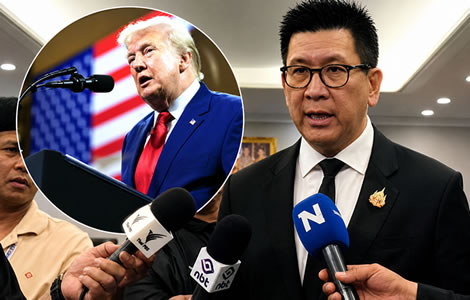
Thailand sought to reassure exporters and investors on Friday after the United States imposed a new tariff regime on 60 trading partners, including the kingdom.
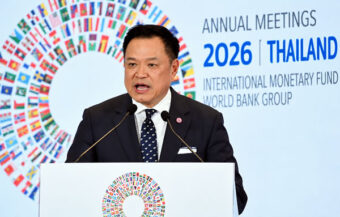
Deputy Prime Minister and Finance Minister Ekniti Nitithanprapas insisted the overall impact would be limited. He said many Thai exports remain exempt from the new measures. As a result, the government expects only a modest effect on the wider economy.
Speaking at Government House on July 24, Mr Ekniti said officials were urgently assessing the new US action while negotiations with Washington continued. He confirmed he had coordinated closely with Commerce Minister Suphajee Suthumpun, who is leading Thailand’s discussions with US counterparts.
Last week, Ms Suphajee travelled to Washington in an effort to secure a negotiated outcome before the latest tariffs came into force. In parallel, government agencies have begun consulting exporters to identify products still exposed to higher duties.
Government moves quickly to assess tariff risks while pushing urgent talks with Washington
Mr Ekniti said numerous Thai product groups already qualify for exemptions under the new framework. However, several industries remain outside those exemptions. Officials must now determine which sectors face additional costs and how severe those costs may become.
They will then consider measures to strengthen competitiveness where necessary. “Right now, we need to see the full details to determine which product groups are actually affected,” Mr Ekniti said. “But in the big picture, I think the impact won’t be significant because many items have already been exempted. We need to expedite negotiations on the remaining items.”
The latest US measures took effect on Friday. Washington imposed tariffs of either 10% or 12.5% on imports from its 60 largest trading partners. Thailand was placed in the higher 12.5% category.
Notably, many products remain outside the new regime because they already face separate sector-specific duties or qualify for exemptions. Consequently, officials believe the practical impact will be narrower than the headline tariff suggests.
The announcement represents the latest chapter in President Donald Trump’s evolving trade strategy. Earlier this year, the US Supreme Court struck down his sweeping reciprocal tariff programme.
The court ruled that emergency powers could not support broad country-specific import duties. In response, the White House rapidly shifted to alternative legal authorities rather than abandoning its protectionist agenda.
Trump replaces emergency tariffs with stronger trade laws to preserve his protectionist agenda
Initially, the administration relied on the International Emergency Economic Powers Act, commonly known as IEEPA. That law formed the basis of what many analysts described as Trump’s first tariff strategy.
After the Supreme Court ruling, however, officials switched to Section 122 of the Trade Act of 1974. That provision permits temporary import tariffs for 150 days to address serious balance-of-payments deficits. Accordingly, Washington maintained a temporary 10% global tariff while preparing a longer-lasting legal framework.
That temporary authority expired shortly after midnight on Friday in Washington. The administration therefore activated its next strategy. This time, officials relied on Section 301 of the Trade Act of 1974.
The statute authorises tariffs following investigations into alleged unfair foreign trade practices. It also served as President Trump’s principal trade weapon during his first-term dispute with China.
This latest investigation centred on forced labour within global supply chains. US Trade Representative Jamieson Greer argued that many trading partners had failed to eliminate products linked to forced labour.
“President Trump recognises that decades of moral suasion have not eradicated forced labour from global supply chains,” Mr Greer said. “The United States has had a forced-labour import ban for nearly a century, and rigorously enforces it; it’s well past time for our trading partners to do the same.”
Forced labour findings split trading partners into tariff bands. China and Thailand hit harder
According to the Office of the US Trade Representative, the targeted economies account for about 99% of all American imports. Separately, Washington divided countries into two tariff categories based on its assessment of forced labour protections.
Around 20 economies qualified for the lower 10% rate. Those included Britain, Malaysia, Indonesia and Mexico. Thailand, by contrast, joined Japan and South Korea in the higher 12.5% group.
China received even tougher treatment. The new 12.5% tariff will be added to existing duties already imposed on Chinese goods. At the same time, products already covered by national security tariffs remain exempt from the latest measures.
Those exemptions include automobiles, steel and aluminium. This layered approach leaves several tariff systems operating simultaneously across different industries.
On another front, the United States continues investigating excess industrial capacity across 16 economies. Thailand is among those under review alongside China, India, Japan, Vietnam and the European Union.
US officials argue that excess production capacity distorts international competition by allowing manufacturers to reduce costs and increase exports. Those investigations could eventually produce additional trade measures beyond the latest tariff package.
Thailand’s low factory utilisation and IPEF talks become key issues in talks with Washington
Thailand’s industrial sector has already drawn attention during that review. Recent figures from the Office of Industrial Economics show manufacturing capacity utilisation at 60.12%. Although still low, the figure improved from previous readings.
Even so, almost 40% of Thailand’s installed factory capacity remains idle. That level has become part of Washington’s wider assessment of industrial competitiveness among major trading partners.
Despite those concerns, Mr Ekniti believes negotiations remain Thailand’s strongest option. He urged faster progress under existing trade cooperation frameworks, particularly the Indo-Pacific Economic Framework, or IPEF. Several competing economies have already completed negotiations and secured access to the lower 10% tariff rate. Thailand has yet to reach that stage.
“The important thing is that we need to negotiate with the United States as quickly as possible because other countries that have already negotiated have received the 10% rate, but Thailand has not yet,” Mr Ekniti said. He confirmed Ms Suphajee continues working urgently to advance those negotiations while officials complete a detailed assessment of the sectors most exposed to the new US measures.
June exports beat expectations as manufacturers accelerated shipments before new US tarriffs
While negotiations continue, Thailand’s export sector has provided a stronger backdrop than many analysts expected. June export figures exceeded market forecasts despite a slower pace than earlier this year.
Even so, overseas shipments remained one of the economy’s strongest sources of growth. The performance offered some reassurance as exporters prepared for another period of uncertainty in global trade.
Demand remained broad across Thailand’s manufacturing sector. Electronics continued performing strongly. Computers and related components also recorded healthy shipments. Air conditioners, automotive products, rubber goods and processed agricultural products all supported export earnings.
In addition, many manufacturers accelerated shipments before possible changes to US trade policy. That strategy helped sustain export momentum during June.
The United States remained Thailand’s largest export market throughout the month. Strong demand for manufactured goods helped offset weaker sales to China. Exporters also maintained healthy shipments to Japan, ASEAN markets and the European Union. Those results reflected Thailand’s diversified industrial base despite increasingly uncertain global trading conditions.
Imports outpace exports despite strong shipments as businesses brace for slower trade ahead
Agricultural exports also contributed to the stronger performance. Rice remained an important export earner. Fruit shipments continued despite changing seasonal conditions. Processed food exports also performed well even as international commodity prices fluctuated. Together, those sectors added further resilience to Thailand’s export mix.
Imports, however, continued rising faster than exports. Thai manufacturers purchased more machinery, electronic components, industrial raw materials and energy products.
Those imports reflected continuing investment and production requirements across the industrial sector. Consequently, Thailand remained in a trade deficit despite historically strong export earnings.
Looking ahead, exporters expect growth to moderate during the second half of 2026. Businesses cite weaker global demand as one risk. Geopolitical tensions remain another concern.
Trade policy uncertainty also continues to affect international commerce. Nevertheless, industry groups still expect positive export growth for the full year because of Thailand’s competitive manufacturing base and diversified overseas markets.
For the government, the immediate challenge extends beyond tariffs alone. Officials must also assess how individual industries will perform under the new US framework. Mr Ekniti acknowledged that detailed product-level analysis remains incomplete.
Government broadens industry review while urging higher standards to strengthen competitiveness
Therefore, officials cannot yet identify every industry facing additional costs. The food sector remains under review alongside several other manufacturing industries.
As part of this process, the Finance Ministry will meet technical teams and other government agencies to complete a comprehensive assessment. Officials will examine export performance, industrial competitiveness and wider economic effects before determining any additional support measures.
They will also continue consulting private sector representatives as more details emerge from Washington.
Mr Ekniti argued that the US focus on forced labour should not be viewed only as a trade obstacle. Instead, he described it as an opportunity to improve Thailand’s long-term competitiveness. He said stronger labour standards and better production practices would strengthen Thailand’s position in world markets while reducing future trade barriers.
According to Mr Ekniti, higher production standards would place Thailand on a more equal footing with competing economies. Lower non-tariff barriers would then create greater opportunities for Thai exporters. Businesses would also gain more room to compete internationally as production standards improved.
For now, the minister maintains that only selected product groups face direct exposure. Many exports remain exempt from the new measures.
Consequently, the government’s priority is completing negotiations before additional industries become affected. Officials believe rapid engagement with Washington offers the best chance of reducing Thailand’s remaining tariff disadvantage.
Washington expands tariff campaign as Thailand races to secure better access in fresh trade talks
The broader US strategy also continues evolving. Alongside the latest tariff measures, Washington has imposed a separate 25% tariff on many Brazilian goods after investigating what it described as unfair trade practices.
It has also announced new 50% tariffs on many Canadian products, citing discriminatory treatment of American alcohol, automobile and dairy exports. Those actions underline the administration’s willingness to pursue country-specific trade actions alongside broader global tariff policies.
Suphajee led high powered Thai team to Washington DC seeking to close a US trade deal and partnership
Transport policy shift following China visit. Thailand to strengthen cargo connectivity with the mainland
Trade specialists believe the White House has deliberately rebuilt its tariff framework using stronger legal foundations after the Supreme Court setback. The administration has replaced emergency powers with trade legislation designed to withstand future legal challenges. As a result, many analysts expect the latest tariff structure to remain in place far longer than the earlier emergency measures.
For Thailand, however, the immediate focus remains unchanged. Officials are working to secure better market access through negotiations while protecting export competitiveness. Detailed assessments are continuing across affected industries.
At the same time, discussions with Washington remain active as Bangkok seeks to narrow the gap with competitors that have already secured lower tariff rates through completed negotiations.
Join the Thai News forum, follow Thai Examiner on Facebook here
Receive all our stories as they come out on Telegram here
Follow Thai Examiner here
Further reading:
Business lobby urges Anutin to improve climate for inward investment by axing old laws and red tape
Tax and welfare revolution as Thailand moves ahead with Negative Income Tax that expands reporting
Thumbs up from economic gurus for 2027 Negative Income Tax plan. It’s a game-changer for progress
Expert warns foreign tourism has become Thailand’s curse, fueling inertia and a widespread malaise