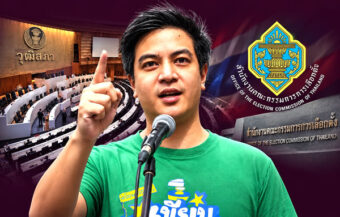
People’s Party slumps to second place with just 112 seats as Nattapong concedes defeat, rules out backing Anutin. The party is prepared for opposition amid looming NACC rulings, internal strain and a sharp shift toward conservative power in Thai politics.
The leader of the People’s Party on Sunday evening conceded defeat before a thinned-out, demoralised crowd at the party’s Bangkok headquarters. Within hours of counting, party supporters knew the contest was over as Bhumjaithai candidates swept key constituencies across central Thailand and the Bangkok periphery. The progressive party is now projected to secure 112 seats, while Bhumjaithai is on track for 197. Party leader Nattapong Ruangpanyawut or ‘Teng’ said he accepted the election result and confirmed that his party would not support or vote for Anutin Charnvirakul as prime minister under any circumstances.

With 87 per cent of ballots counted, the People’s Party secured only 112 seats. As a result, it failed to lead the next government. On Sunday night, party leader Nattapong Ruangpanyawut formally conceded defeat. He acknowledged that his party would not form a governing coalition. Instead, he said it would prepare to take its place in opposition.
The results placed the People’s Party second behind the Bhumjaithai Party. Therefore, the parliamentary arithmetic shifted quickly. Previously, the People’s Party had been the largest bloc.
However, it could not repeat that performance in this election. Consequently, its leverage inside parliament weakened immediately.
Election defeat leaves People’s Party sidelined as parliamentary arithmetic shifts decisively to rivals
At the same time, the party faces further pressure. On Monday, the National Anti-Corruption Commission is scheduled to meet. The NACC may rule on the fate of 44 MPs. Those MPs voted to amend Article 112 of the Criminal Code on lèse-majesté. If the ruling goes against them, parliamentary numbers would fall further.
Moreover, the potential losses extend beyond seat counts. Several affected MPs are senior figures. Many are among the party’s most prominent parliamentary performers. Therefore, any ruling could reduce both numbers and experience. In practical terms, the party’s influence could shrink sharply.
Taken together, the election outcome and the pending legal case mark a turning point. In contrast to recent cycles, conservative forces now hold the initiative. Consequently, the next government is expected to reflect a more conservative alignment. This shift is already visible in coalition arithmetic.
Among voters, reactions were swift and divided. Many People’s Party supporters expressed despair. However, anger also surfaced among pro-democratic groups. That anger focused on past strategic decisions. In particular, critics cited the party’s vote last September.
Supporter anger resurfaces as party’s past backing of Anutin returns to haunt the election narrative
At that time, the party supported Anutin Charnvirakul as prime minister. As a result, trust among parts of its base weakened. During the campaign, that decision resurfaced repeatedly. After the election, it became a focal point of criticism.
In the light of the results, internal weaknesses became clearer. The party struggled to manage votes at the constituency level. Moreover, local organisations failed to deliver expected returns. These shortcomings appeared across several regions. Consequently, national support did not translate into seats.
On Sunday night, Nattapong addressed the outcome directly. He said the People’s Party accepted the election results. He stated clearly that it was not the leading party. Therefore, he said, it would move into opposition. He repeated that the party would respect parliamentary norms.
He also drew firm political lines. Notably, he said the party would not join a Bhumjaithai-led government. Likewise, it would not vote for Anutin as prime minister. He repeated this position several times. Therefore, any coalition talks were effectively ruled out.
Nattapong rules out coalition talks and confirms refusal to back Anutin under any circumstances
However, Nattapong declined to address several issues. These included internal party weaknesses. They also included past rhetoric on the military. Additionally, he avoided questions about alleged irregularities related to vote buying and an incident in Phayao province on Sunday.
An election official is reported to have destroyed seven People’s Party votes and resubmitted them for another party. She later admitted to police that she was paid by that party to do so. On Sunday, Mr Nattapong declined to comment on the case.
Later that evening, the party held a press conference. It began at 9:45 p.m. The venue was the Future Forward Party headquarters. The timing followed the release of unofficial results. The atmosphere was restrained but deliberate.
Several senior figures attended the event. Somporn Jungrungruangkit was present. She is the mother of Thanathorn Jungrungruangkit, chairman of the Progressive Movement. Also present was Suchart Ruangpanyawut, Nattapong’s father. Their attendance underlined the moment’s significance.
Senior figures gather as party confronts defeat, legal pressure and allegations of vote manipulation
During the briefing, Nattapong thanked voters nationwide. He praised citizens for exercising their right to vote. He described the election as a form of referendum. However, he noted that the results were not yet final. Despite that, he congratulated the public on participation.
He then turned to constitutional issues. He said there was a high likelihood of public approval. That approval concerned drafting a new constitution. He linked this expectation to the referendum result. Nonetheless, he avoided firm predictions.
Regarding party performance, he was direct. He said the People’s Party accepted it was not number one. Therefore, it would not attempt to form a government. He said this position had been stated repeatedly before the election. Consequently, the party would not reverse course.
Earlier, party leaders had emphasised this stance. They pledged to respect parliamentary procedures. Accordingly, they would allow the leading party to form a government first. Nattapong said consistency mattered more than short-term advantage.
Party leadership reiterates constitutional stance and refusal to reverse pre-election commitments
He also addressed the broader electorate. He said elections remained a mechanism for solving national problems. Moreover, he urged citizens to stay politically engaged. He encouraged continued participation in future votes. He framed this as essential to democracy.
When asked about joining a government, his response was firm. He said Bhumjaithai was the leading party. Therefore, it had the right to form a government. Consequently, the People’s Party would act as opposition. He described this as unavoidable.
He also stressed procedural rules. He said his party could not vote for a Bhumjaithai prime ministerial candidate. This applied directly to Anutin. He said parliamentary norms required such discipline. Therefore, compromise was not possible.
Asked whether the party would compete to form a government, he dismissed the idea. He said it would not challenge the leading party. Instead, it would step aside. He repeated that respect for the system guided this choice.
Opposition role confirmed as party rejects compromise and defers to the leading bloc’s mandate
On the meaning of the result, Nattapong remained cautious. He said every election reflected the will of the people. He declined to offer a deeper interpretation. However, he commented on turnout. He said he hoped participation would not decline.
When pressed for analysis, he deferred again. He said analysts and citizens would draw their own conclusions. Meanwhile, he said the party would continue its political work. Policy development and institutional reform would continue, he said.
On coalition talks, he was unequivocal. He said no party had approached the People’s Party. He repeated that the initiative belonged to the leading party. Based on the results, he said, his party knew it could not win. Therefore, it is prepared for opposition.
He also addressed a hypothetical scenario. If Bhumjaithai approached them, he said they would refuse. He said they could not support its prime ministerial candidate. He confirmed again that no approach had occurred.
Coalition door closed as party prepares for opposition and dismisses hypothetical talks
Questions then turned to September 2025. At that time, the party supported Anutin for prime minister. Nattapong acknowledged public reaction to that decision. However, he linked it to the constitutional drafting process. He said the party had moved past that phase.
He said it was impossible to isolate its impact. Voters made decisions for many reasons. Therefore, no single factor explained the loss. Nonetheless, he said restoring public trust was now essential. He said the party would focus on that task.
On political dynasties, he spoke generally. He said the party constantly assessed the political system. He said it examined how structures affected its work. Moreover, he said outreach would improve before the next election.
Attention then shifted to election irregularities. Nattapong said the party received multiple reports. However, he said these could not override the overall result. Instead, he said cases would be examined individually. He said the party coordinated with the Election Commission.
Party looks inward after loss as leadership acknowledges trust deficit and organisational shortcomings
Asked whether joining the government could speed constitutional reform, he rejected the premise. He said the leading party must form the government first. He emphasised campaign promises. He said party leaders unanimously agreed not to support a Bhumjaithai prime minister.
On constitutional amendments, he urged MPs to act responsibly. He said the referendum reflected the public will. He noted that amendments require House and Senate votes. Therefore, numbers in the lower house still mattered.
Regarding the Senate, he cited campaign statements. Some Bhumjaithai figures supported a new constitution. Consequently, future votes remained uncertain. He said the process would unfold after government formation.
When asked about military-related rhetoric, he declined specifics. He said many factors influenced voters. He refused to single out any one cause. He reiterated acceptance of the result.
Constitutional reform path remains uncertain as party defers to process and parliamentary arithmetic
On the Bangkok results, he expressed cautious confidence. He said he believed many districts would go to his party. However, he said counting was not complete. He said monitoring would continue.
Allegations of fraud in Phayao province followed. Certain sources had implicated the party in the affair. Nattapong said he believed no People’s Party official was involved. He urged investigators to determine responsibility based on facts.
Huge shift in Thai politics as Bhumjaithai Party wins a landslide election victory. People’s Party loses big
Polls, surveys conflicted as counting continues apace. Pheu Thai has done well. Referendum is a big Yes
Thailand voted. Now to see if the people of kingdom have voted for big change or a conservative path
Asked about defamation, he outlined the procedure. The party would review the evidence first. If falsehoods were proven and the party was smeared, legal action would follow.
Finally, he returned to parliamentary roles. If Bhumjaithai formed a government, he said his party would be in opposition. He described this as the natural outcome. He urged all parties to accept the results and honour promises, including constitutional reform going forward.
Join the Thai News forum, follow Thai Examiner on Facebook here
Receive all our stories as they come out on Telegram here
Follow Thai Examiner here
Further reading:
Thailand voted. Now to see if the people of kingdom have voted for big change or a conservative path
Bank of Thailand Governor orders monitoring of cash withdrawals amid widespread vote buying fears