Poll surge reshapes Thai power race as Pheu Thai rebounds and Yotsanan Wongsawat breaks out, outranking PM Anutin and closing on People’s Party leader Nattapong, tightening a volatile three-way contest ahead of the February 2026 election.
For a party long dismissed as merely waiting for the next government to form in April or May, Pheu Thai has enjoyed a sudden change of fortune. In recent days, it has emerged amid growing disquiet over the shambolic and unpredictable government of Prime Minister Anutin Charnvirakul, and the wooden, increasingly questionable grasp of political reality shown by the People’s Party leadership under Teng, or Nattapong Ruangpanyawut. Against that backdrop, Pheu Thai’s new prime ministerial nominee has scored strongly in his first encounter with Thai voters.
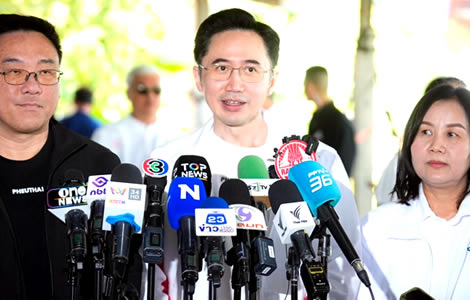
On Sunday in Ayutthaya, Pheu Thai moved decisively to reset the national contest. Yotsanan Wongsawat delivered his first speech on the election hustings. It marked his formal entry as the party’s preferred prime ministerial candidate. From the start, the reaction cut through the usual campaign noise. Importantly, the response was not limited to party supporters. Instead, it travelled quickly across the wider political space.
Almost immediately, polling data reinforced what was seen on the ground. Soon after the speech, a national Suan Dusit Poll confirmed the shift. As a result, Yotsanan emerged as a serious contender, not a placeholder. For Pheu Thai, the timing mattered. For rivals, the signal was unwelcome.
The Suan Dusit Poll was conducted nationwide by Suan Dusit University. It surveyed 2,232 respondents. The fieldwork ran between December 16 and 19, 2025. Both online and in-person methods were used. The question was simple and direct. If an election were held on February 8, 2026, who would voters choose?
Poll results show a fragmented race with no dominant party and tightening margins across all major camps
On party preference, the People’s Party remained in front. It secured 24.55 per cent support. However, Pheu Thai followed closely at 21.62 per cent. Meanwhile, Bhumjaithai stood at 16.04 per cent. Notably, no party approached a commanding lead. Instead, the numbers pointed to a fragmented and fluid race.
More striking were the prime ministerial figures. Nattapong Ruangpanyawut of the People’s Party ranked first with 23.97 per cent. However, Yotsanan Wongsawat followed closely with 21.95 per cent. By contrast, incumbent Prime Minister Anutin Charnvirakul trailed at 16.25 percent. Crucially, Yotsanan outranked the sitting prime minister.
That ordering changed the dynamics. First, it underlined pressure on Anutin. Second, it placed Yotsanan within reach of the frontrunner. In electoral terms, the gap was narrow. Politically, it was explosive.
According to Suan Dusit Poll chair Dr Pornphan Buathong, the People’s Party still leads overall. She said it remains ahead at both party and individual levels. However, she also acknowledged movement among voters. In particular, she pointed to renewed traction for Pheu Thai.
Poll chair flags voter movement as Pheu Thai regains traction as Bhumjaithai declines marginally
She said Pheu Thai’s restructuring has not yet delivered full results. Even so, she noted that rebranding through fresh faces is drawing voters back. Meanwhile, she observed that Bhumjaithai’s popularity has declined. Still, she stressed the gap remains manageable. As a result, she said a turnaround is still possible.
Behind these figures lies a deeper political shift. Since August 2025, voter confidence has been unsettled. First came confusion over the Thai–Cambodian conflict. Then followed reports of grey money circulating within political circles. Together, these issues weakened trust across the spectrum.
Soon after, the People’s Party made a defining move. In early September, it voted to support Anutin as prime minister. That decision surprised many supporters. Moreover, it blurred the line between opposition and government. The consequences have lingered.
Since then, undecided voters have drifted. Importantly, recent polling suggests that drift favours Pheu Thai. Rather than ideology, the movement appears tactical. Voters are reassessing who can realistically hold power. As a result, viability now matters more than branding.
Undecided voters punish the People’s Party as its support softens after September Prime Minister vote
Within this environment, Yotsanan’s emergence became decisive. After Pheu Thai announced its three prime ministerial candidates, his name gained traction rapidly. Notably, the momentum did not originate from party headquarters. Instead, it spread through political conversations and online networks.
Consequently, the effect lifted the party as a whole. Pheu Thai’s numbers began to stabilise. In turn, its narrative shifted from recovery to contention.
Yotsanan’s surname is well known in Thai politics. His family has long-standing national links. That connection is widely recognised. However, it has not defined the current reaction. Instead, he is not widely framed as a political heir.
Rather, he is seen as a figure shaped away from the campaign spotlight. He is associated with policy work and internal governance. For many voters, that distinction matters. After months of turbulence, competence now carries weight.
Yotsanan framed less as a political heir and more as a policy operator shaped outside the spotlight
Observers describe Yotsanan as grounded in process. He is seen as familiar with how decisions move through the state. Moreover, he is viewed as someone who worked for years behind the scenes. By contrast, many rivals are defined by constant exposure.
That contrast was reinforced during his first campaign visit. On December 21, at 9:00 a.m., Yotsanan travelled to Chay Na Subdistrict in Sena District, Ayutthaya. He was joined by party leader Julaphan Amornvivat. Senior executives and prospective candidates attended.
Those present included Anusorn Eiamsa-ard and deputy party leader Chakraphong Saengmanee. Anucha Nakasai was also in attendance. The setting was deliberate and strategic.
Ayutthaya suffers chronic flooding. Parts of the district act as water retention zones. As a result, floodwaters linger for extended periods. Economic damage accumulates over time. Residents live with repeated disruption.
Flood-prone Ayutthaya chosen for first campaign speech on unresolved water and compensation issues
During the meeting, residents spoke directly. One resident described prolonged flooding in the area. Because it is a catchment zone, water from elsewhere flows in. Relief, they said, often arrives late. Compensation, they added, comes only after the waters recede.
Yotsanan responded without theatrical language. First, he said urgent problems cannot be understood from inside meeting rooms. Next, he said policies designed in isolation fail to reflect real suffering. Therefore, he stressed the need to listen before deciding priorities.
The Pheu Thai hopeful then turned to agriculture. Firstly, he said low prices remain unresolved across regions. Secondly, he also cited off-season cropping as a persistent problem. Importantly, he described these issues as structural, not temporary.
As a result, he argued that solutions must be comprehensive. He said domestic measures alone are insufficient. Instead, he said negotiations with trading partners must proceed simultaneously. In his framing, production, pricing, and markets are linked.
Candidate focuses on structure and process, rejecting slogans while linking agriculture, pricing and trade
Turning back to flooding, he called for appropriate compensation. He said water management must be systematic. Moreover, he said solutions must address upstream causes, not just local impacts. He also referred to past mega-projects that were halted.
Those remarks reinforced his positioning. He spoke as an operator rather than a performer. The emphasis remained on mechanisms, not slogans.
Senior figures followed with endorsements. Anucha Nakasai publicly guaranteed Yotsanan’s capability. He urged voters to support him as prime minister. At the same time, the party rolled out policy commitments.
Julaphan Amornvivat announced a policy guaranteeing a 30 per cent profit margin on agricultural products. The pledge targeted long-standing farmer concerns. Importantly, it was framed as a concrete measure, not an abstract promise.
Taken together, the visit marked a shift for Pheu Thai. The party moved beyond damage control. Instead, it entered full contest mode.
Polling pressure forces a three-party contest as People’s Party lead narrows and Pheu Thai momentum builds
The broader polling picture explains why. Although the People’s Party still leads, its margin is narrow. It leads both in party preference and prime ministerial choice. However, its advantage is no longer comfortable.
Moreover, the People’s Party carries unresolved baggage. The September vote for Anutin remains controversial. It exposed tension between leadership strategy and base sentiment. That tension has not disappeared.
Bhumjaithai occupies a different position. Its polling has slipped. Nevertheless, its organisational strength remains intact. It retains resources and reach. Therefore, it cannot be discounted.
As a result, the race has become clearly three-sided. Each party occupies a distinct lane. The People’s Party holds first place but faces scrutiny. Pheu Thai is regaining momentum through a new figure. Meanwhile, Bhumjaithai remains competitive under pressure.
Social mood shifts quietly as leadership misjudgements erode trust and surface-level reforms fail to convince
Dr Pornphan described the balance clearly. One side holds confidence and numbers. Another gains traction from freshness. A third retains material advantage. None, she suggested, can afford complacency.
Beyond the numbers, social mood plays a growing role. Observers note that recent movement is not driven by parliamentary manoeuvres. Instead, it reflects shifts in public sentiment. That sentiment has moved quietly, but decisively.
Earlier misjudgements weakened Pheu Thai’s standing. Leadership decisions escalated into nationalist and security issues. Consequently, the party’s long-held aura of inevitability cracked.
Attempts to refresh followed. Leadership changed. The executive committee was reshaped to appear younger. However, trust did not fully return. Many voters saw surface change without core reform.
Yotsanan’s profile reframes Pheu Thai as voters respond to governance familiarity rather than lineage
Yotsanan altered that perception. His emergence triggered an emotional shift. His name carried different signals. It suggested distance from factional politics. It also suggested familiarity with governance.
Importantly, he is not framed as a generational mascot. Instead, he is framed as someone shaped by a different political rhythm. In that rhythm, leaders must explain decisions and face questions.
That framing has gained traction. It also reflects broader fatigue. Voters are weary of politics built solely on families and personalities. Increasingly, they look for ability and clarity.
Poll shows there’s still a chance for a Pheu Thai People’s Party coalition but it will take a bit of luck
Pheu Thai presents new Prime Ministerial nominee as the party aims to reset and win back voters to the fold
For Pheu Thai, the moment cuts both ways. Yotsanan’s rise offers a chance to reset the party’s image. At the same time, it carries a warning. Voters do not want a new face defending old habits.
With a projected election date of February 8, 2026, the timeline is tightening. Polling shows movement rather than settlement. Power is now in play.
Yotsanan’s first step onto the campaign stage has altered the geometry of the race. He is no longer a background figure. He is now a measurable contender. Thai politics has entered a sharper phase, and the contest is fully open.
Join the Thai News forum, follow Thai Examiner on Facebook here
Receive all our stories as they come out on Telegram here
Follow Thai Examiner here
Further reading:
People’s Party on campaign but on guard against potential legal complaints to oversight agencies
Wealthy young People’s Party leader aims to create a technology-driven and efficient welfare state