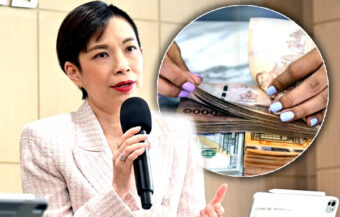
Thailand on the brink: growth set to crash below 2% as debt soars, tourism slumps and the baht surges. Analysts warn 2026 could bring the weakest economy in 30 years, leaving Thailand trailing its neighbours and businesses fearing the worst.
On Tuesday, Poj Aramwattananon of the Joint Standing Committee on Commerce, Industry and Banking (JSCCIB) warned that Thailand faces its worst economic performance in two decades in 2026. The body highlighted deep-rooted structural problems that continue to choke growth and forecast GDP of just 1.5% this year and only 2% in 2025. Soon after, leading academic and business figure Mr. Somphop Manarangsarn, President of Panyapiwat Institute of Management, warned that Thailand is on course to lose its position as Southeast Asia’s second-largest economy to Vietnam. He said the shift is already eroding development and much-needed Foreign Direct Investment (FDI).

Thailand is entering 2026 under mounting pressure. Certainly, the country faces structural and cyclical challenges that continue to weigh on confidence, growth, and investment. Moreover, officials and analysts warn that growth could fall below 2% this year. That would mark the weakest expansion in three decades outside crisis periods. It would also place Thailand at the bottom of the regional growth table.
The problems are not new. In particular, Thailand’s population is ageing and beginning to decline. Meanwhile, household debt remains elevated and limits spending and borrowing. Business leaders warn that the country lacks competitiveness in key industries.
Meanwhile, the baht has appreciated, hurting exporters. Tourism, once the main growth engine, has weakened. At the same time, geopolitical and trade tensions continue to grow.
Thailand faces its weakest growth in three decades as debt stagnates and competitiveness falls
The Joint Standing Committee on Commerce, Industry and Banking, or JSCCIB, issued its latest assessment this week. Accordingly, it warned that GDP growth in 2026 is expected to be below 2%, most likely around 1.5%.
The group said this would be the lowest level in 30 years outside exceptional crisis years. It also said Thailand would post the weakest growth rate in the region.
The JSCCIB cited several risk factors. These include high household debt, a large informal economy, weak competitiveness, and ongoing fiscal constraints. In addition, the committee said regulatory burdens and fragmented data systems also hold back economic efficiency. It noted that previous disasters and delays to budget processes continue to weigh on activity. It also pointed to cybercrime and illicit capital flows as additional concerns.
Currency strength has become another source of strain. Specifically, the baht appreciated by 8.2% last year, the second strongest gain in the region. The JSCCIB warned that the stronger currency acts like an added tariff on exports. Therefore, it said this trend was eroding competitiveness and pressuring margins for exporters.
Pundits warnthat a stronger baht and rising geopolitical risk could further weaken sentiment
Committee chairman Poj Aramwattananon urged regulators to keep a close watch on exchange rate movements. “I would like the relevant regulatory agencies to monitor the movement of currency exchange rates that appreciate in line with gold prices, and the role of digital asset trading in Thailand on the Thai baht,” he said.
The committee said the global economic outlook remains uncertain. In particular, it cited widening geopolitical tensions and rising polarisation. As a result, it expects world growth to slow. It also warned that the impact of US tariffs will increasingly weigh on Thai exports. It said exports excluding electronics are already contracting.
Even so, the group said it supports government efforts to restructure the economy and resolve debt problems. It called for greater integration of the informal economy into the formal financial system.
It also stressed the need to reduce obstacles to new investment. Finally, the JSCCIB said action against corruption and illegal activities would help restore confidence and reduce hidden business costs.
Thailand’s economy remains exposed as tourism weakens and higher US tariffs hit exporters
Meanwhile, Thailand remains exposed to shifting global trade patterns. The country earlier benefited from advance orders by US importers reacting to American tariffs. However, that temporary boost faded last year.
Higher tariffs in the US market now pose new risks. At the same time, political tensions in the region remain a concern. There are fears of renewed hostilities along the Thai–Cambodian border. Thailand has yet to conclude a trade agreement with the United States.
Tourism has weakened sharply. Foreign arrivals fell by 7.23% last year. Officials had expected growth of around 10%. Consequently, the decline removed one of the country’s most important growth pillars.
Structural weaknesses extend into the financial system. Household debt remains high and continues to restrain loan growth. The household debt-to-GDP ratio stood at 86.8% in the second quarter of 2025. Therefore, bank executives warn that this limits borrowers’ ability to access credit. They expect 2026 to remain a challenging year.
Bankers warn that fear itself could deepen Thailand’s slowdown as homes and firms hold back
Siam Commercial Bank chief executive Kris Chantanotoke said growth will remain subdued and fragile. SCB’s research arm expects GDP to expand by only 1.5% in 2026. That forecast matches the Bank of Thailand’s projection. “This pace reflects growth below potential and heightened economic fragility. As a result, 2026 will be another challenging year,” he said.
Mr Kris said both external and domestic pressures are weighing on sentiment. These include trade tensions, weaker global demand, household debt and political uncertainty. He warned that fear itself risks amplifying economic weakness. “The most dangerous risk may not be the economic fundamentals themselves, but a climate of fear that could trigger a self-fulfilling prophecy,” he said.
Despite the difficult outlook, SCB still plans targeted loan growth. The bank will focus on corporate lending, mortgages and auto loans. It aims to expand while preserving asset quality and limiting bad debt. It also plans to support government debt-resolution schemes for vulnerable borrowers.
Bangkok Bank president Chartsiri Sophonpanich also expects growth below 2% this year. Therefore, he said the bank will focus on helping customers adapt to a weak environment. “Under this scenario, the bank needs to work at full capacity to help clients adapt to a changing environment,” he said. He added that banks must now provide broader support beyond lending alone.
Banks say reforms are vital as inflation stays low and Vietnam’s younger economy gains ground
Both banks said they expect manageable levels of non-performing loans in 2026. Moreover, they also expressed support for structural reforms to improve competitiveness and attract investment. The central bank has already cut interest rates to support growth. Commercial banks have followed with lower lending rates.
Inflation remains subdued. Headline inflation was negative 0.28% in December. Meanwhile, core inflation stood at 0.59%. The Bank of Thailand said the economy continues to face challenges, including declining competitiveness and weaker exports due to US tariffs.
Academics warn that Thailand also faces increasing competitive pressure from Vietnam. Vietnam’s population is larger and younger. Its economy remains in a rapid expansion phase. Analysts say Vietnam is improving its infrastructure, reforming its economy and opening further to trade and investment.
Somphop Manarangsarn, President of Panyapiwat Institute of Management, said Thailand can no longer rely on its old development model. He said Vietnam is using a similar manufacturing-led strategy but with lower costs and stronger demographics. As a result, he warned that Vietnam could soon overtake Thailand’s economy if current trends continue. He also said this would undermine Thailand’s efforts to attract foreign direct investment.
Vietnam’s younger and larger workforce reshapes Southeast Asia’s landscape as Thailand slows
Vietnam’s population is estimated at more than 101 million. By contrast, Thailand’s population is between 66 and 71 million and has begun to decline. Thailand is more urbanised, but Vietnam benefits from a larger labour force and a younger demographic profile. Therefore, academics say this gives Vietnam more potential for long-term growth.
Mr Somphop said Thailand should expand its service sector. He said the country has strong capabilities in healthcare, food, entertainment, tourism and retail. Thus, he argued that services could become a main engine of growth while still linking to manufacturing and agriculture.
At the same time, Thailand faces growing geopolitical risk. Analysts point to wider global polarisation and trade realignment. Business leaders warn that Thailand must adapt to rapid changes. Accordingly, the JSCCIB said new uncertainty is emerging from global interventions and shifting alliances.
Reform momentum continues but Thailand still faces slowing growth and rising competition
The committee said that despite the challenges, reform efforts continue. It expressed hope that the government will strengthen fiscal discipline and tax structures. It also urged stronger cooperation between the state and the private sector.
Banks and businesses agree that investment remains essential. They say both public and private investment will be needed to stabilise growth. In addition, they also stress the need to remove barriers to high-potential industries.
For now, the macroeconomic picture remains weak. Growth is slowing. Tourism has contracted. Exporters face stronger currency pressures and higher tariffs. Inflation is subdued. Household debt is high. The population is ageing. Businesses remain cautious. Banks expect only modest loan growth while prioritising stability.
Political parties are getting serious about Thailand’s lack of babies problem with new policies unveiled
Rates cut to 1.25% as damaged economy limps on to the end of 2025 with even stiffer headwinds ahead
Crisis for Thailand as baht rockets in value putting exports and foreign tourism under further pressure
Officials and analysts describe 2026 as a turning point. They say Thailand must accelerate restructuring to remain competitive. Without adjustment, they warn that the economy risks continued under-performance. However, with reform, they say Thailand can still stabilise and rebuild momentum.
What remains clear is that Thailand enters 2026 facing multiple constraints. Growth is slowing. Risk is rising. Competitors are advancing. Policymakers continue to weigh responses as the country navigates one of its most difficult economic environments in decades.
Join the Thai News forum, follow Thai Examiner on Facebook here
Receive all our stories as they come out on Telegram here
Follow Thai Examiner here
Further reading:
Thailand’s days of GDP growth in excess of 5% may be a thing of the past as it has grown too old
Cabinet in pension move as the number of working Thais to over 60s is set to half in 20 years
Thailand’s new move to boost the birth rate and fight the negative impact of an ageing population
Denmark and Thailand seek economic partnership and face the same challenge – demographics
Thailand’s new move to boost the birth rate and fight the negative impact of an ageing population