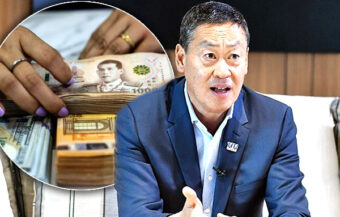
Senator demands probe as Thai baht jumps 9% despite weak economy. Crypto market trades over ฿100bn monthly, raising laundering fears. Agencies and Bitkub summoned to Parliament as strong currency squeezes exports and tourism while deficits deepen.
A Thai senator is demanding answers on the relentless rise of the Thai baht against the US dollar. Dr. Premsak Piayura insists government and regulatory agencies must act to understand and control the surge without delay. The warning comes as Thai exports and the vital tourism industry are being hit hard by a currency climbing above regional peers and competitors.

A leading senator is demanding answers about the Thai baht’s unusual strength. The currency rose nine percent against the US dollar in 2025. However, the rise occurred during a period of weak domestic growth. Thailand’s economy remained stagnant with long-standing structural problems. Nevertheless, the baht stayed elevated throughout the year.
Analysts point to Thailand’s strong external reserves. Yet, the country recorded a projected trade deficit of $3.87 billion from January to October 2025. In addition, November produced another deficit of $2.769 billion. These figures normally weaken a currency. Despite this, the baht continued to appreciate.
One explanation involved the price of gold. The gold-to-baht value showed a correlation of 0.8 to 0.88. Consequently, capital linked to bullion appeared to support the currency. However, Senator Dr. Premsak Piayura has identified a second factor. He pointed to heavy trading in cryptocurrency markets.
Heavy USDT trading over 100 billion baht monthly prompts Senate hearing on baht strength and data gaps
More than ฿100 billion is traded monthly on local exchanges. Moreover, the dollar-linked USDT coin dominates this activity. Official data show USDT accounted for 52 per cent of traded funds. Bitcoin represented only 19 per cent of turnover. Therefore, stablecoins outweighed volatile assets in Thailand.
Dr. Premsak submitted a motion to the Senate Committee on Economics, Finance, and Fiscal Affairs. The request went to Chairman Senator Kampol Supapang. Subsequently, the chairman agreed to examine the issue. A formal hearing was set for January 20, 2026. The meeting will take place at Parliament.
The committee summoned several agencies to testify. These include the Bank of Thailand and the SEC. In addition, the Anti-Money Laundering Office (AMLO) and Bitkub Online Company were called. Bitkub is the country’s largest cryptocurrency exchange. Dr. Premsak will attend as the proposer.
Academics earlier questioned gaps in official information. The Bank of Thailand lacked detailed figures on digital trading. Meanwhile, the SEC reported monthly volumes above by ฿100 billion. Trading patterns looked abnormal to specialists. For example, highly volatile coins held a small share.
SEC figures show USDT dominance while markets fear platforms used for illicit money flows concerns
SEC data from November 2025 confirmed the imbalance. USDT recorded the highest trading volume by far. In contrast, Bitcoin’s share remained below one-fifth. Market observers said this structure was unusual. As a result, concerns grew inside capital markets.
Some participants believe platforms could be used for illicit flows. Funds may be converted into USDT and then into baht. Afterwards, the baht can be transferred abroad quickly. Dr. Premsak warned that this route may move large sums.
He said the origin of these funds remained unclear. Consequently, the inflows may have distorted the exchange rate. Calls for urgent central bank action increased. Therefore, proposals for strict reporting systems emerged.
The Bank of Thailand recently introduced new rules. They cover cash or foreign funds used to buy baht or gold. However, it is unclear if the rules cover cryptocurrencies. The SEC is believed to maintain separate controls.
Strong baht raises costs above Vietnam, Malaysia and Japan, hitting exports, tourism and farmers
Dr. Premsak stressed the broader economic impact. A strong baht raises Thailand’s costs against Vietnam and Malaysia. Moreover, Japan is becoming more competitive in exports. Key sectors feel direct pressure. For instance, tourism faces higher prices for visitors.
Exporters report tighter margins in global markets. Farmers receive lower returns in baht terms. At the same time, hotel operators struggle with regional rivals. These industries form the core of national income.
The senator argued that the currency issue needs a coordinated policy. Therefore, the committee will seek explanations from all agencies. Officials must clarify how digital trading affects rates. The inquiry follows months of debate.
Academics repeatedly challenged the lack of central bank data. Meanwhile, the SEC’s statistics showed explosive growth. Lawmakers now want a unified picture of capital movements. The hearing aims to close the information gap.
Bitkub, Central Bank, SEC and AMLO to face senators on oversight of massive crypto turnover impact probe
Bitkub’s role appearance will be extremely useful. The exchange processes a dominant share of domestic trades. The firm also has a deep understanding of the market. In addition, senators will question compliance systems which are overseen by the Securities and Exchange Commission. AMLO will outline anti-money laundering safeguards.
The Bank of Thailand must explain its oversight framework. Furthermore, it will be asked how it tracks crypto inflows. The SEC will present turnover records. Legislators seek reasons for unusual patterns.
Dr. Premsak highlighted the sheer scale of activity. Monthly volumes rival parts of traditional finance. Therefore, such levels can influence the baht market. The committee wants to measure this effect.
The investigation begins as Thailand faces a difficult 2026. Growth forecasts remain fragile after years of slowdown. Consequently, policymakers view the high baht as a major threat. Export and tourism revenues are already strained.
Committee seeks factual clarity on digital assets regulation and financial stability risks oversight
Senator Kampol said the matter affects financial stability. Thus, the committee will pursue factual clarification only. No conclusions have been reached in advance. Witnesses must first provide complete records.
The debate mirrors global concerns about digital assets. Stablecoins like USDT expanded rapidly in Thailand. However, regulation has lagged behind market growth. Clear rules are seen as necessary for transparency.
Dr. Premsak noted that many countries require strict reporting. Therefore, he urged Thailand to adopt similar standards. The goal is to protect the payment system from abuse. The senator linked this to the currency surge.
Lawmakers will examine coordination between agencies. In particular, overlapping duties may have caused blind spots. The committee seeks a single monitoring framework. Recommendations will follow the hearings.
Uncertainty over the baht persists as the Senate prepares to hear evidence on January 20th
Until then, uncertainty surrounds the baht’s direction. Markets continue to track daily movements. Meanwhile, the central bank has not explained the appreciation. Attention focuses on testimony scheduled for January 20.
The senator repeated that the motion seeks facts only. Accordingly, the process will rely on official evidence. The committee will not assume wrongdoing beforehand. Findings will be released after questioning ends.
The strong baht remains a pressing economic concern. Businesses complain of rising operating costs. Moreover, competitors in the region benefit from weaker currencies. Pressure on the government is rising.
The Senate inquiry marks the first formal review of the issue. Therefore, agencies are expected to present detailed data on digital flows. The outcome could help reshape financial supervision.
Call for urgent clarity as Senate aims to deliver conclusions guiding national regulation in 2026
Dr. Premsak concluded that clarity cannot wait. Otherwise, policy planning may be undermined. The committee intends to deliver concrete conclusions. These results will guide regulation in 2026.
The coming hearing will test Thailand’s oversight system. Meanwhile, traders continue heavy activity in USDT. Monthly turnover remains above ฿100 billion. The baht stays near multi-year highs.
One of Thailand’s top business entrepreneurs calls for a halt to the economic rot and a new digital age
Crisis for Thailand as baht rockets in value putting exports and foreign tourism under further pressure
Officials must now explain the contradiction. Certainly, it is striking that large deficits coexist with a strong currency. The Senate wants to know and understand why. Some answers may emerge later in Parliament this week.
Join the Thai News forum, follow Thai Examiner on Facebook here
Receive all our stories as they come out on Telegram here
Follow Thai Examiner here
Further reading:
Rates cut to 1.25% as damaged economy limps on to the end of 2025 with even stiffer headwinds ahead
Ex Energy Minister supports oil and arms supplies blockade against Cambodia in the Gulf of Thailand
War to continue says PM Anutin. Dismisses President Trump’s ceasefire talk as a ‘misunderstanding’
Confusion after Trump’s 20 minute phone call with PM Anutin. US side claimed a ceasefire was agreed