NACC hits 44 ex-Move Forward MPs with Supreme Court charges over Article 112 push. Massive case file lands as top People’s Party figures face bans. First, a long legal battle is expected, but top Thai political stars are likely to be removed.
The Secretary-General of the National Anti-Corruption Commission (NACC) will finally move against 44 former Move Forward Party MPs on Thursday. It comes as the government delivers its policy statement to parliament. The case, tied to efforts to amend the lèse-majesté provisions of the Criminal Code, is expected to result in the 44 individuals being banned from politics for at least 10 years. Crucially, three top People’s Party MPs are among them. Leader Nattapong Ruangpanyawut and star performers Sirikanya Tansakul and Rangsiman Rome face removal.
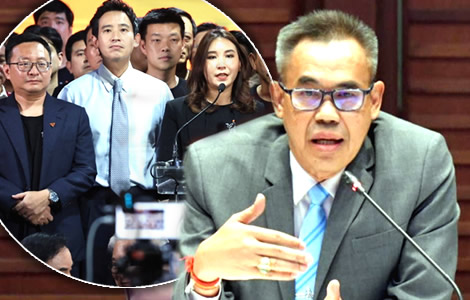
The Secretary-General of the National Anti-Corruption Commission will file charges against 44 former MPs on Thursday at the Supreme Court. The submission is scheduled for 9:00 AM. The case targets former members of the Move Forward Party and centres on alleged serious ethical violations.
Specifically, the charges relate to efforts in 2022 and 2023 to amend Article 112 of the Criminal Code. This provision, widely known as the lèse-majesté law, remains central to the case. The law prohibits criticism or acts against Thailand’s monarchy.
The former Move Forward Party moved to water down its provisions and limit its application. They argued the provisions were weaponised by conservative groups to stymie political commentary. Therefore, the proceedings focus on legislative conduct tied directly to that amendment effort.
Filing advances after long delay with extensive evidence compiled and submitted to Supreme Court
The filing follows a long administrative process that moved slowly through official channels. However, officials now confirm that all required documentation is complete. The submission includes 56 sets of complaint documents prepared for court review.
In total, the case file spans nearly 100,000 pages. Moreover, the documents are packed into almost 200 boxes. These materials will be transported in three vans to the court. Consequently, the scale of the operation reflects the breadth of the investigation. Coordination with court officials has already taken place to ensure compliance with procedure.
The Secretary-General, Surapong Intanathaworn, confirmed the timeline on April 8. He stated that the documents had been thoroughly reviewed. Furthermore, he described them as complete and accurate. He assigned Pattanapong Chanpetchapool to submit the complaint. Accordingly, the assistant will deliver the materials directly to the Supreme Court. Court officials will first verify the documents before accepting the case. Only after this verification will the case formally proceed.
However, the National Anti-Corruption Commission has rejected suggestions of political timing. The filing coincides with a government policy statement on the same day. Nevertheless, officials insist that this overlap is incidental. The policy statement will be delivered by the Bhumjaithai Party-led government.
Commission rejects political timing claims as filing coincides with government policy address day
Even so, the commission maintains that its actions are procedural. It states clearly that the government’s agenda is unrelated to its legal process. Therefore, it frames the submission as a routine step within its mandate.
At this stage, the Supreme Court has issued no ruling on the matter. Instead, the court must first establish an investigative panel. This panel will review the submitted evidence in detail. Subsequently, it will assess whether the case file is complete and accurate. It may also consider whether to proceed with formal charges.
In addition, the panel could recommend interim measures against the accused. For example, it may consider ordering them to cease performing duties. However, no timeline has been provided for such decisions. As a result, the process remains open-ended.
The 44 accused are all former MPs of the Move Forward Party. However, some have since joined the People’s Party. At present, only 10 remain MPs under that party. Nevertheless, these include several prominent parliamentary figures.
Key People’s Party figures among the accused as court review begins, with an uncertain timeline ahead
Among them are Rangsiman Rome and Sirikanya Tansakul. In addition, the party’s leader, Nattapong Ruangpanyawut, is also among the group. These individuals have maintained visible roles in parliamentary proceedings. Consequently, their involvement increases the significance of the case.
The charges stem directly from legislative actions taken during their tenure. Specifically, they relate to signing or supporting amendments to Article 112. These efforts formed a key part of the party’s policy platform at the time.
Previously, the Constitutional Court issued a decisive ruling on related conduct. In that judgment, it dissolved the Move Forward Party. It also banned its executive members from political activity. The ruling cited the same amendment efforts as grounds for action. Therefore, this precedent now frames expectations surrounding the current proceedings.
Reports indicate that the People’s Party will contest the charges through legal channels. It is expected to challenge the case before the court. However, similar legal efforts by progressive groups have previously failed. Despite these planned challenges, earlier rulings by the court on the issue suggest that 44 former MPs are doomed. They will be banned from politics. Even so, the current case will proceed independently under Supreme Court review.
Court process unfolds in stages, as opposition impact and parliamentary balance are expected to shift
The legal process will now move through several stages. First, the court will complete its initial verification of documents. It must then decide whether to take up the case. After that, it will establish a procedural schedule.
This schedule will include hearings, evidence review, and witness testimony. Eventually, the court will issue a final judgment. However, no timeframe has been announced for these steps. Therefore, the duration of the case remains uncertain.
Meanwhile, the potential parliamentary impact is drawing attention. The loss of these MPs could weaken the opposition in the House of Representatives. Many of the accused are regarded as experienced performers in debate and oversight. Consequently, their absence may alter the performance of this new House of Representatives. The contributions of both Rangsiman Rome MP and Sirikanya Tansakul in the last House of Representatives were highly significant.
Kla Tham Party poised to expand role as opposition weakens and political landscape is altered
Attention is now shifting to other opposition groups. The Kla Tham Party is expected to take on a more active role. The party is led by Thamanat Prompow, a former deputy prime minister.
The Kla Tham Party has previously demonstrated effectiveness in parliamentary scrutiny. For instance, it played a role in holding the government to account during the energy crisis. Therefore, it may expand its presence if gaps emerge in the opposition ranks. This shift would follow the potential loss of key figures from the current opposition bloc.
Critics have pointed to broader political effects linked to such cases. They cite a continued erosion of experienced figures from the progressive movement. This trend has been driven by legal rulings and political bans. As a result, the movement’s parliamentary strength has declined. Some also reference the February general election outcome.
The People’s Party lost support during that contest. Observers have attributed this to leadership decisions and campaign performance. Specifically, they cite difficulties in mobilising voter support on the ground.
Case enters judicial phase with no ruling yet as political impact looms over opposition ranks
Nevertheless, the current case remains focused on legal questions. The charges concern ethical conduct tied to legislative actions. The National Anti-Corruption Commission maintains that its work follows established procedures. It emphasises the completeness and accuracy of its case file. Furthermore, it highlights coordination with court officials as part of the process.
April 9 marks the formal submission of the complaint to the Supreme Court. From that point, judicial review of the submission will begin. The formation of an investigative panel will guide the next steps. Its findings will determine whether the case proceeds further.
People’s Party leader Teng concedes defeat. Accepts poll results. Confirms no support for Anutin as PM
Cobras emerge from the Pheu Thai ranks as Anutin’s PM bid faces harsh scrutiny from People’s Party MPs
No preliminary ruling has been issued at this stage. Therefore, all outcomes remain pending. The case now enters the court system for formal consideration. Therefore, in terms of immediate political impact, three of the main opposition party’s star performers will find themselves operating in parliament with a sword over their heads.
The case is widely seen as a final move in a process which has seen the establishment of the Bhumjaithai Party, linked with powerful local interests, come to power in Thailand. It is undoubtedly a shift away from radical, progressive politics in the kingdom.
Join the Thai News forum, follow Thai Examiner on Facebook here
Receive all our stories as they come out on Telegram here
Follow Thai Examiner here
Further reading:
Thailand voted. Now to see if the people of kingdom have voted for big change or a conservative path
Bank of Thailand Governor orders monitoring of cash withdrawals amid widespread vote buying fears