Thailand to cut visa-free stays to 30 days, targets short-stay genuine foreign tourists while rolling out new fees and mandatory insurance as arrivals fall. The government shifts to high-spending tourists while tightening rules amid rising crime concerns.
Tourism Minister Surasak Phanjaroenworakul on Friday outlined a tougher visa regime for foreign tourists. He confirmed the government will curb long-stay visitors seeking residency or small business activity. He also backed a Tourism Authority of Thailand shift away from arrival targets in 2026, as numbers are expected to fall. Instead, the state will raise airport charges, introduce an arrivals tax, and require mandatory travel insurance. He added that 89% of tourists stay just 1–3 days. The policy marks a sharp break from the more open approach under the governments of Srettha Thavisin and Prayut Chan-o-cha. The aim is clear. The government aims to sever the link between tourism and long-term stay residents.
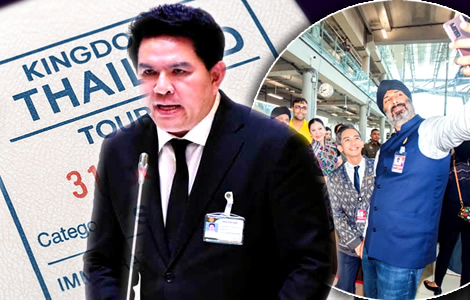
New Tourism and Sports Minister Surasak confirmed a major visa policy shift on Friday during a parliamentary session in Bangkok. The announcement came during a government policy debate in the House of Representatives.
At 4:15 pm, a joint sitting convened to review the Cabinet’s policy statement. During this session, the minister outlined sweeping changes to tourism and sports policy. Most notably, he confirmed that the government will abolish the 60-day visa waiver for tourists from 93 countries.
Instead, the permitted stay will be reduced to 30 days. This decision follows a review by the Visa Policy Committee. That review examined actual travel behaviour among foreign visitors. As a result, officials concluded the current allowance exceeds real demand. Therefore, the government will align visa policy with observed travel patterns.
Government moves to cut visa-free stays to 30 days after review shows tourists stay far shorter on average
Accordingly, Surasak told MPs that the average tourist remains in Thailand for nine days. Furthermore, he said most visitors stay only briefly. Specifically, 89% of tourists spend between one and three days in the kingdom.
In addition, the longest recorded average stay reached just 21 days. Therefore, the 60-day allowance does not reflect actual behaviour. Consequently, the proposed reduction is not expected to affect most visitors.
At the same time, the data indicates a decline in long-stay tourism. This trend challenges previous assumptions about foreign visitors. Moreover, it confirms that long-haul, long-duration travel is decreasing. As a result, policymakers are shifting focus toward shorter, higher-value visits.
However, the minister also raised concerns about extended stays. He said some foreign visitors remain beyond typical tourism activity. In some cases, they establish businesses while holding tourist status. As a result, authorities view prolonged stays as a regulatory concern.
Authorities warn long-stay visitors blur tourism lines and raise concerns over work and residency status
Surasak stated that such cases blur the distinction between tourism and residency. Therefore, reducing the visa period aims to address this issue. In addition, he said some groups take employment opportunities from Thai nationals. Consequently, the policy aims to reinforce legal boundaries. At the same time, longer stays will still be available under specific visa categories.
In addition, Surasak cited rising criminal activity linked to visa misuse.
It comes as security sources suggest scam operations involving foreign nationals have increased. Notably, these developments follow enforcement crackdowns in neighbouring countries. Specifically, he referred to actions in Myanmar and Cambodia. As a result, some criminal networks have shifted into Thailand.
Consequently, authorities have observed increased activity inside the kingdom. Moreover, police sources said criminal organisations exploit flexible visa rules. They enter and leave Thailand repeatedly with minimal restriction. Therefore, the system creates enforcement vulnerabilities.
Criminal groups exploit visa loopholes and shift operations into Thailand as crackdowns intensify
In addition, it must be noted that some groups bypass formal immigration channels entirely. These include networks linked to African and Nigerian cartels. According to recent case files, many of these rogue operators cross borders without passport checks.
This activity occurs through land borders with neighbouring states. In particular, sources identify Malaysia and Laos as key routes. Furthermore, similar patterns persist along the border with Cambodia. As a result, the government views visa reform as part of a broader security response. At the same time, enforcement and monitoring will be strengthened.
Meanwhile, the policy shift comes during a downturn in tourism. Data from the Tourism Authority of Thailand shows declining arrivals in early 2026. Specifically, 9.31 million tourists visited between January and March. By comparison, 9.55 million arrived during the same period in 2025. Therefore, arrivals fell by 2.51% year-on-year.
The decline reflects global economic pressures and geopolitical uncertainty. In particular, rising living costs and fuel prices have reduced travel demand. Consequently, outbound tourism from key markets has weakened. As a result, Thailand’s tourism sector faces sustained pressure.
Tourism downturn deepens as arrivals fall and global pressures hit travel demand and key markets
Accordingly, the Tourism Authority of Thailand has revised its annual forecast. It now expects between 30 and 34 million visitors in 2026. This represents an 18% reduction from earlier projections.
Indeed, some industry experts have projected foreign tourist arrivals to plunge in 2026 to 28 million arrivals. This is in contrast to 33 million in 2025. In short, the industry has been decimated by yet another world crisis.
On Friday, Minister Surasak highlighted the new Tourism Authority of Thailand (TAT) approach. At length, the agency has adopted a “Value over Volume” strategy. This approach prioritises revenue rather than total arrivals.
Therefore, the focus shifts to higher-spending visitors. Similarly, Surasak confirmed this policy direction in parliament. He stated that future policy will emphasise income generation. Notably, visitor numbers will no longer be the primary metric.
Shift to value over volume as government prioritises tourism revenue over total visitor numbers
At the same time, the minister outlined structural reforms within his ministry. Tourism functions will be aligned more closely with cultural policy. Meanwhile, sports administration will be separated into a dedicated ministry.
He stated that tourism and culture are closely connected. Therefore, integration will strengthen Thailand’s appeal. In contrast, sports development requires a distinct institutional framework. As a result, a new Ministry of Sports will be established. This change aims to improve governance and direction. Moreover, it is expected to support professional athlete development.
In addition, Surasak addressed infrastructure challenges in the sports sector. He noted that several stadiums remain unused or underutilised. Therefore, the government will move to restore these facilities. To achieve this, a joint committee will be established. It will address budget constraints and administrative barriers.
Previously, such issues had delayed progress. At the same time, the minister stressed the importance of cost-effectiveness. Hosting major sporting events will be reviewed carefully. If projects are not viable, they will be reconsidered.
Tourism funding shifts to communities while domestic travel and transport upgrades take priority
Meanwhile, the government is also adjusting tourism funding mechanisms. Resources will be allocated based on visitor volume in specific areas. As a result, communities with high tourist numbers will receive greater support.
Furthermore, this policy aims to distribute income more effectively. Local communities are expected to benefit directly. At the same time, safety measures will be enhanced. These steps are intended to build confidence among visitors.
In addition, domestic tourism remains a key priority. The government plans to promote travel within the country. Specifically, it will develop secondary cities and improve access. Moreover, mass transit systems will play a central role.
Rail networks and shared transport services will be expanded. Consequently, travel costs are expected to decrease. In the current economic climate, this approach addresses rising living costs. Therefore, domestic tourism is seen as a stabilising factor.
Rising unpaid medical bills push plan for mandatory insurance as hospitals absorb foreign patient costs
However, healthcare costs linked to tourism remain a concern. Authorities report rising unpaid medical bills from foreign patients. According to the Ministry of Public Health, these exceed 100 million baht annually.
Major tourist destinations are most affected. Hospitals must provide emergency care regardless of payment. As a result, they absorb significant financial losses.
For example, a hospital in Phuket reports losses of around 10 million baht each year. These costs stem from uninsured foreign patients. In many cases, accidents involve inexperienced motorcycle use. Additionally, alcohol and drug consumption contribute to incidents.
Therefore, authorities are seeking preventative measures. As a result, the government plans to introduce mandatory insurance for foreign tourists. This policy would require coverage before entry. It aims to reduce financial strain on public hospitals.
Currently, travel insurance remains relatively inexpensive. A two-week policy costs about 1,100 baht. Coverage typically ranges from 3.6 million to 9 million baht. However, many travellers still arrive uninsured. Consequently, unpaid medical costs continue to rise.
New entry fees and higher airport taxes planned as Thailand targets revenue over visitor numbers
Meanwhile, the government is still reviewing an entry fee for tourists. A proposed charge of 300 baht remains under cabinet review. This fee would apply to air arrivals. Importantly, it will not be linked to insurance coverage. Instead, it will fund tourism infrastructure development.
These funds will support safety and service improvements. In addition, airport charges are set to increase. Departure tax will rise from 730 baht to 1,120 baht. This represents a 53% increase.
At the same time, global conditions continue to affect tourism flows. Key markets have not fully recovered. In particular, China remains below previous levels.
Nevertheless, China remains the largest source of visitors. Other major markets include Malaysia, Russia, India, and South Korea. Therefore, Thailand is diversifying its target regions. Specifically, ASEAN, Europe, and the Middle East are expected to play larger roles. Increased flight capacity will support this strategy. Promotional campaigns are also being expanded.
Government tightens visa rules and shifts strategy as Thailand moves away from mass tourism model
Furthermore, the government continues to promote year-round tourism. This includes initiatives to attract visitors across all seasons. As a result, Thailand aims to maintain consistent demand.
In parallel, policies are being developed to support local communities. Funding allocation will be linked to visitor distribution. Consequently, income generation at the local level will be prioritised.
At the same time, enforcement and monitoring will be strengthened. Authorities will track entry and exit patterns more closely. This will support efforts to prevent visa misuse.
In addition, all visa-free countries will be reviewed. Eligibility criteria will be reassessed based on compliance and travel patterns. Therefore, future access may change.
Moreover, the government is coordinating with the Ministry of Foreign Affairs. This includes reviewing long-stay visa categories. Some visas currently allow stays of up to 180 days. However, access to these visas may be adjusted.
The focus will remain on attracting higher-value visitors. Consequently, policy decisions will reflect economic priorities.
Hardline shift under anutin marks break from previous pro-foreigner policies and crackdown intensifies
Finally, Surasak confirmed that reforms will be implemented in stages. The transition will be gradual and data-driven. Therefore, further adjustments are expected in the coming months. Overall, the policy framework combines visa reform, economic strategy, and enforcement measures. It reflects changing conditions in global tourism.
Nonetheless, the government has signalled a clear and immediate shift in direction. It appears to have discarded any effort to achieve foreign tourist volume in 2026. In contrast, it is tightening the visa framework and raising the entry requirements for foreign tourists with new charges and mandatory insurance.
Visa entry period to go from 60 to 30 days. Agreement in principle as foreign tourism numbers fall by 10%
Projected arrivals in Thailand down 18% for January 2026 as foreign tourism gets off to an extremely rocky start
Higher return fares to Thailand after 53% Airport Tax rise ok’d by panel chaired by Transport Minister
Certainly, this has been the approach since Prime Minister Anutin Charnvirakul became Prime Minister in September 2025. After that, a rigorous campaign against foreign small business operators in southern provinces was launched. This campaign continues as the government moves to tighten nominee shareholder loopholes while simultaneously pursuing prosecutions of foreign entrepreneurs and seizing business assets.
Many of those targeted in the crackdowns have been European and Israeli entrepreneurs.
The emerging policy is in stark contrast to the more open visa policy introduced by the government of Srettha Thavisin in 2024, and even efforts by the former government of Prayut Chan-o-cha to encourage foreigners to come and live in Thailand.
Join the Thai News forum, follow Thai Examiner on Facebook here
Receive all our stories as they come out on Telegram here
Follow Thai Examiner here
Further reading:
60-day visa regime to be ended confirms Minister responding to rising industry security concerns
Tourism boss warns Thailand it is facing a Chinese blacklist if another security controversy erupts
Visa waiver scheme questioned with another China Crisis for foreign tourism driven by security fears
Tourism cryptocurrency sandbox payment plan is bound to face stiff opposition from the central bank
Thaksin calls for crypto-based bonds. Notes success and beauty of Isan women who marry foreigners
Future Bank of Thailand Chairman Pick warns that the Thai economy faces ‘disaster’ without rate cuts