War rages as Thai F-16s bomb a missile depot in Poipet, a sharp escalation in border fighting. Military death toll hits 21 in addition to citizens as BM-21 rockets strike civilian areas. Thailand warns of drone threats to Gulf oil rigs while ASEAN talks will take place on Monday.
Thai-Cambodian war intensifies as Royal Thai Air Force F-16s bombed a missile supply depot in Poipet on Friday. Thailand is bracing for a prolonged conflict, even as quiet talks continue with Chinese and US diplomats. On Monday, Foreign Minister Sihasak Phuangketkeow will travel to Kuala Lumpur, where the crisis is expected to dominate the ASEAN summit. Meanwhile, Defence Minister General Nattapol Nakpanit warned that Thailand has taken precautions amid fears of a drone attack on an oil rig. The warning followed confirmation that the military death toll on Thursday reached 21, with scores of civilians also reported killed by Cambodian missile strikes across the border into Thailand.
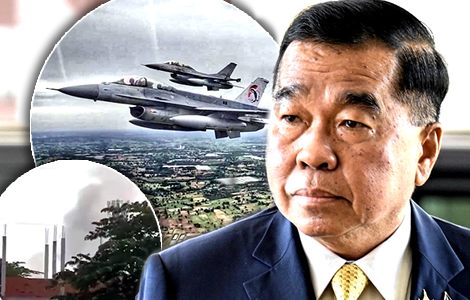
Thai F-16 fighter jets struck a military supply depot outside Poipet on Friday, marking a sharp escalation in cross-border fighting. The Royal Thai Air Force said the target stored BM-21 rockets used in repeated attacks on Thai territory. According to the Air Force, the strike followed confirmed intelligence of heavy weapon movements.
Earlier that day, surveillance detected BM-21 multiple rocket launchers entering and leaving the area. As a result, the air force approved the mission. The operation began at about 11 am. It was carried out by F-16 aircraft assigned to border defence operations.
According to the Royal Thai Air Force, the target functioned as an arms depot and logistics centre. Importantly, intelligence assessments found no civilian presence at the site. Consequently, the strike proceeded under existing engagement rules. Video footage later released showed secondary explosions inside the compound.
Air Force confirms secondary explosions after strike as Cambodia denies any military target in Poipet
Those explosions indicated that stored rockets detonated after impact. As stated by air force officials, the destruction was consistent with BM-21 munitions. Moreover, the air force said no civilian structures were damaged. It also said there was no unnecessary loss of life.
Meanwhile, Cambodian authorities rejected Thailand’s account of the strike. Cambodia’s Ministry of National Defence condemned the operation as hostile. At the same time, Poipet municipality denied any military presence in the city. Officials there said Poipet was a commercial and economic hub.
In response, Thailand’s Ministry of Foreign Affairs rejected claims that F-16s bombed civilian areas. Instead, it described such reports as fake news. The ministry said the strike targeted only a confirmed military weapons depot. Furthermore, it stressed that the target was outside populated zones.
According to the ministry, every air mission undergoes layered scrutiny. This includes intelligence verification and international law review. Additionally, officials said civilian harm avoidance is mandatory. Therefore, only confirmed military targets are approved.
Fighting intensifies along border as clashes spread across seven provinces and military deaths rise
The Poipet strike occurred amid sustained clashes along the Thai-Cambodian border. Meanwhile, fighting has spread across seven Thai border provinces. Combat has taken place on land, at sea, and in the air. As a result, the conflict has intensified rapidly.
On Thursday, Thai authorities confirmed the military death toll had reached 21. Since then, further clashes have continued. According to Thai officials, Cambodian forces fired BM-21 rockets toward Thai positions. These attacks also struck civilian centres.
Thai authorities described the rocket fire as indiscriminate. Consequently, border communities reported heavy damage. Homes, roads, and utilities were affected. In several areas, civilians could not reach shelters in time.
Meanwhile, Defence Minister General Nattapol Nakpanit defended Thailand’s actions. He said all operations were proportionate acts of self-defence. He added that Thailand would continue responding until attacks ceased. According to him, Cambodian statements on talks lacked credibility.
Minister says ceasefire talk is misplaced with daily missile attacks. Withdrawal demanded first
Specifically, General Nattapol said fighting continued despite public calls for negotiation. Daily bombardments, he said, persisted along the frontline. Therefore, he stated, Thailand could not rely on verbal assurances. Instead, actions on the ground were required.
He said Thailand had no intention of expanding operations deeper into Cambodia. In particular, he said Thailand would not pursue forces toward Phnom Penh. However, he insisted that opposing forces must withdraw. Only then, he said, could a ceasefire be assessed.
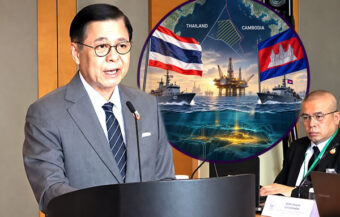
At the same time, the conflict expanded beyond land borders. On Friday, General Nattapol warned of potential threats at sea. He said Cambodia may be attempting to target Thai oil rigs. This followed the sighting of a drone near an offshore rig. There are over 125 such rigs in the Gulf.
According to General Nattapol, the drone was spotted in the Gulf of Thailand. As a result, authorities began a formal investigation. He said it was too early to confirm sabotage. However, the possibility was being examined.
Drone sighting near offshore rig raises alarm as officials cite limits of maritime surveillance and warnings
Meanwhile, he noted that maritime surveillance remains difficult. Unlike land areas, territorial waters lack constant observation. Moreover, drone detection at sea is limited. This complicates early warning efforts.
Citing the Maritime Security Command, he said drone use at sea is widespread. Approximately 10,000 fishing vessels operate drones in Thai waters. Consequently, identifying hostile drones is challenging. Investigations are now underway.
Following the drone incident, General Nattapol ordered heightened security. All branches of the armed forces received new instructions. Additionally, offshore infrastructure security was reinforced. The Air Force was assigned drone countermeasure responsibility.
At the same time, the Navy increased patrols near oil installations. Extra monitoring measures were introduced. According to officials, coordination between services was strengthened. This included real-time information sharing.
Thailand moves to harden offshore defences as PTT seeks approval to install counter-drone systems
General Nattapol also addressed counter-drone defences. He said PTT sought permission to install anti-drone systems. These systems would protect oil drilling sites. He described the matter as a national interest issue.
According to him, such systems fall under NBTC authority. Therefore, installation could proceed once approved. He confirmed discussions were already underway. No timeline was announced.
He also commented on a December 18 drone incident. Cambodia released images claiming it destroyed a Thai surveillance drone. General Nattapol acknowledged the loss. He said the drone was likely a DP-20 or D-Eyes 04.
He added that Cambodian forces possess anti-aircraft weapons. Therefore, losses were possible during operations. He said equipment losses were regrettable. However, he stressed that resources must be used when required.
Diplomatic tensions rise as Cambodia shuts land borders and Thailand files protest with United Nations
Meanwhile, diplomatic tensions escalated alongside the fighting. On December 17, Cambodia suspended land border crossings. This prevented Thai citizens from returning home by land. Thailand protested the decision.
On December 19, Thailand’s Ministry of Foreign Affairs addressed the issue publicly. Ministry spokesperson Nikorndej Plangkul spoke at a press conference. He said Foreign Minister Sihasak Phuangketkeow had written to the UN. The letter was sent to the High Commissioner for Human Rights.
According to the ministry, the border suspension violated international obligations. These included the ICCPR and the Fourth Geneva Convention. The Vienna Convention on Consular Relations was also cited. Thailand urged corrective action.
Meanwhile, the ministry outlined assistance for Thai citizens. This included travel documents and temporary accommodation. Airline tickets were also provided. Coordination with Cambodian authorities continued.
Since December 7, Thai missions in Cambodia have issued repeated warnings. Thai nationals in Cambodia were urged to return home. So far, more than 400 have returned. Embassy officials in Phnom Penh continue outreach efforts.
Citizens blocked at Poipet as exit requests were denied as authorities counter false casualty reports
However, Thai citizens in Poipet face restrictions. Requests for land exits were formally denied. Letters sent to Cambodia’s Interior Ministry received no approval. As a result, land crossings remain closed.
Following this, Thai missions promoted air travel registration. Citizens were asked to register online for assistance. However, registration numbers remained low. Some registrants could not be contacted.
Officials said commercial flights remained available. Therefore, charter flights were not yet prioritised. Nevertheless, preparations for charters continued. Airlines remained in coordination with the ministry.
Meanwhile, Thailand addressed further misinformation. Cambodian media claimed over 5,000 Thai soldiers had died. Thai authorities rejected the figure outright. They said verified data showed far lower casualties.
Officials said all casualties were documented and confirmed. Support and compensation were provided to families. The ministry described the false reports as misleading. AI-generated images were also cited.
ASEAN focus sharpens as Thailand sets ceasefire conditions and rejects mediation speculation
Regionally, attention shifted to ASEAN. Foreign Minister Sihasak will attend the ASEAN Foreign Ministers’ Meeting in Kuala Lumpur on December 22. A military representative will join the delegation. The conflict will dominate discussions.
Thailand said it remained open to ASEAN mechanisms. However, it set clear conditions. Cambodia must declare a ceasefire first. The ceasefire must then be continuous.
Additionally, Cambodia must cooperate on landmine clearance. Thai officials said none of these conditions were met. Therefore, talks remained limited.
Separately, Sihasak visited Japan from December 18 to 20. He discussed regional security issues. The Thai-Cambodian border situation was raised. Political developments in Thailand were also discussed.
Travellers being ‘restricted’ from entering Thailand as security risks linked to the Thai Cambodian war
Top tourist body expresses concern about the Thai Cambodian war’s impact on foreign tourism industry
Moreover, Thailand held talks with China, the United States, and the EU. Chinese Foreign Minister Wang Yi expressed concern. China indicated readiness to support negotiations. However, no mediation was confirmed.
Prime Minister Anutin Charnvirakul addressed mediation reports. He said he had not been personally contacted. Diplomatic channels may have been used. He said China acting as a mediator was unlikely.
Finally, political sources in Bangkok assessed the conflict outlook. They suggest the fighting may be prolonged. Thailand’s position remained unchanged. Cambodia must cease fire before meaningful talks can occur.
Join the Thai News forum, follow Thai Examiner on Facebook here
Receive all our stories as they come out on Telegram here
Follow Thai Examiner here
Further reading:
War to continue says PM Anutin. Dismisses President Trump’s ceasefire talk as a ‘misunderstanding’
Confusion after Trump’s 20 minute phone call with PM Anutin. US side claimed a ceasefire was agreed
People’s Party on campaign but on guard against potential legal complaints to oversight agencies
Wealthy young People’s Party leader aims to create a technology-driven and efficient welfare state