Thailand’s Election Commission faces fresh turmoil days before polling as a minor party pushes plans to buy Manchester United, clone dinosaurs, fix marriages and redraw borders, forcing officials to probe the legality of the manifesto as voters head to the polls.
Amid the headaches being faced this week by the under-fire Election Commission, trying to conduct Thailand’s General Election under the demanding rules of the 2017 Constitution, is the manifesto of a relatively minor party. Weeks ago, the New Alternative Party, founded in 2018, secured the number 10 designation in the country’s party-list vote. Each election has a party-list and constituency vote. However, the policy platform for the New Alternative Party has come to the Commission’s front door for urgent attention. It appears to be bizarre. From live dinosaurs to discounts at massage parlours and the deployment of the government as the national matchmaker, it appears to be beyond reason.

A political party formed in 2018 has piled pressure on Thailand’s already embattled Election Commission days before the February 8 general election. At the same time, the commission is already managing an intense election timetable. It has been left reeling from flaws in last Sunday’s advance voting poll, in addition to rising fears of vote buying.
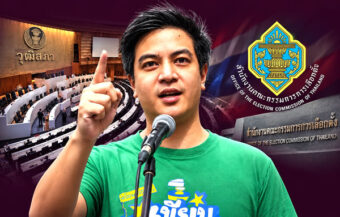
Against this backdrop, the aptly named New Alternative Party has released a policy platform that is attracting sustained attention. Notably, the party is led by Secretary-General Mongkolkit Suksintharanon. Publicly, he is known as “Teh” Mongkolkit. Importantly, he is also a prime ministerial candidate.
Notably, the party has secured the most sought-after Number 10 for the party-list poll nationwide. However, its policy platform is causing another headache for the election agency and its under-fire Secretary-General Sawaeng Boonmee. In brief, its policy proposals are somewhat outlandish.
Election Commission scrutiny intensifies after New Alternative Party unveils controversial policy platform
Initially, the party promoted its policies openly during campaign events and online postings. Soon after, several proposals prompted questions from election officials. Consequently, the Election Commission began monitoring the party’s public statements. According to officials, some policies raised concerns over legality and feasibility. Indeed, the party’s manifesto, in many respects, is simply bonkers. As a result, the party was asked to provide clarification.
Among the most widely discussed proposals is a plan involving football ownership. Specifically, the party proposes that the Thai government purchase Manchester United. The club competes in England’s Premier League.
Repeatedly, the proposal has been highlighted during campaign appearances. However, election officials have indicated such a purchase may be illegal. Moreover, they have suggested it may be impossible to implement under Thai law.
At the same time, tourism policy forms another major feature of the platform. In particular, the party proposes a new attraction inspired by the Jurassic Park movie series. Notably, the proposal goes beyond theme branding. Instead, the party has stated that real dinosaurs would be cloned. These dinosaurs would populate the park set in Thailand’s vast parklands. In effect, the concept mirrors the storyline of the original film.
Dinosaur cloning tourism plan draws attention as it mirrors Jurassic Park storyline in Thai parklands
Meanwhile, Thailand already has cinematic links to the franchise. Previously, parts of the 2025 film Jurassic World Rebirth were filmed in the country. Specifically, scenes were shot at national parks in Phang-nga, Trang, and Krabi. In addition, the locations were promoted internationally through the film’s release. However, no scientific framework for dinosaur cloning has been outlined by the party.
Beyond tourism, the party’s platform addresses daily lifestyle issues. For example, one proposal calls for discounted prices at massage parlours nationwide. Under the plan, discounts would apply exclusively to Thai nationals. Notably, massage parlours are widespread across the country. Accordingly, the policy has been framed as a broad consumer benefit.
Next, the party assigns the state a direct role in personal relationships. Under this proposal, the government would provide spouses for citizens lacking suitable partners. Importantly, sexual orientation would not restrict eligibility. Thus, male-female, male-male, and female-female couples are included. Similarly, age and employment sector are not limiting factors.
If incompatibility arises, further state intervention is proposed. In that case, the government would arrange a new partner. At the same time, the policy extends beyond national borders. Consequently, citizens seeking foreign partners would receive assistance. Notably, the proposal applies to all nationalities.
State matchmaking and lifestyle management policies place government at centre of relationships
Meanwhile, welfare for senior citizens occupies a central place in the manifesto. In particular, the party proposes increasing the monthly allowance to 3,000 baht. The policy would apply to approximately 13.8 million elderly people. Significantly, the monthly payment at this time is only 600 baht. However, no detailed fiscal breakdown has been released.
Healthcare measures are also included. Under the proposal, elderly citizens would be entitled to facial lifts. Specifically, the procedure would extend to the neck. Moreover, it would be available once every ten years. In addition, one corrective surgery would be covered. All procedures would fall under universal health coverage.
Separately, the party has outlined policies aimed at encouraging childbirth. Previously, Mongkolkit promoted fertility-related measures. These include granting rights for one or two labiaplasty procedures. In addition, monthly tonic medicine would be provided. The stated aim is fertility stimulation. Eligibility would apply to women aged 36 to 50. All benefits would be provided free under universal health coverage.
Cultural policy also features prominently. In this area, the party proposes support for Thai films, dramas, and television series. Specifically, small and medium producers would receive subsidies. Funding would be shared equally between the government and private investors. Accordingly, a revolving fund of five billion baht per year is proposed.
Welfare, cosmetic healthcare and cultural subsidies form core of party’s domestic policy proposals
Under this plan, the government would invest 50 per cent upfront. Meanwhile, private investors would borrow the remaining amount from public-private banks. After sales, the principal would be repaid to the government. Importantly, no interest would be charged on the loans.
Alongside welfare initiatives, the party has outlined a detailed security agenda. In particular, these proposals focus on Thailand’s ongoing border dispute with Cambodia. The measures would be implemented only if the party forms a government. They are presented as immediate actions. Certainly, it is a hardline, hawkish stance. Cambodia’s strongman Hun Sen would not want to see Mongkolkit emerge as Thailand’s next government leader.
According to Mongkolkit, electoral targets have been clearly defined. Specifically, the party seeks 20 party-list seats. In addition, it aims to win 43 constituency seats. Together, this would produce 63 members of parliament. If successful, the party would lead a coalition government. Then, if selected by coalition partners, Mongkolkit would become the 33rd prime minister.
Hardline security agenda outlines territorial, military and labour actions tied to the Cambodia dispute
After taking office, the party proposes swift action. First, the government would seek parliamentary approval to cancel agreements. Specifically, it would revoke the 2000 and 2001 Memoranda of Understanding with Cambodia. These agreements relate to territorial arrangements involving the Eastern Kingdom. They are known as MOU 43 and 44, referring to the Thai years in which they were agreed.
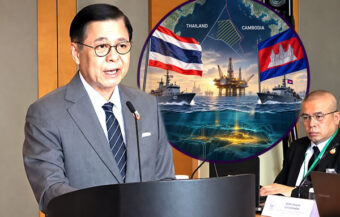
Next, the party proposes a territorial declaration. Under this plan, 26,000 square kilometres in the Gulf of Thailand would be declared Thai territory. The party states there would be no overlapping claims with Cambodia. Immediately, six frigate warships would be deployed along maritime boundaries.
In addition, the party proposes a change in cartographic standards. The government would declare exclusive use of a 1:50,000 scale map. Following that, military forces would be deployed. The stated aim is reclaiming what the party describes as original Thai territory.
Labour policy also features in the security agenda. Specifically, the party proposes expelling more than 200,000 Cambodian workers from Thailand. The expulsion would take place immediately. Workers would be returned to Cambodia.
Proposed expulsions and cross-border military operations mark an escalation in party’s regional stance
At the same time, the party claims that Thai nationals are being held abroad. According to its statements, around 30,000 Thais are currently in Cambodia. They are described as victims of deception. The party states they were forced into scam operations or mule accounts. These individuals are said to be spread across 25 Cambodian provinces.
Under the proposal, Thailand would formally notify the Cambodian government. Cambodia would be asked to repatriate the individuals within seven days. The stated purpose is to end exploitation involving Thai citizens.
If repatriation does not occur, further action is proposed. In that case, Thai forces would enter Cambodian territory. Operations would involve the army, navy, and air force. Border police, fighter jets, warships, and armoured vehicles would also be deployed. Operations would extend into inner provinces.
Separately, Mongkolkit has outlined diplomatic intentions. He has stated he would personally travel to Phnom Penh. There, he would seek meetings with Hun Sen and Hun Manet. He has said he hopes both would receive his delegation.
Election Commission responds as the legality of campaign policies comes under formal investigation
Meanwhile, the Election Commission has responded publicly. On February 4, 2026, comments were made at the commission’s office. The remarks came from Secretary-General Sawaeng Boonmee. He addressed the New Alternative Party directly.
According to Sawaeng, several campaign policies are being monitored and reviewed. These include the dinosaur proposal and the Manchester United plan. Discounted massage parlours were also cited. The party submitted its policies under Section 57 of the Organic Act on Political Parties.
Tensions between the Election Commission and top political parties in the 2026 General Election deepen
People’s Party firebrand ‘ICE’ calls for actions against Election Commission after advance voting errors
As a result of the review, the commission stated that some proposals may be illegal. Others were described as impossible to implement. Consequently, a formal letter was sent to the party seeking clarification. At the same time, election officials were instructed to investigate potential violations.
So far, no final rulings have been issued. Nevertheless, monitoring continues as the election approaches. In the meantime, voters will cast their ballots on February 8. However, if the policies are ruled out of bounds, negative implications for the party may follow after polling day.
Join the Thai News forum, follow Thai Examiner on Facebook here
Receive all our stories as they come out on Telegram here
Follow Thai Examiner here
Further reading:
Bank of Thailand Governor orders monitoring of cash withdrawals amid widespread vote buying fears
High powered, secretive meeting chaired by PM agrees robust action against Cambodian networks
Ben Smith affair & allegations of links to Cambodian scam centres continues to rage in parliament