Global cannabis smuggling networks, collapsing prices and mounting overseas pressure have pushed Thailand’s landmark legal cannabis experiment to the brink, with senior Bhumjaithai leaders now openly questioning the future of a policy that transformed Asia’s drug scene.
Thailand’s landmark cannabis revolution is on the brink of collapse after Prime Minister Anutin Charnvirakul, the architect of Asia’s first cannabis decriminalisation policy, warned he is prepared to recriminalise the drug and shut down the industry following a wave of major international cannabis seizures linked to Thailand. Backed by senior Bhumjaithai Party legal adviser Supachai Jaisamut’s insistence that the party only ever intended cannabis for medical use, the intervention signals the gravest threat yet to the 2022 reforms as organised trafficking networks, collapsing prices, stalled legislation and mounting international pressure drive the government towards a historic policy reversal.
Thailand’s cannabis revolution is approaching its most critical moment since it was delisted as an iilegal narcotic in June 2022. Four years after becoming Asia’s first nation to legalise the plant, the government is openly discussing reversing the policy.
A succession of international drug seizures has transformed the debate. Now, the politicians who championed the reform are signalling a dramatic change of direction.
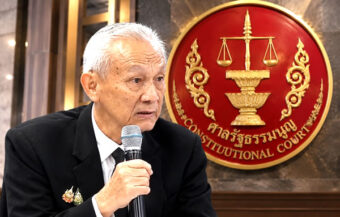
The writing appears to be on the wall for the landmark policy. Within days, two of its principal architects have publicly questioned its future. Senior Bhumjaithai Party legal adviser Supachai Jaisamut insisted the party had always supported cannabis for medical use only. Then Prime Minister Anutin Charnvirakul went further. On Sunday, he acknowledged publicly for the first time that recriminalising cannabis is now an option.
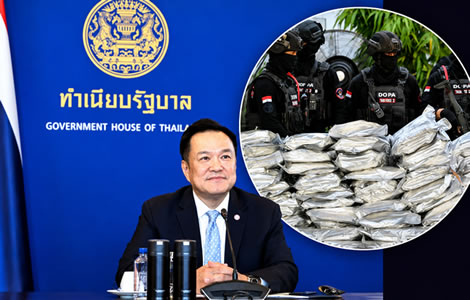
PM Anutin and Supachai Jaisamut signal a dramatic rethink of Thailand’s cannabis policy
The shift is politically significant. Mr Anutin personally signed the ministerial order removing cannabis from Thailand’s narcotics list in June 2022. That decision made Thailand the first country in Asia to decriminalise the drug.
It was promoted as a medical cannabis programme and a new cash crop for farmers. However, the commercial market quickly expanded far beyond those original ambitions.
Many observers believe a return to criminal penalties would receive broad public backing. Equally important, it would restore extensive enforcement powers to the Royal Thai Police. Since cannabis was removed from the narcotics list, officers have operated under a much weaker legal framework.
They lost many powers of seizure, arrest and prosecution. As a result, police have repeatedly found themselves confronting organised trafficking networks without the criminal powers previously available.
A reversal would immediately strengthen enforcement. Cannabis would again become a scheduled narcotic. Police could seize shipments more easily, arrest offenders under narcotics legislation and pursue stronger criminal prosecutions. Those convicted would again face the prospect of lengthy prison sentences rather than administrative penalties.
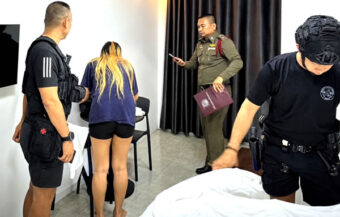
Recriminalisation would restore police powers lost after cannabis was removed from narcotics list
The government’s reassessment follows an extraordinary series of international investigations. Authorities in Germany, Indonesia, Hong Kong and the United Kingdom have all announced significant cannabis seizures linked to Thailand.
Collectively, the operations have cast a shadow over what was intended to be a tightly controlled medical cannabis industry. Instead, investigators increasingly believe criminal syndicates are exploiting Thailand’s legal cultivation system to supply lucrative overseas markets.
Speaking to reporters on Sunday, Mr Anutin accepted that the current approach may no longer be working.
“No matter how strict our measures are, if people can still smuggle drugs out, we need to go back and reassess our approach,” he said.
Notably, the Prime Minister framed the issue as one affecting Thailand’s international standing rather than simply domestic law enforcement.
“We need to figure out what we should do to prevent other countries from blaming Thailand as being the weak link in this problem,” he said.
International cannabis seizures push Thailand to reassess laws amid mounting pressure overseas
He then delivered his strongest warning yet.
If authorities concluded the industry was causing more harm than benefit, he said he was prepared to “shut down” the cannabis sector altogether.
The comments represent a remarkable shift for the politician most closely associated with cannabis liberalisation. Until now, ministers had defended tighter regulation rather than policy reversal. This time, however, Mr Anutin openly raised the prospect of recriminalisation.
His remarks followed similar comments from Mr Supachai. The senior Bhumjaithai legal adviser stressed that the party had never intended to legalise recreational cannabis. Instead, he said the policy had always centred on medical treatment. That distinction has become increasingly important as the recreational market has expanded far beyond its original scope.
When cannabis was decriminalised, ministers promised a tightly regulated medical industry. Farmers anticipated a valuable new agricultural crop. Patients expected wider access to treatment. Yet comprehensive legislation never followed. Parliament continued debating a Cannabis Bill while commercial activity accelerated. Consequently, legal uncertainty became the defining feature of the industry.
Anutin warns he could shut the industry as uncertainty continues to dominate Thailand’s cannabis trade
Thousands of dispensaries subsequently appeared across Bangkok, Pattaya, Phuket, Chiang Mai and other tourist centres. Many openly sold high-potency cannabis for recreational use.
Although ministers repeatedly insisted recreational consumption was never government policy, enforcement remained inconsistent. Recreational smoking, therefore, became increasingly visible in places where possession once carried prison sentences.
At the same time, cultivation expanded rapidly across the country. Growers invested heavily during the early boom. Many expected substantial financial returns. Instead, production soon exceeded demand. Wholesale prices collapsed. Smaller cultivators struggled to survive. Criminal organisations, meanwhile, found an opportunity to purchase cannabis cheaply for export into higher-value overseas markets.
Last week’s international investigations illustrate how rapidly the problem has escalated.
German customs authorities announced they had dismantled a maritime smuggling operation transporting Thai cannabis into Europe. Officers seized two shipments containing a combined 1.2 tonnes of cannabis. The drugs carried an estimated street value exceeding US$13 million.
German customs uncover a maritime cannabis smuggling route from Thailand worth over US$13 million
Investigators said the cannabis had been concealed inside containers declared as building materials. Hanover Customs Office identified the suspects as a German-Polish criminal group. Authorities believe the organisation repeatedly smuggled significant quantities of cannabis by sea from Thailand into Europe.
Separately, Indonesian authorities announced an even larger seizure.
Police in East Java intercepted approximately 3.37 tonnes of cannabis buds believed to have originated in Thailand. Investigators said the shipment was destined for cannabis-infused vaping products sold in Jakarta and Bali. Twelve suspects were arrested, including several Thai nationals.
On another front, British authorities continued confronting a different trafficking method.
British nationals have increasingly been arrested, leaving Thailand with cannabis concealed inside luggage. Investigators believe organised crime groups recruit couriers through the Telegram messaging platform. Participants are reportedly offered free holidays in exchange for transporting cannabis back to Britain.
British courier arrests expose trafficking networks using free holidays and Telegram recruitment from Thailand
According to investigators, couriers refusing to cooperate have reportedly faced threats after returning home. Others have attempted indirect travel routes to avoid detection. Those efforts have instead resulted in arrests in countries with strict anti-drug laws, including Singapore and Turkey.
In response, the United Kingdom Embassy in Bangkok last week repeated its warning to British citizens.
The embassy urged travellers not to carry cannabis or transport packages for other people. It also reminded passengers that anyone caught leaving Thailand with cannabis could face fines of 30,000 baht per kilogram seized. Those unable to pay could also face imprisonment.
Elsewhere, Hong Kong customs officers announced two further arrests involving flights from Thailand.
Hong Kong joins growing list of jurisdictions intercepting cannabis couriers arriving on flights from Thailand
One passenger from mainland China allegedly carried about 13 kilograms of suspected cannabis buds. A Hong Kong resident allegedly carried another 10 kilograms. Both cases further intensified international scrutiny of Thailand’s cannabis exports.
As part of this tightening response, the Thai government has already strengthened domestic controls.
Cannabis dispensaries must now hold official licences. Buyers must also produce certificates demonstrating medical need. Hundreds of dispensaries have since closed. Even so, recreational cannabis remains widely available. Parliament, meanwhile, continues debating the long-delayed Cannabis Bill. Consequently, uncertainty still surrounds cultivation, retail sales and regulatory enforcement.
Legitimate operators argue that the prolonged legal vacuum has damaged compliant businesses while benefiting illegal exporters. Many say the absence of permanent legislation created opportunities for criminal networks to flourish alongside legal enterprises.
Growers say collapsing prices and legal uncertainty have left legitimate cannabis businesses struggling
One former grower, identified as Noi, said she experienced that transformation firsthand. During the industry’s early expansion, she cultivated around 500 cannabis plants. She also filled two containers with premium cannabis buds ready for sale. Like many growers, she expected strong profits. Instead, collapsing prices destroyed the business model.
She said only large plantations with substantial medical contracts, or illegal exporters supplying overseas markets, could still generate meaningful returns.
“We need to make it illegal again. If it had just stayed underground where it used to be, it wouldn’t have gotten this messy,” she said.
Noi said cannabis previously sold for more than 10,000 baht per kilogram. Today, she said, prices have fallen to roughly half that level.
“I’m furious at myself for ever having been fooled into growing it in the first place,” she said.
Her experience reflects broader pressures confronting Thailand’s cannabis industry. International seizures continue to mount. Criminal investigations are expanding across several jurisdictions.
Top Bhumjaithai Party figure defends the party’s position on cannabis. Only supported medical use
Screws are being fitted and are soon to be turned on Thailand’s cannabis industry which must be reined in
Senior Bhumjaithai leaders are retreating from earlier positions. Most importantly, the Prime Minister who introduced Asia’s first cannabis decriminalisation policy has now publicly acknowledged that reversing it is no longer unthinkable.
Join the Thai News forum, follow Thai Examiner on Facebook here
Receive all our stories as they come out on Telegram here
Follow Thai Examiner here
Further reading:
Top Bhumjaithai Party figure defends the party’s position on cannabis. Only supported medical use
Bungling French drug dealer arrested at Phuket Airport after cocaine sachets found on concourse