Thailand is betting its future on more than exports, with the government using gold, diplomatic neutrality and expanding trade deals to strengthen the kingdom’s position as global rivalry between Washington and Beijing reshapes international commerce.
Gold has emerged as far more than a traditional safe-haven investment, with Deputy Prime Minister and Commerce Minister Suphajee Suthumpun declaring it a strategic asset at the heart of Thailand’s future economic ambitions as US-China rivalry reshapes global trade. She argued Thailand is well placed to capitalise on the changing world economy through diplomatic neutrality, expanding free trade agreements and stronger supply chains. Her intervention comes as exports continue to surge, gold remains one of Thailand’s most valuable export earners and millions of Thai families still rely on the precious metal as a trusted store of wealth.

Deputy Prime Minister and Commerce Minister Suphajee Suthumpun has described gold as a strategic asset at the centre of a rapidly changing global economy.
She said Thailand should use its diplomatic neutrality and geographical position to expand trade and investment opportunities as geopolitical tensions reshape international commerce.
Ms Suphajee made the remarks while opening the Thailand Gold Summit 2026 on July 5 in Bangkok. The conference, organised by Business Tomorrow in partnership with Than Lok and Trader KP at True Digital Park, carried the theme Thailand’s Golden Opportunity: Thailand’s Golden Opportunities in the New World. Gold traders, investors, economists, analysts and market specialists attended the event.
Global tensions in trade as Thailand seeks balanced diplomacy between Washington and Beijing
She said the summit came at a critical moment. The global economy, she noted, was entering a period of heightened uncertainty.
Increasingly, international security concerns were influencing trade, investment and economic policy rather than remaining confined to diplomacy. Governments, businesses and investors therefore faced a far more complex operating environment.
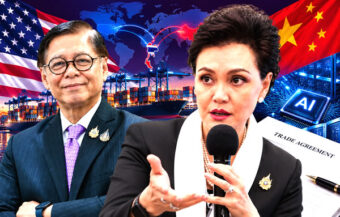
Ms Suphajee said strategic competition between the United States and China was driving much of that change. Both countries, she explained, were using economic policy to advance wider national objectives.
The United States continued relying on tariffs and trade negotiations. Meanwhile, China maintained its emphasis on free trade and international trading rules. Those contrasting approaches, she said, required countries such as Thailand to adjust their own economic strategies.
“The United States remains Thailand’s largest export market, while China is our largest trading partner overall,” Ms Suphajee said. Against that backdrop, Thailand must preserve balanced relations with both countries.
She stressed that cooperation should be based on mutual benefit rather than favouring either side. At the same time, Thailand would continue negotiations aimed at reducing both tariff and non-tariff trade barriers. Those efforts, she said, would strengthen confidence among trading partners and improve long-term economic resilience.
China investment, stronger supply chains and wider export markets are the next stage of Thailand’s trade
Turning to China, Ms Suphajee said discussions had centred on improving both trade quality and investment standards. Imported products, she said, should consistently meet recognised quality requirements.
Foreign investment should also deliver measurable benefits to the Thai economy. That includes greater use of domestic raw materials, increased employment of Thai workers and stronger local supply chains. She said future investment should create lasting economic value rather than simply expanding imports.
As part of this strategy, the government is encouraging joint investment in agricultural processing industries using Thailand as a production base. Such projects would increase the value of Thai agricultural products while reducing seasonal oversupply. Farmers would, in turn, benefit from more stable incomes. Ms Suphajee described the proposal as a mutually beneficial arrangement for Thailand and its international partners.
Separately, the Ministry of Commerce is accelerating efforts to diversify export markets. Ms Suphajee said negotiations on a free trade agreement with the European Union continued to make steady progress.
Officials were also expanding commercial links with Africa and Latin America. In parallel, Thailand was advancing free trade negotiations with Canada and South Korea. She said broader market access would reduce dependence on any single destination while creating additional opportunities for Thai exporters.
Neutrality, geography and free trade agreements underpin Thailand’s strategy to attract global investment
Thailand, she argued, already possessed several important competitive advantages. The country has maintained diplomatic neutrality for decades. It also occupies a strategic position at the centre of Asia.
Equally important, Thailand benefits from an extensive network of free trade agreements covering numerous international markets. Those strengths, she said, provide a strong platform for attracting investment and reinforcing Thailand’s position within regional supply chains.
“The government will leverage these strengths to build investor confidence,” Ms Suphajee said. “Thailand is ready to grow with international partners on the basis of mutual benefit.”
She said that the approach was already producing measurable results. Despite global uncertainty, Thailand recorded strong export growth during the first five months of 2026. Agricultural exports also expanded for the first time in several years. Ms Suphajee said those figures reflected successful market diversification, greater value creation and more effective use of Thailand’s competitive strengths.
Gold exports remain vital as domestic demand keeps the precious metal central to Thailand’s wider economy
Official trade data support that assessment. Thailand exported goods worth US$162.09 billion between January and May, an increase of 17% compared with the same period last year.
Gold remains one of the country’s highest-value export products alongside electronics, machinery, vehicles, food products and agricultural goods. Consequently, movements in global gold prices can have a noticeable effect on Thailand’s monthly export earnings. Even so, gold consistently contributes significant foreign exchange income and remains an important component of Thailand’s external trade.
Gold also occupies a unique position within Thailand’s domestic economy. Unlike many countries, physical gold has long served as both a traditional store of wealth and a practical savings instrument.
Millions of Thai households purchase gold jewellery and small gold bars not merely for personal use but as a reliable form of financial security. That practice extends across generations and remains deeply embedded in Thai society.
Household savings and high-tech industries give gold an expanding role in Thailand and the economy
Notably, gold plays an especially important role among lower and middle-income families. Many households buy small amounts whenever finances permit, gradually building savings over many years. Gold can then be sold or pledged quickly when cash is urgently required. Thailand’s nationwide network of gold shops makes that process straightforward.
As a result, physical gold often functions as an informal savings account and emergency reserve, particularly for families with limited access to more sophisticated investment products.
Against that domestic background, Ms Suphajee said gold’s international importance had expanded well beyond its traditional role. Gold now functions as a public asset, a national reserve asset and a global investment asset.
Beyond finance, it has become an essential raw material for advanced technology and modern electronics manufacturing. Its conductivity, durability and resistance to corrosion make it indispensable in numerous high-value industrial applications. She therefore described gold as both a legacy asset and a future material supporting the next phase of global economic development.
Suphajee urges informed investing as market volatility sees gold prices exposed to geopolitical risks
Even so, Ms Suphajee cautioned that gold should not be regarded as risk-free. Prices continue responding to market conditions, economic developments and geopolitical events. Investors, she said, should study the market carefully before committing funds.
Sharpest fall in gold in 43 years sees baht fall by 2 per cent against the US dollar and gold shop panic
PM vows action on rising gold exports to Cambodia and the runaway Thai baht against the US dollar this year
They should also invest only through reputable and transparent businesses. According to Ms Suphajee, successful investing depends upon accurate information, sound knowledge and disciplined decision-making.
She concluded by describing every investment as an investment in the future. Ultimately, investors should understand the products they buy, assess risks carefully and choose trustworthy investment partners. Proper risk management, she said, remains essential for achieving long-term financial security and sustainable investment success.
Join the Thai News forum, follow Thai Examiner on Facebook here
Receive all our stories as they come out on Telegram here
Follow Thai Examiner here
Further reading:
Rate cut anticipated as outgoing Bank of Thailand governor attends last Monetary Policy Committee
Last minute tweaks in Bangkok as deal is finalised with U.S. However, Thailand may not match Vietnam