Ceasefire hopes flicker as ASEAN talks continue, but Thailand doubts Cambodia’s intent. With civilian areas hit, the landmines issue unresolved and military chiefs due to meet on Christmas Eve, Bangkok wants proof, not promises, amid rising US pressure.
Uncertainty surrounds whether a new and more credible ceasefire can be forged as the ASEAN Summit continues in Kuala Lumpur, while Thai and Cambodian military chiefs prepare to meet in Chanthaburi on December 24, Christmas Eve. The General Border Committee meeting is expected to test Cambodia’s intent, with Thailand demanding firm guarantees on landmine removal, action against scam centres and genuine compliance. Meanwhile, in Bangkok, the prevailing view is that Thailand is going through the motions under mounting political pressure, particularly from the United States and Secretary of State Marco Rubio.
Amid two days of compressed diplomacy in Kuala Lumpur, the prospect of a Thai-Cambodian ceasefire has emerged as a test of credibility, timing and control. While ASEAN foreign ministers gathered to discuss de-escalation, Thailand made clear it would not accept a ceasefire defined only by language. At the same time, military coordination intensified in Bangkok, reflecting doubt that diplomacy alone could restrain events on the ground.
On Monday, the Asean Summit in Kuala Lumpur narrowed its focus to whether a ceasefire could be negotiated and enforced. The meeting was convened urgently as fighting between Thailand and Cambodia entered its fifteenth consecutive day. From the outset, the issue was not peace in principle, but implementation in practice.
Thai Foreign Minister Sihasak Phuangketkeow addressed the meeting directly and without ambiguity. He warned that a ceasefire must be real, sustained and verifiable. Otherwise, he said, it would amount to nothing more than a declaration. In previous rounds, such declarations had failed quickly once tested by events on the ground.
Thailand lays down ceasefire conditions as landmine injuries and trust failures dominate diplomatic talks
Accordingly, Thailand set out firm conditions. Cambodia, Sihasak said, must be the party to declare a ceasefire first. Moreover, that ceasefire must be sustained over time, not temporary. Most critically, Cambodia must demonstrate sincerity through cooperation on humanitarian demining.
During the meeting, Sihasak detailed incidents since the previous round of fighting. In particular, he highlighted landmine injuries suffered by Thai soldiers along the border. Several incidents occurred after a peace accord was made in July. A seventh and in recent days, an eighth injury followed the signing of the October peace declaration.
As a result, Thailand sought clarification from Cambodia. However, according to Sihasak, no explanation had been provided. Consequently, trust between the two sides continued to erode. This unresolved issue, he stressed, lay at the heart of Thailand’s scepticism.
Nevertheless, Sihasak emphasised that Thailand did not attend the ASEAN meeting to exchange accusations. Instead, he said the facts were already known to all parties. The purpose, therefore, was to determine how to proceed toward a ceasefire that could actually hold.
Cambodia’s ceasefire questioned as Thailand highlights lack of direct engagement with Cambodia
However, Cambodia’s approach raised immediate concerns. According to Sihasak, Cambodia had spoken about a ceasefire with multiple parties, but not directly with Thailand. As a result, he questioned how such a ceasefire could be implemented. Coordination between the two militaries, he insisted, was essential.
That concern intensified when Cambodia proposed a ceasefire by 10 p.m. on Monday night. Thailand rejected the proposal. The timing, Thai officials said, was premature. There were no agreed measures, no timelines, and no monitoring mechanisms.
ASEAN members accepted this assessment. Therefore, rather than issuing another statement, the meeting moved towards process. It concluded with an agreement to convene a meeting of the General Border Committee (GBC), bringing the issue directly to the military level.
The GBC meeting was scheduled for Wednesday, December 24. The date was proposed by Cambodia, and Thailand agreed. Thailand proposed Chanthaburi province as the venue. Cambodia had not yet responded to that proposal.
Responsibility shifts from diplomats to commanders as GBC talks become the test for ceasefire
Importantly, the decision shifted responsibility from diplomats to commanders. Senior military officers from both sides would assess the situation on the ground. They would then decide whether, and how, a ceasefire could be implemented.
Yet even as this pathway was agreed in Kuala Lumpur, developments on the border undermined confidence. On the same day as the ASEAN meeting, Cambodian forces intensified attacks on civilian areas in Thailand’s Sa Kaeo Province. The timing carried political weight.
Early on December 22, Cambodian heavy weapons, including BM-21 missile launchers, fired continuously into Thai territory. At approximately 7:20 a.m., shells landed in Khok Sung district. The impact area lay near Ban Nong Ya Kaeo, not far from residential communities.
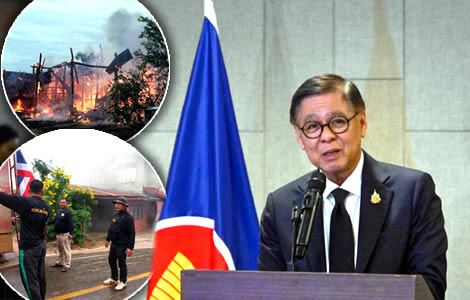
According to officials, the shelling appeared indiscriminate. Several houses were damaged. One home caught fire, forcing emergency services to intervene quickly. Fire crews worked to prevent the flames from spreading.
Subsequent investigations confirmed damage in the Ban Don Lum area. In particular, the home of a resident identified as Phisut was struck by stray rounds. The structure ignited, causing extensive property damage.
Civilian homes struck in Sa Kaeo as border fighting escalates during ceasefire discussions in Kuala Lumpur
Fortunately, no injuries were reported at the time. Most residents had evacuated earlier due to ongoing clashes. Nevertheless, panic spread across nearby communities as heavy gunfire continued intermittently.
As a result, security forces secured the area and expanded evacuation measures. Officials assessed damage and provided assistance to affected residents. At the same time, authorities reiterated warnings to avoid high-risk zones near the border.
Throughout the day, the situation in Sa Kaeo Province remained tense. Security agencies maintained continuous monitoring. Public concern increased as the prospect of prolonged unrest became more apparent.
The attacks stood in stark contrast to the diplomatic messaging in Kuala Lumpur. While ceasefire mechanics were being discussed, shells were landing on civilian homes. In Bangkok, this contrast was noted carefully.
Hun Sen’s war rhetoric and mounting casualties deepen Thai doubts over Cambodia’s ceasefire intentions
That scepticism deepened further following statements from Cambodia’s leadership. Former strongman Hun Sen publicly voiced support for a protracted and long-term war. His remarks directly undercut the notion of imminent de-escalation.
As a result, unease grew within the Thai security establishment. Confidence in Cambodia’s intentions weakened. The ceasefire prospect appeared increasingly fragile. This comes with 22 Thai soldiers dead and at least 53 civilian casualties on both sides since December 7th.
At the same time, Thai authorities confronted additional security concerns. Unidentified drones were detected near Suvarnabhumi Airport. Although details were not publicly disclosed, the sightings raised alarm.
Within the security establishment, attention turned to Cambodia’s use of drone technology. The origin of the drones remained unknown. Nevertheless, the incidents heightened concerns about airspace security.
Bangkok shifts from diplomacy to command readiness as Prime Minister convenes top brass
Against this backdrop, Bangkok moved decisively. Prime Minister Anutin Charnvirakul convened senior military leaders to assess the situation. The focus shifted from diplomacy to readiness.
Before any formal meeting, Anutin held informal discussions at Government House. He met with the Chief of the Royal Thai Armed Forces and commanders of all service branches. The Secretary-General of the National Security Council also attended.
Shortly thereafter, Anutin chaired the 17th National Security Council meeting of 2025. The meeting began at 9:35 a.m. at the NSC office in Government House. Attendance reflected the seriousness of the situation.
Defence Minister General Natthaphol Nakpanich was present. Justice Minister Police Lieutenant General Ruddhaphol Naovarat attended. The Minister of Digital Economy and Society also participated.
In addition, representatives from the Department of Airports and the Civil Aviation Authority of Thailand joined the session. Other relevant agencies were present. The agenda covered border fighting and airspace security.
Government concludes diplomacy alone is insufficient as enforcement gaps and military risks persist
These meetings highlighted the government’s assessment that diplomacy alone was insufficient. While talks continued abroad, Bangkok prepared for escalation. Coordination across military and civilian agencies was reinforced.
Despite ASEAN engagement, uncertainty dominated. No ceasefire had been secured. Only a framework for further talks had been established. Implementation remained unresolved.
This uncertainty was shaped by experience. Previous ceasefires had collapsed quickly. Verification gaps had undermined enforcement. Thailand’s insistence on military oversight reflected those lessons.
The Kuala Lumpur Peace Declaration remained the formal reference point. It was signed on October 26 in Kuala Lumpur. The signing took place in the presence of United States President Donald Trump.
The declaration outlined a path toward peace. It emphasised border disarmament, troop reductions and humanitarian mine clearance. It also addressed cross-border scams and encroached areas.
Landmines, sovereignty disputes and trust deficits complicate Thailand’s path back to the peace
For Thailand, mine clearance carried particular weight. At least six Thai soldiers had lost limbs to landmines. A seventh and now an eighth injury have occurred after the declaration was signed.
Sihasak rejected claims that these incidents were accidents. He said they constituted violations of the agreement. Accordingly, Thailand demanded clarity before moving forward.
Throughout the ASEAN meeting, Thailand reiterated its principles. Officials emphasised national dignity and sovereignty. Actions, they said, were defensive, not provocative.
Thailand also stressed its preference for bilateral resolution. Historically, disputes were managed directly between the two sides. Cambodia’s move to internationalise the issue altered that balance.
Cambodia raised the conflict at the United Nations. Thai officials criticised that approach. Trust between the sides deteriorated further.
The release of recorded discussion tapes added another layer of tension. They show Cambodian officials briefing soldiers on how to plant landmines. Sihasak publicly questioned Cambodia’s intent. He asked whether the releases aimed to resolve the issue or undermine Thailand’s government.
Ceasefire prospects narrow as politics, military realities, and credibility collide ahead of December 24
Earlier noises from Kuala Lumpur had briefly raised expectations. The peace declaration momentarily stabilised the situation. Those expectations faded as fighting resumed. By Monday, Thailand’s position had hardened. Military realities overtook diplomatic optimism. The ceasefire question has become one of credibility and control.
Sources in Bangkok had previously indicated the war would continue. That assessment has retained traction. Political timing added further pressure. Prime Minister Anutin faced an election scheduled for February 8. His party stands third in current opinion polls. Meanwhile, the Pheu Thai Party recorded a surge in support.
In this context, security leadership carried political significance. The handling of the border crisis matters domestically. Perceptions of resolve are being closely watched.
Asean Summit on Monday and Tuesday seen by United States as pivotal to restoring border peace
Poll shows a boost for Pheu Thai and popular support for Yotsanan Wongsawat as he begins campaigning
As night fell on Monday, December 22, and the summit reconvened on Tuesday, the ceasefire prospect remained open but fragile. Guns had not fallen silent. Civilian homes have been damaged. The political environment in Bangkok is not conducive to an end to these hostilities.
Attention turned to December 24. The General Border Committee meeting loomed. Military officers must determine the next steps. Whether a ceasefire could move from declaration to enforcement remains highly uncertain. For now, diplomacy, force and political calculation remain tightly bound.
Join the Thai News forum, follow Thai Examiner on Facebook here
Receive all our stories as they come out on Telegram here
Follow Thai Examiner here
Further reading:
War to continue says PM Anutin. Dismisses President Trump’s ceasefire talk as a ‘misunderstanding’
Confusion after Trump’s 20 minute phone call with PM Anutin. US side claimed a ceasefire was agreed