Thailand votes in a high-stakes election with record turnout expected amid rampant vote-buying fears. A kingdom with a deep political divide, polls point one way, but power is likely decided by coalition deals, cash, on the ground networks and courts after all the ballots are counted and inevitable issues emerge.
Thailand went to the polls on Sunday, with voting ending before 5 pm, at a decisive moment in the nation’s fortunes. The campaign and vote reflect years of political instability and repeated ruptures that have left successive governments unable to confront deep structural problems. These include an ageing population, an obsolete industrial base, and soaring household debt. As a result, Thailand is stuck in a development trap and, like many middle-income economies, has stagnated. On Sunday, voters chose between a progressive future and a more traditional, nationalist path. Yet whatever the outcome, entrenched fault lines and political divisions continue to threaten the country’s future.
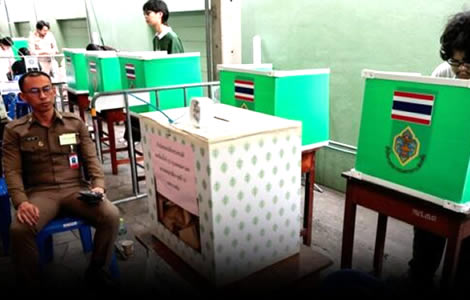
Thailand went to the polls on Sunday in a fiercely contested general election marked by high turnout expectations and intense political scrutiny. From early morning, polling stations opened across the country. Voters arrived steadily throughout the day. Overall participation was expected to exceed 80 per cent, a figure that would set a national record.
Based on opinion polling alone, the likely outcome appeared straightforward. Surveys consistently pointed to strong performances by the People’s Party and the Pheu Thai Party.
Together, polling suggested they controlled close to two-thirds of voter preferences. However, Thailand’s political system rarely follows polling predictions.
Parliamentary arithmetic and post-election negotiations will decide power rather than opinion polls
Instead, power is determined by parliamentary arithmetic and post-election negotiations. The House of Representatives holds decisive authority. Its 500 elected members will choose the next prime minister. That vote is expected in May 2026. Before then, coalition talks must conclude. At the same time, election results must be formally certified.
Historically, Thai elections rarely produce immediate clarity. Legal challenges often follow voting day. Administrative disputes are also common. Consequently, uncertainty remains despite strong pre-election indicators. As a result, political outcomes often shift after ballots are counted.
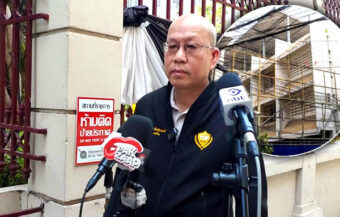
Tensions surfaced early on Sunday. Election Commission Secretary-General Sawaeng Boonmee said he was considering legal action against political party leaders. This statement followed a Supreme Court ruling issued earlier. The court invalidated candidates from most political parties. However, the ruling Bhumjaithai Party was notably exempt.
Meanwhile, Mr Sawaeng faced sustained criticism throughout the election period. Observers cited repeated misstatements and administrative missteps. Others raised concerns about oversight and communication. Nevertheless, he projected confidence on polling day. He predicted turnout would exceed 80 per cent. If confirmed, this would mark a record in Thai electoral history.
High stakes election includes parliamentary vote and national referendum amid fragile trust
Moreover, the election carried unusually high stakes. The vote was widely viewed as decisive for Thailand’s political direction. At the same time, voters faced multiple choices. In addition to parliamentary ballots, a national referendum was held.
Specifically, voters received three ballots. A green ballot selected constituency members of parliament. A pink ballot selected party-list MPs. A yellow ballot addressed the constitutional referendum. Voters could approve, disapprove, or abstain. The referendum concerns drafting a new constitution. Early expectations suggested the proposal would pass.
Responsibility for administering the vote rested with the Election Commission. The body oversaw 99,538 polling stations nationwide. Its mandate required orderly, honest, and fair procedures. Importantly, it also sought to restore public confidence. That confidence had been damaged during earlier voting.
Previously, advance voting on February 1 revealed several problems. Some ballots lacked complete candidate name tags. Others contained incorrect QR codes. Additionally, district codes on ballots did not match voter registrations. Returned ballots showed inconsistencies. Moreover, discrepancies appeared between voter counts and ballots cast.
Vote buying fears intensify as authorities tighten monitoring following advance voting problems
As a result, scrutiny intensified before election day. Consequently, provincial election directors received stricter instructions. They were ordered to monitor and prevent vote buying. Northeastern provinces received particular attention. Southern provinces were also closely watched.
Furthermore, election officials coordinated with police forces. Their stated aim was prevention. Authorities sought to deter vote buying and selling. According to officials, enforcement was necessary to rebuild trust. Public confidence remained fragile.
At the same time, financial monitoring expanded beyond election agencies. The Bank of Thailand became directly involved. Commercial banks were instructed to report unusual cash withdrawals. Large transactions drew special scrutiny. This monitoring began 10 to 14 days before election day.
Meanwhile, reports of suspicious activity emerged. One case involved cash withdrawals totalling 250 million baht. Another involved 200 million baht, split between banks. Some withdrawals included large volumes of 100-baht notes. Consequently, concerns about vote buying intensified.
Central bank and election commission trace suspicious cash flows amid allegations of vote buying
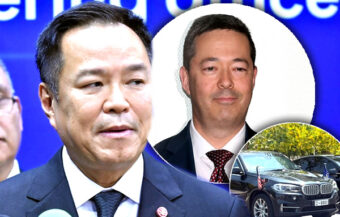
As a result, the Bank of Thailand began tracing money trails. Governor Vithai Rattanagorn said suspicious cases would be forwarded for investigation. These would go to the Anti-Money Laundering Office. If linked to the election, they would go to the Election Commission.
In response, the Election Commission acknowledged receiving the information. The 250 million baht case involved six individuals. Officials said procedures would be followed strictly. The data was forwarded to a fact-finding subcommittee. The panel will assess links to candidates or parties. After that, at the end of the week, further information was sent to the election agency by the central bank. This concerned 11 named accounts and substantial withdrawals.
Undeniably, vote buying has been rampant in this general election. Whether it can influence the ultimate outcome will be known very shortly.
Meanwhile, political campaigning continued alongside voting. The ruling Bhumjaithai Party entered the election from a position of power. The party has governed for only a short period. Therefore, it campaigned on consolidation and stability. National security featured prominently in its messaging.
Bhumjaithai leans on nationalism and entrenched local networks as it seeks to dominate conservative voters
Notably, nationalist sentiment rose during the campaign. Tensions linked to the Thai-Cambodian border dispute played a role. Consequently, Bhumjaithai leaned heavily into patriotic themes. Prime Minister Anutin Charnvirakul led the campaign personally.
In addition, the party relied on entrenched political networks. Local brokers mobilised voters across provinces. Influential families, known as “Big Houses,” played a role. These networks remain powerful in rural areas. Their influence shaped local outcomes.
As a result, party officials projected strong gains. They predicted between 140 and 150 seats. If achieved, this would position Bhumjaithai as the largest party. However, the final outcome remained uncertain.
In contrast, the People’s Party campaigned as a reformist force. Party leaders reported rising enthusiasm nationwide. They compared momentum favourably with 2023. That year, their predecessor shocked the establishment.
Reformist People’s Party seeks repeat of 2023 surge after dissolution of earlier progressive movements
Previously, the Move Forward Party won the 2023 election. Its victory disrupted traditional power structures. However, legal rulings later dissolved the party. Earlier still, the Future Forward Party met a similar fate. Consequently, the People’s Party emerged as its successor.
During the campaign, leader Nattapong Ruangpanyawut set ambitious goals. He appealed directly for a landslide victory. He urged voters to secure more than half of the parliamentary seats. According to party leaders, this would ensure policy implementation.
The People’s Party outlined several core policies. Military reform featured prominently. It proposed replacing compulsory conscription with voluntary service. Additionally, the party pledged financial support for small and medium-sized enterprises.
Meanwhile, Pheu Thai staged a notable political comeback. Only months earlier, the party appeared sidelined. Its decline followed dramatic events in 2025. In August that year, Prime Minister Paetongtarn Shinawatra was removed from office. The Constitutional Court cited serious ethical violations linked to the Thai-Cambodian conflict.
Pheu Thai resurges after political collapse, betting on populist economics and new leadership momentum
In the following days, her father, Thaksin Shinawatra, was jailed. This occurred in early September 2025. Consequently, Pheu Thai was widely written off. Many analysts predicted a prolonged decline.
However, the party regrouped quickly. It nominated Dr Yotsanu Wongsawat as its prime ministerial candidate. Since then, his profile has risen sharply. Campaign rallies attracted large crowds.
Pheu Thai focused its campaign on economic relief. Policies targeted low-income voters and provincial regions. Promises included higher incomes for farmers. Pay rises for civil servants were pledged. Police and soldiers were also included. Additionally, the party promoted a wealth creation policy. It promised to create nine millionaires every day.
Meanwhile, Thailand’s oldest political party re-entered the contest. The Democrat Party campaigned under former Prime Minister Abhisit Vejjajiva. The party sought renewed relevance. However, structural limits constrained conservative parties.
Conservative vote fragmented as analysts warn a landslide victory is unlikely amid deep divisions
Analysts estimate conservative support at 35 to 38 percent. Consequently, competition within the bloc intensified. Bhumjaithai aimed to dominate conservative voters. Yet fragmentation posed risks. Multiple parties targeted the same constituencies.
Across the political spectrum, analysts agreed on one point. A landslide victory was unlikely. Thailand’s ideological divisions remain deep. Economic pressures further complicated outcomes.
The economy ranked high among voter concerns. The cost-of-living weighed heavily on income-deprived and over-borrowed households. Income insecurity shaped decision-making. Additionally, the Thai-Cambodian border issue influenced perceptions.
Regional observers track turnout, youth participation and coalition prospects as polls close across Thailand
The Straits Times closely followed the election. The Singapore-based outlet reported nearly 53 million eligible voters nationwide. This included 2.3 million first-time voters. Youth participation drew particular attention.
Vote buying operation detected in Khon Kaen in viral video clip. Report lodged with Election Commission
PM Anutin bullish as he campaigned in Sisaket as the Constitutional Court threw out 2 cases against him
According to the report, voters prioritised economic stability. Border tensions were also prominent. Analysts told the Singapore-based newspaper that divisions would prevent a clear winner. Therefore, coalition negotiations were expected.
As polls closed, attention turned to results and certification. Coalition talks loomed. Legal challenges remained possible. Consequently, Thailand may be entering another period of political uncertainty.
This is exacerbated by an unwieldy constitution, which denudes elected representatives of power, and by the country’s fault line of conflict between traditional and progressive forces.
Join the Thai News forum, follow Thai Examiner on Facebook here
Receive all our stories as they come out on Telegram here
Follow Thai Examiner here
Further reading:
Bank of Thailand Governor orders monitoring of cash withdrawals amid widespread vote buying fears
High powered, secretive meeting chaired by PM agrees robust action against Cambodian networks