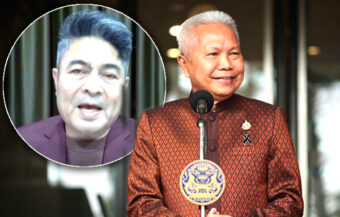
The Financial Times brands Thailand the “sick man of Asia” as debt nears 90%, growth lags at 2%, factories close, and tourism declines. Two Prime Ministers hit back, but ageing demographics, weak wages, tariffs and political churn deepen fears over a slowing economy.
Both Prime Minister Anutin Charnvirakul and former Prime Minister Srettha Thavisin responded this week to the Financial Times analysis of Thailand’s economy published on February 4, an article that laid out the stark challenges facing any government trying to steer the kingdom’s troubled economy. Srettha pointed to what should have been done under his short-lived administration before his removal in August 2024, while the newly elected Anutin promised strong and prudent financial management. Yet it will take far more to fix a developing country heading for super-aged status by 2033.
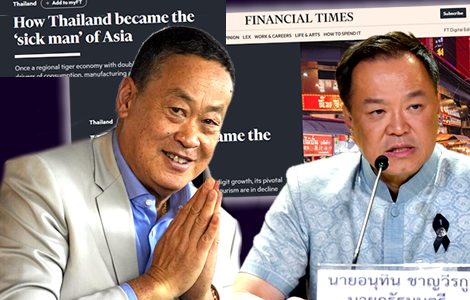
On February 4, the Financial Times published a stark assessment of Thailand’s economy. In that analysis, it described the country as the “sick man of Asia.” Moreover, it outlined proposals to revive growth and restore competitiveness.
The article pointed to structural weaknesses, prolonged stagnation and policy drift. As a result, the language resonated sharply in Bangkok. Consequently, senior political figures moved quickly to respond.
On February 11, the newspaper carried a formal reply in its “Letters to the Editor” column. The response came from former Prime Minister Srettha Thavisin. In his letter, he accepted that the economy showed visible strain. However, he argued that the proposed cure was incomplete. While acknowledging the “symptoms,” he challenged the diagnosis. Therefore, he set out his own prescription in direct terms.
Debt reset plan and ageing pressures shape Srettha’s response to Financial Times critique
First, Mr Srettha said consumer confidence must be restored. Above all, he identified household debt as the central obstacle. Thailand’s household debt-to-GDP ratio stands near 90 per cent. As such, it ranks among the highest in Asia. According to him, earlier stimulus measures failed to deliver a full impact. Specifically, debt burdens diluted the benefits. In addition, economic uncertainty suppressed spending. Consequently, growth impulses faded quickly.
Accordingly, he proposed what he termed a “major reset.” Under this approach, asset management companies would purchase non-performing loans. In turn, this would restore liquidity to households. Then, households could re-enter the economic cycle. Ultimately, he argued, domestic consumption would strengthen. At the same time, confidence would gradually recover.
Meanwhile, the February 4 analysis placed heavy emphasis on demographics. Thailand is now classified as an aged society.
Notably, it is among the first still-developing countries to reach that status. Currently, more than 20 per cent of the population is over 60. By 2033, that share will rise to 30 per cent. In parallel, the population has been shrinking for four consecutive years. In 2025, the birth rate reached a 75-year low.
Super aged status looms as growth weakens and traditional engines lose power nationwide
Indeed, Thailand is on course to become one of the world’s first still-developing economies to become super aged. It is certainly a frightening first.
Consequently, labour supply is tightening. Furthermore, the domestic consumer base is narrowing. Productivity and output face sustained constraints. Over the past five years, annual growth has hovered around 2 per cent. By contrast, growth reached 13 per cent in 1988. At that time, Thailand was hailed as an “Asian tiger.” Today, that benchmark appears distant.
Moreover, the country’s core growth engines are weakening. Consumption has slowed sharply. Manufacturing has declined steadily. Tourism has lost momentum. Together, these sectors once powered expansion. Now, they signal structural fatigue.
Manufacturing has faced years of pressure. On one side, domestic demand has softened. On the other hand, cheaper Chinese imports have intensified competition. In addition, newer hubs such as Vietnam have gained ground. As a result, Thailand’s competitiveness has eroded. Output levels have fallen from earlier peaks.
Factory cuts, credit tightening and weak markets deepen Thailand’s economic slowdown
The automotive sector provides a clear example. Previously, Thailand served as a regional hub for vehicle production. However, several global manufacturers have reduced operations. In recent years, Nissan, Honda and Suzuki have shut factories or scaled back output. Consequently, vehicle production has declined. Domestic car sales have also fallen. Likewise, plant utilisation rates remain below pre-pandemic levels.
At the same time, financial conditions have tightened. Banks, concerned about defaults, have reduced lending. As a consequence, credit growth has slowed. Meanwhile, the property market is in its worst slump in three decades.
In addition, headline inflation turned negative last year. This signalled weak demand across sectors. Furthermore, Thailand’s stock market declined 10 per cent in 2025 in local currency terms. Over that period, it was Asia’s worst performer.
Growth forecasts remain subdued. The government projects a 2 per cent expansion this year. However, the International Monetary Fund forecasts 1.6 per cent. That would mark the slowest pace among major Southeast Asian economies. Therefore, expectations remain restrained.
Tourism slowdown hits small firms as visitor numbers fall and consumer spending weakens
Tourism, another key engine, is also under strain. In 2025, Thailand recorded 32.9 million foreign visitors. That represented a 7 per cent decline from the previous year. Moreover, it remained below the 40 million recorded in 2019. Industry representatives cite safety concerns. They also note rising competition from Vietnam and Japan. Consequently, related sectors have felt the impact.
Retail sales have softened. Hotel occupancy has weakened. Restaurant traffic has thinned. On Bangkok’s Banthat Thong Road, once a busy street food destination, several eateries have closed. As footfall declines, small businesses face mounting pressure.
Tipvimol Wanitthaphan, 57, illustrates the strain. She moved to Bangkok to support her family. For four years, she operated a restaurant serving office workers. Recently, sales plunged by two-thirds. As losses mounted, she decided to close when her lease expires in April. She cited layoffs and falling purchasing power. In addition, she remains concerned about her car loan repayments.
Similarly, Tewanaree Sawangnate, who runs a Bangkok hair salon, reports fewer customers. As a result, she has reduced discretionary spending. Instead, she prioritises essential household expenses. These individual accounts reflect broader consumer caution. In turn, subdued demand feeds back into slower growth.
Infrastructure overhaul and regulatory reform are proposed to reposition Thailand globally
In his letter, Mr Srettha also addressed infrastructure and regulation. He argued that Thailand must become an indispensable part of the global economy. Therefore, he proposed a two-pronged infrastructure strategy.
First, he highlighted the development of the north-south railway system. Second, he referenced the land bridge linking the Andaman Sea and the Gulf of Thailand. According to him, these projects would improve trade efficiency and logistics flow.
In addition, he called for regulatory modernisation. Specifically, he supported direct power purchase agreements. This would allow foreign investors to access clean energy directly. Moreover, he said environmental, social and governance barriers should be reduced for major technology firms. He also promoted a “Go Cloud First” policy. In his view, this would attract investment in data centres and semiconductors. Consequently, productivity in the AI era could rise.
On tourism, he advocated a shift from volume to value. Thailand, he said, offers more than beaches. Therefore, a more diversified tourism and recreation sector is required. This, he argued, would help counter the slowdown noted in the February 4 analysis.
Political turnover and fiscal discipline debate frame official responses to the scathing FT critique
However, Mr Srettha was removed from office on August 14, 2024. The Constitutional Court ruled him unfit under the 2017 Constitution. His departure added to frequent leadership changes. Since 2006, Thailand has had 11 prime ministers. Since 1932, it has experienced 13 coup d’état and 11 attempted coups. In the past three years alone, the country has had three prime ministers. Consequently, political continuity has been limited.
On Thursday, February 12, 2026, Prime Minister Anutin Charnvirakul addressed the Financial Times assessment at Government House. The PM who has just won Thailand’s controversial February 8 General Election rejected the “sick man of Asia” label. Instead, he said the description reflected the previous government’s performance. Furthermore, he pledged strong fiscal discipline.
Mr Anutin emphasised credibility with international observers. For example, he cited prompt budget allocations to repay agricultural debts to the Bank for Agriculture and Agricultural Cooperatives. According to him, this demonstrated fiscal responsibility. As a result, Thailand avoided a downgrade and maintained investor confidence.
Stability claims meet recession warnings as tariffs and a strong baht will pressure exports in 2026
When asked whether instability might deter foreign investors, he dismissed the concern. He said preliminary election results pointed to stability. While political rhetoric continued, he noted disputes did not escalate. Therefore, he described the government as strong and in control.
Industrial leaders remain wary. They warn of recession risks. In particular, they cite 19 per cent US tariffs. They also highlight the baht’s gains against the dollar. As a consequence, export competitiveness has weakened. Therefore, calls to transform traditional industries have intensified.
Economists argue that restrictions on foreign investment should be eased. They also recommend upgrading infrastructure. Potential growth areas include data centres, high-value manufacturing, pharmaceuticals and biotechnology. Nevertheless, immediate pressure rests on domestic demand.
Debt burden and weak wages tighten grip as scrutiny of Thailand’s economic path intensifies
High household debt constrains spending. Stagnant wages limit purchasing power. Consequently, many Thais are cutting discretionary expenses. Banks remain cautious. Together, these factors reinforce subdued growth.
New government urged to deal with economic decline headon. Grasp technology investors and fight debt
One of Thailand’s top business entrepreneurs calls for a halt to the economic rot and a new digital age
The Financial Times article sharpened scrutiny of Thailand’s economic record. In response, a former prime minister defended his policy framework and proposed structural reforms. Meanwhile, the sitting prime minister rejected the characterisation and stressed fiscal control. Both addressed the same economic realities.
Thailand faces ageing demographics, heavy debt and declining competitiveness. Growth remains modest. Political turnover has been frequent. Therefore, economic management is under sustained examination. The debate is now explicit and data-driven. The figures are clear. The pressures are defined. The response continues to unfold at the highest political level.
Join the Thai News forum, follow Thai Examiner on Facebook here
Receive all our stories as they come out on Telegram here
Follow Thai Examiner here
Further reading:
New government urged to deal with economic decline headon. Grasp technology investors and fight debt
Thailand’s days of GDP growth in excess of 5% may be a thing of the past as it has grown too old
Cabinet in pension move as the number of working Thais to over 60s is set to half in 20 years
Thailand’s new move to boost the birth rate and fight the negative impact of an ageing population
Denmark and Thailand seek economic partnership and face the same challenge – demographics
Thailand’s new move to boost the birth rate and fight the negative impact of an ageing population