Thailand to hike airport departure tax 53% despite falling tourist numbers. Former Democrat deputy Samart slams the timing as arrivals drop 7.5%. Outbound fee jumps to 1,120 baht from June 2026, hitting potentially tens of millions of passengers.
Thailand’s top airports will impose a 53% increase in the passenger service charge on all outbound travellers from June 2026. The move by the Bhumjaithai-led government comes as foreign tourism slides, with arrivals in early 2026 down 7.53% and 2025 closing 7.2% lower than the year before. On Friday, former Democrat Party deputy leader Samart Ratchapolsitte sharply criticised the decision, saying it makes Suvarnabhumi and other Thai airports markedly more expensive than several of the world’s leading gateways. The higher levy will be built into airfares and will affect return tickets purchased for travel after June.
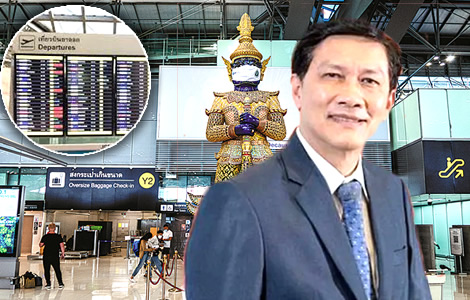
Former Democrat Party deputy leader Samart Ratchapolsitte has sharply questioned Thailand’s decision to raise its international passenger service charge, drawing comparisons with leading global airports as foreign tourist arrivals decline.
Additionally, analysts have also questioned the timing of the move, with foreign tourism numbers in continuous decline. According to figures to February 15, 2026, arrivals are down 7.53%. Meanwhile, final figures for 2025 stand at 33 million visitors. Earlier data recorded a 7.2% drop last year compared to 2024. Against this backdrop, the Civil Aviation Authority of Thailand will proceed with a 53% increase in the outbound levy.
As a result, the passenger service charge will rise from 730 baht to 1,120 baht. The increase amounts to 390 baht per traveller. Consequently, outbound international travel from Thailand will become more expensive from June 20, 2026.
53% outbound levy approved for six AOT airports handling 35 million international passengers annually
The charge applies to all international departures from airports operated by Airports of Thailand Public Company Limited. These include Suvarnabhumi, Don Mueang, Phuket, Chiang Mai, Hat Yai and Chiang Rai. Together, the six airports handle roughly 35 million international passengers each year. However, the domestic passenger service charge will remain unchanged at 130 baht.
The Civil Aviation Board approved the increase on December 3, 2025. Notably, the meeting was chaired by Transport Minister Phiphat Ratchakitprakarn. The decision followed an application by Airports of Thailand seeking a higher rate.
Subsequently, AOT confirmed that the new charge will take effect after the required administrative steps. Before enforcement, the company must gather feedback from relevant groups. It must then submit final documents to the transport minister. After endorsement, AOT must publicise the new rate at least four months in advance. Therefore, airlines and travel agents will have time to adjust booking systems and fare structures.
Importantly, the passenger service charge is bundled into airline tickets at purchase. Travellers do not pay it separately at the airport. Accordingly, once implemented, the higher rate will appear directly in ticket breakdowns. Airlines operating outbound international flights from the six airports will incorporate the 1,120 baht charge automatically.
AOT projects a ฿13 billion revenue boost in 2027 to fund terminal expansion and reduce borrowing
According to AOT president Paweena Jariyathitipong, studies support the adjustment. She said the charge represents only a small proportion of overall travel expenses. Therefore, the company does not expect the increase to alter travel decisions.
In addition, AOT projects that the higher rate will generate about 13 billion baht in fiscal 2027. Earlier estimates indicated roughly 10 billion baht annually. The additional revenue will serve as investment capital for future projects.
In particular, a major allocation is planned for a new South Terminal at Suvarnabhumi Airport. The project carries a value of more than 200 billion baht. Furthermore, the company said the increased levy will help improve its cost structure. It aims to reduce reliance on borrowing and ease interest burdens. Consequently, AOT stated that the objective is to strengthen financial resilience rather than maximise profit.
At the same time, AOT cited international practice. It said more than 90% of airports worldwide charge both departing and transit passengers. By contrast, Thailand charges only departing passengers. As a result, AOT described the country as part of roughly 5% of airports that do not levy transit fees. The company argued that this limits long-term revenue potential.
Operational pressures mount across the network as airports cite rising costs and infrastructure demands
Operational pressures have intensified across the network. For example, Suvarnabhumi remains Thailand’s primary long-haul hub. Meanwhile, Don Mueang manages heavy low-cost carrier volumes.
Phuket and Chiang Mai record strong passenger flows during peak tourism seasons. In addition, Hat Yai and Chiang Rai support important regional traffic. Airports face rising maintenance costs and infrastructure demands. Security systems require regular upgrades. Digital platforms need constant updates. Therefore, operators argue that stable revenue streams are essential.
However, Mr Samart questioned whether passengers would see tangible improvements. He said the issue is not simply the size of the increase. Instead, he argued the focus must be on service standards delivered in return. Notably, he observed that after adjustment, the charge at Suvarnabhumi will surpass levels at many top-rated global hubs. This is despite Suvarnabhumi ranking only 39th in the latest Skytrax list.
Samart compares global airport charges and warns of higher fares and tourism competitiveness risk
He cited comparative passenger service charge levels at leading airports. Singapore’s Changi stands at about 1,600 baht. Doha’s Hamad and Tokyo’s Haneda charge around 600 baht. Seoul’s Incheon stands at about 370 baht. Tokyo’s Narita is about 640 baht. Hong Kong charges roughly 800 baht. Therefore, he asked what level of service travellers would receive if they paid at global levels.
Moreover, Mr Samart warned of possible fare impacts on low-cost routes. He said the 390 baht increase could raise ticket prices by 7% to 10%. This applies to typical four- to five-hour flights priced between 4,000 and 5,000 baht. Consequently, he said Thailand’s price competitiveness could be affected. He added that tourists might divert to cheaper destinations. Furthermore, he pointed to potential long-term implications for the tourism economy.
He argued that revenue from the higher charge should be transparently directed toward practical upgrades. For example, he listed shorter queues at immigration and security checkpoints.
He cited faster baggage handling systems and adequate seating. He mentioned sufficient toilets and reliable high-speed Wi-Fi. In addition, he referred to fully functional self-check-in systems and biometric processing. He also highlighted enhanced security measures and expanded infrastructure to relieve congestion.
Duty-free income declines as short-haul and lower-spending travellers reshape airport revenues
Meanwhile, the increase coincides with reported declines in duty-free income at airports. This reflects changing traveller behaviour and spending patterns.
In addition, airports have seen a rise in short-haul and lower-spending tourists. Consequently, non-aeronautical revenues have come under pressure. Against this broader financial context, the passenger service charge rise represents a significant adjustment.
Higher return fares to Thailand after 53% Airport Tax rise ok’d by panel chaired by Transport Minister
The 390 baht increase marks one of the largest revisions to the international departure levy in recent years. Once implemented, every outbound international passenger from the six AOT airports will pay 1,120 baht.
Therefore, from June 20, 2026, Thailand’s main air gateways will operate under the higher charge regime. The Civil Aviation Board has approved the framework. AOT has confirmed the timetable. Airlines will update fares. Passengers will bear the additional cost as part of their ticket price.
Join the Thai News forum, follow Thai Examiner on Facebook here
Receive all our stories as they come out on Telegram here
Follow Thai Examiner here
Further reading:
Another false dawn? Minister announces delayed tourism levy will be instituted under his watch
Tourism Levy will take at least six months to implement even after a cabinet decision to approve it
New Electronic Travel Authorisation (ETA) system coming soon with a ฿300 tourist levy and insurance
Tragic death of a Taiwanese tourist is another wake-up call for the government on insurance cover
66-year-old Thai woman highlights Thailand’s official tiered pricing in hospitals for foreigners
Negative reaction and horror at Thailand’s plan to charge foreigners more than locals at hotels