Middle East war triggers mass airspace closures, flight chaos and 32 cancellations to Suvarnabhumi Airport. Major hubs shut, passengers stranded, casualties reported and governments issue urgent travel warnings as disruption spreads across Europe–Asia routes.
Thailand’s flight agencies on Sunday warned foreign tourists and travellers flying via the Middle East as disruption intensified, with observers saying the crisis could last days or weeks and stranded passengers and mounting backlogs now disrupting the international flight system. By Saturday morning, Suvarnabhumi Airport had recorded 32 cancelled flights, while 10 incoming services to Phuket International Airport were scrapped. Airports of Thailand is assisting passengers at its international airports, and the Civil Aviation Authority of Thailand has issued guidance on passenger rights. The warning came as US President Donald Trump said military operations were “ahead of schedule”, with three American military personnel killed and five wounded, as Washington and Israel appear committed to regime change in Tehran.
Thailand’s flight agencies and authorities issued urgent guidance to travellers on Sunday as severe disruption hit international air links. Officials described it as the biggest rupture since the COVID-19 crisis of 2020. The breakdown followed the escalating war in the Middle East.
Specifically, the United States and Israel launched strikes against Iran early Saturday. In response, Iran attacked Gulf states. Consequently, airspace closures spread rapidly across the region. Authorities now expect the conflict to continue for days or weeks.
Across the Middle East, airlines cancelled and diverted flights within hours of the strikes. As a result, operations at major hubs were suspended. Flights in and out of Tel Aviv, Dubai, Doha and other key airports were halted. Meanwhile, Iran completely closed its airspace. Israel also shut its skies to commercial traffic.
Gulf states impose sweeping airspace closures as major carriers suspend regional flights
In addition, Iraq, Qatar, Bahrain, Kuwait, Syria and the United Arab Emirates imposed closures. Saudi Arabia enacted partial restrictions. However, Jordanian and Lebanese airspace remained open, though traffic was limited.
Emirates suspended all operations in and out of Dubai due to airspace closures. The suspension lasted until 15:00 local time on Monday. Similarly, Etihad Airways halted flights out of Abu Dhabi until 02:00 local time.
Consequently, passengers were left stranded across multiple continents. Dubai International, the world’s busiest airport by passenger traffic, faced immediate operational strain. Since the strikes began, one person was killed at airports in Dubai and Abu Dhabi. Additionally, 11 others were injured. Four of those injured were staff at Dubai International. Authorities have released no further operational details.
British Airways cancelled services to Tel Aviv and Bahrain until Wednesday. Furthermore, it warned that Heathrow routes to Abu Dhabi, Amman, Bahrain, Doha, Dubai and Tel Aviv could face disruption for several days. Virgin Atlantic also suspended services between London and Riyadh and Dubai over the weekend.
Heathrow and foreign offices warn travellers as evacuation planning begins amid crisis
Moreover, it cautioned that flights to India, Saudi Arabia and the Maldives may take longer. Aircraft are being rerouted around restricted airspace. Therefore, long-haul travel times have increased across Europe–Asia corridors. Heathrow Airport urged travellers to check directly with airlines before departure.
The UK Foreign Office issued updated travel advice as the crisis deepened. It warned against all but essential travel to Bahrain, Kuwait, Qatar and the United Arab Emirates.
Furthermore, British citizens already in those countries were advised to shelter. At the same time, British officials began formulating plans to potentially evacuate UK nationals. However, timelines remain unclear because much regional airspace remains closed.
Similarly, for European Union countries. On Sunday, Ireland advised all nationals travelling to and via the Middle East to be prepared for disruptions. Citizens were advised to allow extra time, check social media and follow instructions from consular and local authorities diligently at this time.
Global flight paths rerouted as passengers stranded across Middle East transit hubs
Flight tracking data showed aircraft between Europe and Asia diverting via Saudi Arabia or the Caucasus. Consequently, established flight paths across Iran and Iraq were avoided. As closures persisted into Sunday morning, scheduling pressure intensified. Airlines worldwide cancelled or rerouted services to avoid restricted zones. Thus, the disruption extended well beyond the Middle East.
Passengers reported uncertainty at transit hubs. For example, Richard and Hannah from London were travelling to Oman when their journey was interrupted in Bahrain. Hannah said a drone attacked the airport in the early hours. Consequently, they could not reach Oman as planned. She described an uneasy 24 hours.
Given the regional escalation, they are now considering returning home. Similarly, Emma Belcher and her husband, Vic, were returning to Heathrow from the Maldives via Dubai. However, their connecting flight was cancelled. She said there was no information on when airspace might reopen.
Thailand airports hit as Suvarnabhumi records 32 cancellations amid Israel-Iran war in the sky
As a result, they remained in Dubai without a confirmed onward departure. In another case, Steve Rudderham and his wife were travelling to the Maldives via Doha to mark their wedding anniversary. Instead, they became stranded during a stopover. As days passed, he said they were reviewing plans to abandon the holiday and return home.
Meanwhile, the disruption extended to Southeast Asia. In Thailand, nine airlines cancelled 32 flights at Suvarnabhumi Airport due to the Israel–Iran unrest. Initially, eight airlines were affected on the night of 28 February 2026.
Airports of Thailand mobilised staff immediately to manage the fallout. The carriers involved were EL AL Israel Airlines, Air Arabia, Emirates, Qatar Airways, Etihad Airways, Gulf Air, Arkia Israel Inland Airlines and Kuwait Airways.
Together, they cancelled 16 flights, comprising 14 departures and two arrivals. However, by 06:48 on 1 March 2026, World2Fly also announced cancellations. Consequently, the total number of cancelled flights rose to 32, evenly split between departures and arrivals.
Airports of Thailand deploy staff and support measures as passengers face delays
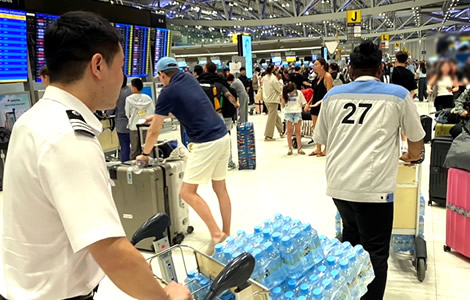
In response, Airports of Thailand deployed staff at information points throughout the terminal. Additionally, drinking water was distributed to passengers waiting to check in.
Furthermore, sufficient seating areas were prepared to handle increased waiting times. Temporary seating was added on the second floor of the arrivals terminal near gates 1 and 10. Authorities stated that airlines arranged accommodation for affected passengers as appropriate.
As a result, no departing passengers were left stranded at the airport. Airports of Thailand coordinated closely with airlines overnight to manage schedules and passenger support smoothly.
Passengers planning travel to Middle Eastern destinations or nearby regions were advised to monitor flight status closely. Specifically, airlines instructed travellers to check official websites or mobile applications.
Alternatively, passengers could approach airline counters at Suvarnabhumi Airport. Direct airline contact channels were also made available. In addition, travellers could call the AOT Contact Centre at 1722, which operates 24 hours a day.
Civil aviation authority outlines passenger rights amid flight delays and cancellations as routes close
The Civil Aviation Authority of Thailand issued formal guidance on passenger rights. According to the regulator, travellers should verify their entitlements if international flights from Thailand are delayed or cancelled.
Moreover, passengers facing service problems may file complaints at complaint.caat.or.th. The authority confirmed that Iran completely closed its airspace, while Israel shut its skies to commercial flights. In addition, the United Arab Emirates, Qatar and Kuwait partially closed airspace for security reasons. Consequently, flights to Europe, Asia and Asia-Pacific destinations may continue to face disruption.
Under Thai aviation regulations, passenger assistance is clearly defined. If a flight is delayed more than two hours, airlines must provide food and beverages or coupons. They must also provide communication devices free of charge. If a delay exceeds five hours, airlines must provide accommodation in addition to food and communication support. Furthermore, passengers are entitled to compensation of 1,500 baht.
This may be paid in cash, credit shells, travel vouchers, frequent flyer miles or equivalents. If delays exceed 10 hours, compensation increases to between 2,000 and 4,500 baht, depending on flight distance. Airlines must also provide accommodation and full assistance.
Passengers offered refunds, rebooking or alternative transport under Thai aviation rules
Passengers who cancel their trips have three options under the rules. First, they may request a full refund or alternatives such as credit shells or vouchers. Second, they may change flights to reach their original or a nearby destination.
Third, they may choose alternative transport to reach that destination. If flights are cancelled without prior notice and without alternative options, airlines must provide the same compensation as for delays exceeding 10 hours.
As the conflict continues, aviation networks remain under sustained pressure. Airspace restrictions still cover critical corridors between Europe and Asia. Consequently, rerouting remains widespread.
Airlines adjust schedules daily as governments update advisories and closures persist
Airlines are adjusting schedules daily as conditions evolve. Governments continue to update travel advisories. For now, closures remain in force across much of the Middle East. Therefore, further cancellations and delays are expected while military operations and retaliatory strikes continue.
Thailand faces Middle East instability as Khamanei is killed and US Israeli forces push regime change
Major war breaks out between United States and Iran causing chaos for air travel to Thailand at this time
US attack on Iran and Gulf of Hormuz threats spark fears of an oil price shock and more economic pain
The question is whether this is a coordinated regime change action or a war which may persist. President Donald Trump told CNBC on Sunday that military operations were going well and were “ahead of schedule”. At the same time, US Central Command confirmed three military personnel were killed in the operations so far, with five wounded.
Certain sources in Tel Aviv and Jerusalem suggest that the Israeli government is committed to a prolonged onslaught to finally overthrow the despised Iranian regime.
Join the Thai News forum, follow Thai Examiner on Facebook here
Receive all our stories as they come out on Telegram here
Follow Thai Examiner here
Further reading:
Liquidity crisis or shortage of cash on the ground is shrinking Thailand’s economic growth prospects
Thai Minsters engage with US trade chief Jamieson Greer in Paris at global OECD ministerial meeting
Commerce Minister meets US trade boss Jamieson Greer in Korea. Paul Chambers case still dogs talks