US Defence Secretary Pete Hegseth warned of China’s growing military power, urged Asian allies to boost defence spending, strengthened security ties with Thailand, backed support for Taiwan, and outlined Washington’s strategy for deterring threats across the Indo-Pacific.
A stark warning on China, a demand for higher Asian defence spending, and a deepening US-Thailand security partnership dominated one of the Indo-Pacific’s most important security summits. Speaking at the Shangri-La Dialogue in Singapore, US Defence Secretary Pete Hegseth urged allies to rapidly strengthen their militaries, declared that the era of security “freeloading” is ending, and outlined Washington’s strategy on threats ranging from Taiwan to Iran, as geopolitical tensions reshape Asia’s balance of power.
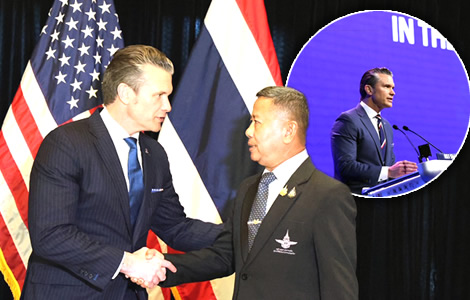
US Secretary of Defence Pete Hegseth on Saturday urged Asian allies to sharply increase defence spending to counter China’s rising military power. He spoke in Singapore at the IISS Shangri-La Dialogue, warning of “rightful alarm” over China’s rapid military buildup.
He said China’s expansion is historic in scale and extends across the region and beyond. He added that a China-dominated Pacific would disrupt the regional balance of power.
He said no state should impose regional dominance, including China. He also warned that security and prosperity across the region would be placed at risk. Moreover, he called for stronger deterrence through collective allied capacity. He linked this directly to increased defence spending.
Hegseth urges allies to boost defence spending, share security burdens and reinforce deterrence now
He urged Asian allies to raise defence spending to 3.5 per cent of GDP. Meanwhile, he said the United States is investing about 0.5 trillion dollars in defence. In addition, he said spending increases are directly tied to deterrence and stability. Therefore, he argued that stronger alliance structures are necessary.
He said allies must assume greater responsibility for regional security. Furthermore, he said reliance on US support must decrease. Consequently, he framed this as a shift toward burden-sharing. He said alliances require self-reliance to remain credible.
He said, “less Shangri-La, more ships, more subs.” At the same time, he said allies seek stability rather than escalation. Moreover, he said stability depends on strength and discipline. He added that deterrence requires visible capability.
He said US leadership will remain steady and disciplined. In addition, he said it will remain confident in execution. He also referenced a “walk softly while carrying a big stick” approach. Therefore, he linked messaging to long-standing deterrence doctrine.
Improved US-China communication and dialogue are presented as safeguards against escalation risks
He said US-China communication is improving. Meanwhile, he said relations are better than in many years. Additionally, he said military-to-military channels are more active. He said contact reduces the risk of miscalculation.
He added that increased communication helps manage tensions. Therefore, he said open lines of dialogue are essential. In parallel, he described engagement as ongoing and structured. He said this reduces escalation risks.
Chinese academic Zhou Bo, a retired PLA senior colonel from Tsinghua University, offered a response at the forum. He described US-China relations as “complicated.” However, he said the tone from Washington has improved compared with last year. He linked this to recent political engagement between both sides.
He said both sides maintain communication channels. Meanwhile, he said dialogue remains open despite tensions. Additionally, he said the situation is less difficult than external perceptions suggest. He noted that media interpretation often exaggerates risk.
Allied burden-sharing takes centre stage as Hegseth presses partners to contribute more equally
China’s defence minister did not attend the dialogue for a second consecutive year. Previously, Chinese officials criticised US remarks at the forum as “vilifying.” This absence marked continued diplomatic distance at a senior level.
Hegseth also focused heavily on allied burden-sharing. He said the era of US subsidy for wealthy allies is ending. Moreover, he said there should be “no freeloading.” In addition, he said allies must have “skin in the game.”
He named South Korea, Thailand, the Philippines, Australia, Singapore, Malaysia, and Japan. Meanwhile, he said these countries contribute to regional security efforts. He added that Japan is strengthening its defence posture. He said the US-Japan alliance requires equal effort.
He said both sides must “pull our weight.” Consequently, he framed alliance strength as dependent on shared responsibility. In parallel, he said imbalance weakens deterrence. Therefore, he called for coordinated investment.
Thailand and the United States deepen defence ties through technology, readiness and training efforts
On the sidelines, Thailand’s Defence Minister Adul Bunthamcharoen met US officials during the summit. The meeting focused on Indo-Pacific security conditions and bilateral defence cooperation. Meanwhile, both sides reaffirmed their strategic partnership. They also reviewed long-term cooperation frameworks.
Thailand expressed appreciation for US support in defence capability development. This included unmanned aerial systems and counter-UAS systems. In addition, it included cybersecurity and space technology. It also covered modern battlefield management systems.
These capabilities were linked to future operational requirements. Therefore, both sides emphasised adaptation to evolving threats. In parallel, they discussed continued modernisation of the armed forces. This included technology transfer and capability integration.
Both sides reaffirmed the Cobra Gold exercise. Meanwhile, they described it as a symbol of long-standing cooperation. In addition, it remains a major multinational exercise in the Indo-Pacific. They agreed to continue and further develop it.
The exercise was linked to combat readiness and joint operations. Moreover, it includes responses to emerging threats. It also covers humanitarian assistance and disaster relief. Therefore, it combines military and non-traditional missions.
Defence cooperation expands to crime prevention, regional stability and dispute management efforts
They also agreed to modernise defence cooperation frameworks. In addition, they will update related agreements and documents. This is intended to reflect new operational environments. It also supports long-term defence planning.
Future cooperation includes education and training. Meanwhile, it also includes joint operations and procurement. Additionally, capability development remains a central focus. Therefore, cooperation extends across multiple defence domains.
Both sides also expanded cooperation against transnational crime. In particular, they focused on online scam networks. These networks were described as affecting multiple countries across the region. Consequently, they linked the issue to economic and security risks.
Thailand thanked the United States for its role in regional stability. In addition, it referenced support in managing regional disputes. Meanwhile, both sides discussed Thailand–Cambodia tensions. They supported peaceful resolution through dialogue mechanisms.
Hegseth outlines positions on Iran, Taiwan and broader US military preparedness and policy direction
They agreed that bilateral dialogue should remain the primary channel. Moreover, they emphasised mutual respect in dispute resolution. In parallel, they referenced international law as a guiding framework. Therefore, diplomatic mechanisms were reaffirmed.
Hegseth also addressed wider US military posture. He said the United States remains ready if diplomacy fails with Iran. Meanwhile, he said strike capability remains available if required. In addition, he said negotiations with Tehran are ongoing.
He noted that major differences remain unresolved. Therefore, diplomatic progress remains limited. In parallel, he said President Donald Trump is seeking a strong deal. The aim is to prevent Iran from obtaining nuclear weapons.
On Taiwan, he said US stockpiles remain strong and stable. Meanwhile, he dismissed concerns about ammunition shortages. In addition, he said supply levels are sufficient. He referenced a potential multi-billion-dollar arms package.
US policy continuity on Taiwan and China accompanies wider regional security dialogue discussions
Reports placed the package at up to 4 billion dollars. However, he said final approval rests with the president. He added that there is no change in US policy toward Taiwan. In parallel, military communication with China continues.
Poll shows Thailand supports China while its nearest neighbours are moving towards the United States
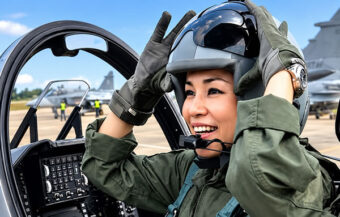
Thai air force opts for Swedish Gripen fighter jets in a rebuff to the United States and its F16 jets proposal
He said engagement channels remain active between Washington and Beijing. Meanwhile, he said final decisions depend on US-China relations. Therefore, he reaffirmed continuity in policy direction.
The Shangri-La Dialogue continued as the region’s key security forum. It brought together defence leaders across the Indo-Pacific. Meanwhile, discussions centred on deterrence, burden-sharing, and regional stability. In addition, bilateral engagements reinforced ongoing defence cooperation.
Join the Thai News forum, follow Thai Examiner on Facebook here
Receive all our stories as they come out on Telegram here
Follow Thai Examiner here
Further reading:
Poll shows Thailand supports China while its nearest neighbours are moving towards the United States
Trade expert warns the government on barter deals with China being pursued by the Commerce Ministry
Top Commerce Ministry official warns that any US trade deal must wait for new parliament and cabinet
Asean Summit on Monday and Tuesday seen by United States as pivotal to restoring border peace
War to continue says PM Anutin. Dismisses President Trump’s ceasefire talk as a ‘misunderstanding’
Confusion after Trump’s 20 minute phone call with PM Anutin. US side claimed a ceasefire was agreed