A fierce Budget Bill clash has thrust ISOC into the spotlight, with Wan Muhammad Nor Matha demanding its abolition over cost, powers and performance. Prime Minister Anutin has rejected the proposal.
Prime Minister Anutin Charnvirakul has flatly rejected a parliamentary call by former House Speaker Wan Muhammad Nor Matha, now chairman of the Prime Minister’s Advisory Council, to dissolve the Internal Security Operations Command (ISOC), setting up a high-stakes clash over one of Thailand’s most powerful security agencies as lawmakers scrutinise the ฿3.788 trillion Budget Bill. The dispute extends beyond spending to overlapping powers, the southern insurgency, the attempted assassination of a Prachachart Party MP and the future of Thailand’s internal security apparatus.
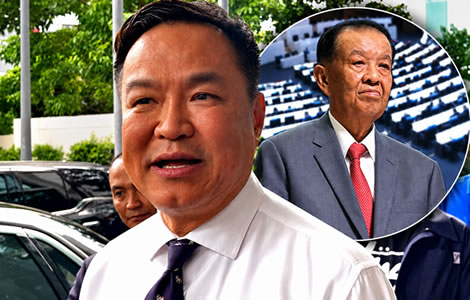
Prime Minister Anutin Charnvirakul has firmly rejected calls to dissolve the Internal Security Operations Command (ISOC), insisting the agency remains an established part of Thailand’s security structure.
He said ISOC has served the country for many years and cannot simply be dismantled. His remarks followed renewed criticism during scrutiny of the government’s proposed Fiscal Year 2027 Budget Bill.
Speaking on July 7 at Bhumjaithai Party headquarters, Mr Anutin addressed the issue as Prime Minister, Interior Minister and director of ISOC. The latest controversy stemmed from comments by Wan Muhammad Nor Matha, chairman of the Prime Minister’s Advisory Council, who urged the government to abolish the agency. In response, Mr Anutin declined to engage directly with the proposal. Instead, he said reporters should put that question to Mr Wan.
Budget bill puts southern security strategy and oversight committees under renewed parliamentary focus
The debate surfaced during examination of the proposed ฿3.788 trillion national budget. At the same time, Mr Wan used scrutiny of the National Security Council’s allocation to question the effectiveness of several security bodies.
As a member of the special committee examining the Budget Bill, he sought detailed information on five committees established under the government’s southern border strategy. He requested details of their membership, responsibilities and past achievements. He said Parliament must determine whether those bodies are still functioning effectively.
The five committees oversee integrated planning and coordination across agencies. They also study decentralisation and governance models for the southern border provinces.
Their work extends to regional education policy, international cooperation supporting peace efforts and promoting multiculturalism in the Deep South. Against that background, Mr Wan argued that tangible progress should already have been visible. He said the long-running insurgency should have eased considerably if those committees had been performing effectively.
Wan questions ISOC’s expanding role, budget and oversight after years of increased powers and funding
Mr Wan then shifted his attention to ISOC itself. He argued that many of the organisation’s responsibilities overlap with those of existing government agencies. As a result, he questioned why it continues receiving substantial annual funding. “I believe it is time to dissolve ISOC,” he said. “It has been allocated billions of baht over many years, and we must ask whether that spending has been worthwhile.”
Notably, Mr Wan also questioned the agency’s operational effectiveness by referring to the attempted assassination of Prachachart Party MP Kamolsak Leewama. Mr Kamolsak narrowly escaped death after gunmen opened fire on his vehicle outside his home in Bacho district in March.
Two of his aides were seriously wounded in the attack. Mr Wan referred to allegations linking ISOC vehicles, weapons and personnel to the case. He argued that the incident intensified questions about the organisation’s oversight and responsibilities.
Mr Wan also claimed ISOC’s role changed fundamentally after the 2006 military coup. Before then, he said, the organisation carried more limited responsibilities. Since then, its mandate has expanded significantly. Its budget has also grown sharply, he argued. He therefore proposed returning funding and personnel to agencies already responsible for those functions.
Anutin dismisses the political rift and says Wan remains a close adviser despite disagreement over ISOC
Reporters later asked Mr Anutin whether he had discussed the proposal with Mr Wan. He replied that no such conversation had taken place. They also asked whether the disagreement risked becoming a politically sensitive issue. However, Mr Anutin rejected that suggestion outright. “Please don’t think like that,” he said.
Instead, the Prime Minister stressed that Mr Wan remains one of the government’s closest advisers. He noted that Mr Wan will accompany him on an upcoming official visit to Malaysia.
He also said Mr Wan regularly joins him during meetings with military commanders and visits to the southern border provinces. Those engagements, he said, demonstrate continued cooperation between them. “I firmly believe there is nothing to this matter,” Mr Anutin said.
Reporters also questioned Mr Anutin about the Prime Minister’s instruction for government agencies to deliver quicker results. In reply, he acknowledged that Mr Wan comes from the southern border region.
He said that background naturally shapes his views following security incidents. Mr Anutin added that such concerns require explanation and clarification. He also said every agency is carrying out its responsibilities to the best of its ability.
Prime Minister rules out abolishing ISOC as wider budget debate expands to overlapping state agencies
Even so, journalists again asked whether ISOC could eventually be dissolved. Mr Anutin’s answer remained unequivocal. “How could it be dissolved?” he said. “It has been a part of Thailand’s nation for so many years.” The response left little doubt about the government’s position on the organisation’s future.
Separately, the budget hearing broadened into a wider examination of overlapping government bodies. Veera Theerapat, an adviser to the special committee, proposed abolishing the Strategic Transformation Office.
He argued that its responsibilities overlap with those of existing agencies. He also questioned whether it performs any distinct function that justifies continued funding.
Meanwhile, ISOC mounted a robust defence before the committee. Secretary-General Chaipruak Doungprapat rejected suggestions that the organisation had become redundant. He said ISOC performs a coordinating role comparable to the United States Department of Homeland Security.
ISOC defends national coordinating role and rejects claims of duplicate staffing and overlapping budgets
According to General Chaipruak, the agency brings together multiple security organisations, closes communication gaps and strengthens operational integration. He argued that those functions remain essential.
On the financial issue, General Chaipruak rejected allegations of duplicate personnel payments. He said budget allocations apply only to officers assigned to specific operational missions. He insisted there are no overlapping salaries or duplicate positions funded through ISOC. He also said the organisation is prepared to accept criticism and improve its efficiency.
Former Speaker piles pressure on the government over gun attack on Prachachart Party MP Kamolsak
Prime Minister Anutin apologises for comments made by army commander in South to mend fences
Overall, the exchanges exposed sharply different views over ISOC as Parliament continues scrutinising government spending for the next fiscal year. Critics questioned overlapping responsibilities, expanding budgets and operational performance.
Government leaders defended the agency’s coordinating role across Thailand’s security system. For now, Mr Anutin’s position remains unequivocal. He insists ISOC is deeply embedded within Thailand’s national security framework and sees no basis for dismantling an organisation that, in his words, “has been a part of Thailand’s nation for so many years.”
Join the Thai News forum, follow Thai Examiner on Facebook here
Receive all our stories as they come out on Telegram here
Follow Thai Examiner here
Further reading:
Former Speaker piles pressure on the government over gun attack on Prachachart Party MP Kamolsak
Prime Minister Anutin apologises for comments made by army commander in South to mend fences
Southern army units robustly deny any involvement in attempted assassination of Prachachart Party MP
Prime Minister Anutin condemns cowardly attack on Southern Muslim MP who voted for him on Thursday