Emergency crews worked through the night at Wongwian Yai after a leaking Purple Line tunnel triggered ground subsidence, bridge demolition, building closures and a major stabilisation operation, leaving 105 residents seeking assistance on Saturday evening.
A major engineering operation entered a decisive phase at Bangkok’s Wongwian Yai intersection on Saturday as crews demolished a pedestrian overpass, deployed heavier machinery and intensified emergency efforts to save the Purple Line South MRT tunnel after a dangerous water leak triggered ground subsidence, cracked nearby buildings and forced the Bangkok Metropolitan Administration to ban their use. Although engineers reported the first encouraging signs that water inflows and subsidence are stabilising, the crisis remains far from over, with round-the-clock monitoring continuing, traffic restrictions still in force and 105 affected residents already seeking assistance.
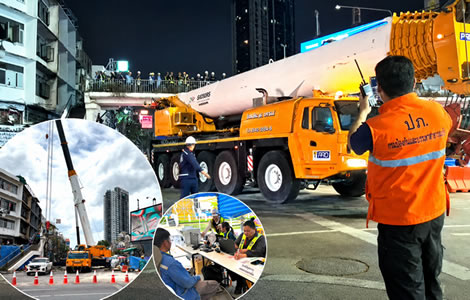
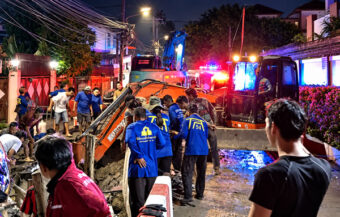
The engineering crisis at Wongwian Yai intensified on Saturday as emergency teams fought to stabilise the ground above Bangkok’s Purple Line South MRT tunnel. Engineers from the Ministry of Transport, the Bangkok Metropolitan Administration (BMA) and the Mass Rapid Transit Authority of Thailand (MRTA) remained at the site throughout the night.
Contractors continued reinforcing weakened ground while tackling water leaking into the tunnel beneath one of Thonburi’s busiest commercial districts.
Overnight, crews completed the demolition of the pedestrian overpass crossing Wongwian Yai. The operation continued without interruption before finishing at about 7.00 am. Workers then removed the remaining sections for storage.
Demolished overpass eases pressure as heavier machinery moves in for emergency tunnel repairs
Officials said dismantling the bridge reduced pressure on unstable ground. It also created access for much larger machinery. Consequently, heavy equipment immediately moved into the work zone to expand reinforcement operations.
Engineers are now injecting cement and chemical materials beneath the road surface to strengthen weakened soil layers. At the same time, specialist crews are working to stop groundwater from entering the tunnel.
Officials said removing the bridge improved access for machinery and accelerated emergency operations. As part of this effort, contractors increased equipment at the site to speed up stabilisation work.
Saturday also delivered the first signs of cautious progress. During the early hours, officials reported guarded optimism. However, they warned that the engineering emergency remained dangerous. Therefore, work continued around the clock as teams monitored every stage of the operation.
The incident involves the Purple Line South MRT project between Tao Poon and Rat Burana. More specifically, it affects Contract 4 between Saphan Phut and Dao Khanong. Ground subsidence and water leakage developed near Wongwian Yai, triggering an intensive engineering response. Since then, emergency operations have continued beneath the major road junction.
Command centre reviews progress as engineers report success in reducing tunnel water inflows
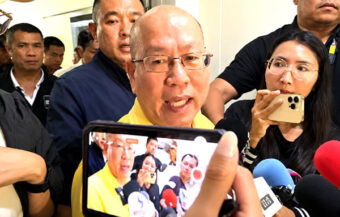
On Saturday morning, the command centre reviewed overnight progress before planning the next phase of operations. Acting Sub-Lieutenant Dechathorn Saengamnat, Director of Thonburi District, said engineers had successfully completed cement grouting at one critical location. According to Mr Dechathorn, the initial containment work has stabilised conditions at that point inside the tunnel.
Importantly, water levels inside the tunnel have remained stable. Moreover, the volume of water entering the excavation continues to decline. Engineers nevertheless remain cautious because work continues at several other seepage points. In response, contractors deployed additional machinery to reinforce the surrounding soil and seal further groundwater inflows.
Officials said approximately 170 cubic metres of chemical materials have already been injected underground. The materials strengthen weakened soil and block water pathways around the tunnel.
So far, engineers have detected no additional building subsidence. Likewise, the movement of the road surface has slowed considerably. Officials described the overall trend as positive. Even so, monitoring remains continuous.
Stabilisation works as engineers reassess the timetable while monitoring roads, cracks and seepage
Earlier assessments suggested emergency operations could take about three days. However, officials are now reassessing that estimate as conditions improve. No revised completion date has been announced. Instead, engineers will continue evaluating conditions before determining when the emergency phase can end.
Meanwhile, traffic restrictions remain firmly in place around Wongwian Yai. Authorities have not confirmed when Prachathipok Road will reopen. Closures will continue until engineers determine the affected ground is stable. Separately, officials said visible road cracks are being monitored independently from tunnel repairs, although both issues remain closely connected.
The overnight demolition of the pedestrian overpass marked one of Saturday’s most significant engineering milestones.
Alongside that operation, contractors completed cement grouting at a depth of 37 metres to block groundwater entering the tunnel at one location. Work nevertheless continues at four additional seepage points. Another treatment location was also scheduled for Saturday as crews broadened the emergency operation.
Notably, underground measurements have produced encouraging results. Water entering the tunnel has decreased compared with Friday. Accordingly, engineers reduced the operation of the pumps, removing water from the excavation. Officials said the lower inflow suggests the first containment measures are proving effective.
Building movement slows as monitoring intensifies and Bangkok expands safety measures on tunnel site
Attention has also shifted to buildings surrounding the construction zone. Every structure within a 30-metre monitoring radius is under continuous observation. Building tilt equipment records movement every 30 minutes.
Current readings show movement is decreasing. Similarly, road subsidence is becoming progressively more stable. Engineers nevertheless remain alert for any further movement.
Later on Saturday, the Bangkok Metropolitan Administration strengthened public safety measures. The BMA prohibited entry into nearby buildings considered to be at risk. The decision followed continued concerns over ground movement after cracks appeared in neighbouring properties. Subsequently, the cordoned area surrounding the site was expanded while stabilisation work continued.
Following the building restrictions, the MRTA and contractors expanded assistance for affected residents. A complaints and assistance centre was established near the King Taksin Monument. Residents affected by the restrictions were encouraged to seek help there. By Saturday afternoon, 105 people had requested assistance after the BMA prohibited the use of affected buildings.
Residents seek assistance as authorities maintain restrictions and monitor high-risk buildings
Some residents have temporarily moved to stay with relatives or friends. Others sought accommodation through the contractor. On another front, officials said 32 residents had not yet contacted the assistance centre regarding accommodation already arranged. Contractors are continuing efforts to reach those individuals.
Officials have also met residents living in higher-risk buildings. They explained the engineering situation and encouraged people either to evacuate voluntarily or monitor their properties for additional cracking. Despite those discussions, the district office has issued no further evacuation orders beyond those already announced.
Bangkok engineering crisis as underground tunnel causes subsidence and cracks in buildings and roads
Bangkok engineers scrambled to repair another large sinkhole in the busy Bang Kapi area of the capital
Sinkhole collapse report delivered to the Ministry of Transport. Phiphat will soon know what went wrong
The BMA and MRTA continue enforcing a 30-metre monitoring zone around the incident. Traffic remains prohibited along Prachathipok Road between Ban Khaek Intersection and the King Taksin Monument. Officials said limiting vehicle movements reduces vibrations that could further affect weakened soil and surrounding buildings.
Presently, officials believe the subsidence is under control. Nevertheless, engineers continue monitoring conditions around the clock. Crews remain focused on reinforcing soil layers and eliminating groundwater entering the tunnel.
Although progress has become increasingly evident, emergency operations remain active. Ultimately, the priority remains securing the tunnel, protecting nearby buildings and restoring stability beneath Wongwian Yai.
Join the Thai News forum, follow Thai Examiner on Facebook here
Receive all our stories as they come out on Telegram here
Follow Thai Examiner here
Further reading:
Bangkok engineering crisis as underground tunnel causes subsidence and cracks in buildings and roads
Just another accident or disaster on Saturday as Thailand’s image abroad takes a battering this week
Italian Thai boss and 16 others arrested on Thursday charged with Auditor General building deaths
Arrested man linked with Chatuchak building collapse now tells police he is a Chinese state employee
Prime Minister orders arrests over the Chatuchak Auditor General building disaster within seven days
Chinese steel firm linked to Chatuchak disaster faces DSI probes. Minister cancels investment status