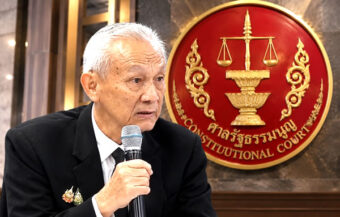
An opposition bid to derail the government’s ฿400 billion emergency borrowing has collapsed after the Constitutional Court upheld the decree, allowing ministers to press ahead with energy reforms and economic stimulus.
While on an official visit to Malaysia, Prime Minister Anutin Charnvirakul thanked the Constitutional Court for swiftly upholding the government’s ฿400 billion emergency borrowing decree, hailing a ruling that delivers a major political victory for his administration and clears the way for one of Thailand’s biggest economic programmes. The judgment removes legal uncertainty over the borrowing plan, paves the way for consumer subsidies, lower electricity costs and investment in the country’s energy transition, while strengthening Anutin’s political position after weeks of opposition efforts to have the decree declared unconstitutional.
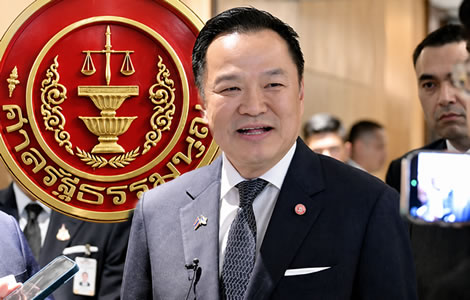
Prime Minister Anutin Charnvirakul has welcomed the Constitutional Court’s decision to uphold the government’s ฿400 billion emergency borrowing decree.
He said the judgment removes uncertainty over one of the administration’s largest economic programmes. The ruling clears the way for lower electricity costs, economic stimulus and Thailand’s energy transition.
Speaking in Kuala Lumpur at 5.15pm local time on Thursday, July 9, Anutin thanked the Constitutional Court judges for delivering their ruling quickly.
Malaysia is one hour ahead of Thailand. He was responding after the court ruled that the emergency decree authorising the Ministry of Finance to borrow ฿400 billion does not violate the Constitution. The borrowing is intended to address the energy crisis while financing the country’s transition to cleaner energy.
Court ruling removes uncertainty over emergency borrowing and strengthens government’s hand
Anutin, who also serves as Minister of the Interior, said the decision gives the government confidence to move forward. He praised the judges for expediting the case.
“Thank you to all the Constitutional Court judges for expediting the ruling on the aforementioned Emergency Decree,” he said. “This will give the government confidence that every baht will be used to its fullest potential for the benefit of the people.”
Asked whether the ruling would allow the government to work with greater peace of mind, Anutin dismissed the suggestion. Instead, he said confidence comes from acting sincerely and serving the public. “The government works with peace of mind if it is working with sincerity and doing everything for the people,” he said. He added that ministers remain conscious that the money is borrowed rather than allocated through the annual budget.
As a result, Anutin said every baht and every satang would be monitored carefully. “We are closely monitoring every baht and every satang, because the name itself indicates that it is borrowed money, not budget funds,” he said. He stressed that borrowed money demands stricter discipline than ordinary government spending. Every expenditure, he added, must generate measurable value because the debt must eventually be repaid.
Anutin promises every borrowed baht will be monitored closely and spent to deliver maximum public benefit
Notably, Anutin highlighted the financing terms secured by the Ministry of Finance. He said officials negotiated the borrowing cost down to just 1.2%. “The interest earned is very low, which the Ministry of Finance was able to negotiate down to 1.2%,” he said. He described the rate as giving the government greater flexibility to invest rather than service debt.
With borrowing costs kept low, Anutin argued the programme can focus on creating economic returns. “Every baht can be used to create added value and generate benefits, creating a multiplier effect,” he said.
He added that each spending cycle should expand economic activity and increase tax collections. “In each cycle, we can collect income tax in various forms,” he said.
In parallel, the Prime Minister said the emergency borrowing would support structural reforms in Thailand’s energy sector. Those reforms are intended to lower electricity costs for households and businesses.
“The funds from the emergency loan decree will be used to restructure the energy sector, reducing electricity costs for the public,” he said. He added that the government must maximise the opportunity created by the favourable financing terms.
Low interest costs and energy investment are expected to drive growth while cutting electricity bills
“We must seize this opportunity to maximise benefits for the government, the people, and the nation as a whole, leading to increased economic value,” Anutin said. He also argued that low interest costs remove concerns over future repayments. “With low interest rates, there’s no need to worry about whether we have enough budget to pay interest,” he said.
Earlier on Thursday, the Constitutional Court ruled that the emergency borrowing decree complies with the Constitution. In response, the judgment removed the final legal obstacle facing the government’s spending plans. The decree authorises borrowing of ฿400 billion, making it one of the administration’s largest financial interventions since taking office.
The government plans to divide the funds equally between two flagship programmes. Around ฿200 billion will finance the Thais Help Thais Plus consumer subsidy scheme, which began last month. The remaining ฿200 billion will support Thailand’s green energy transition through new investment.
Separately, opposition lawmakers brought the constitutional challenge despite backing clean energy investment. They argued the government should not have relied on emergency powers. Instead, they maintained that the proposal should have gone through the normal parliamentary process. They also said Parliament deserved the opportunity to scrutinise projects before approving such extensive borrowing.
Opposition says emergency powers were unnecessary and Parliament should have scrutinised borrowing plans
The Prachachon Party argued the prevailing circumstances failed the constitutional test of an “urgent and unavoidable necessity”. Opposition MPs also claimed the government’s energy spending plans remained too vague. They argued that the projects required greater parliamentary examination before any funds were released.
On another front, Finance Minister Ekniti Nitithanprapas consistently defended the borrowing throughout the legal challenge. He argued that higher energy prices affect every household, business and industry.
Therefore, he maintained the government needed to respond without delay. According to Ekniti, the emergency decree provides the speed required to cushion the economy from rising energy costs.
The cabinet approved the borrowing decree in May as oil prices climbed following the war in Iran. The government argued Thailand’s economy required immediate support. Ministers also said accelerating the energy transition would strengthen long-term economic resilience while reducing dependence on imported energy.
Finance minister says higher energy costs justified emergency borrowing despite opposition’s claims
Delivering its judgment, however, the Constitutional Court rejected the opposition’s arguments. “The court finds that the loan decree is constitutional,” it said in a statement. The ruling immediately cleared the government to implement both spending programmes.
Despite the ruling, Prachachon Party leader Natthapong Ruangpanyawut maintained his criticism. “We are disappointed, but not surprised,” he said. He insisted the government had failed to demonstrate sufficient urgency. “We maintain the government does not need to issue an emergency loan decree because there is no urgency,” he said.
Natthapong also argued that clean energy projects could be financed through the normal fiscal budget. He said the government’s proposals did not satisfy the legal conditions required for emergency borrowing. His party maintained Parliament should have retained full oversight of such spending.
Meanwhile, Prachachon deputy leader Sirikanya Tansakun questioned how parts of the energy transition funding could eventually be allocated. She expressed concern that some projects may already have been quietly arranged.
Sirikanya raises concerns over project selection as government defends imported energy reduction strategy
According to Sirikanya, documents circulated to local administrative organisations resembled a catalogue of projects already eligible for funding. She argued this raised questions over whether contractors or procurement arrangements had effectively been identified in advance.
By contrast, the government has consistently defended the decree as essential. Ministers argue Thailand remains heavily dependent on imported energy, equivalent to almost 10% of gross domestic product.
They maintain that dependence leaves the country vulnerable to external price shocks. Consequently, reducing imported energy has become a central economic objective.
July 9th court decision on 400 billion baht borrowing decree tests Prime Minister Anutin Charnvirakul
Finance Minister defends 400 billion baht loan decree as opposition files Constitutional Court challenge
The ruling comes only months into the Anutin administration’s four-year term. At the same time, the government faces mounting pressure from higher oil prices linked to the war in Iran. Rising energy costs have also deepened financial pressures across the agricultural sector while slowing wider economic activity.
Thailand’s economy expanded by 2.4% last year, trailing several regional peers. The official growth forecast for 2026 has since been raised to 2.3%. Following Thursday’s ruling, the government can now proceed with both the Thais Help Thais Plus subsidy programme and its energy transition projects with full constitutional backing.
Join the Thai News forum, follow Thai Examiner on Facebook here
Receive all our stories as they come out on Telegram here
Follow Thai Examiner here
Further reading:
US Ambassador Seán O’ Neill briefed Prime Minister Anutin Charnvirakul at Government House on War
Visa waivers, discounted hotel stays and 2,000 baht a person per day for stranded tourists announced
Liquidity crisis or shortage of cash on the ground is shrinking Thailand’s economic growth prospects