A dragon emblem worn by Huai Khwang police has ignited a storm, prompting senior commanders to scrap the badge, deny links to Chinese investors and order every station to review its insignia.
A dragon-shaped police shoulder patch has triggered an extraordinary row in Bangkok after claims it symbolised Chinese influence in the capital’s so-called “second Chinatown” forced senior commanders to order its removal, launch a wider review of unauthorised insignia and publicly deny any link to grey Chinese investors, organised crime or illicit funding. The controversy has drawn fresh attention to Huai Khwang’s growing Chinese business community, recent investigations into nominee companies and illegal activities, and prompted the Royal Thai Police to defend the emblem’s origins while tightening uniform regulations across the force.
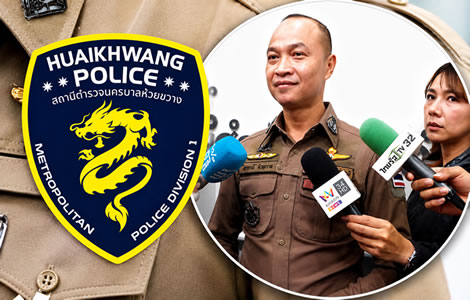
A dragon-shaped shoulder patch worn by officers at Bangkok’s Huai Khwang Police Station has been withdrawn after senior police found it had never received official approval. However, commanders firmly rejected claims that the emblem reflected Chinese investment, organised crime or any hidden agenda.
The controversy erupted after photographs of officers wearing the dragon insignia spread across social media. Soon afterwards, the images prompted widespread criticism and online speculation.
Many questioned whether the symbol reflected the growing influence of Chinese businesses in Huai Khwang. Others linked it to so-called “grey Chinese investors” because of the district’s recent controversies.
Dragon patch controversy grows as Chinese business links and online speculation come under scrutiny
Huai Khwang is widely known as “Bangkok’s second Chinatown”. The district contains one of Bangkok’s largest concentrations of Chinese-owned businesses.
In recent years, several businesses have faced scrutiny over nominee shareholding, suspected illicit financial activity and illegal gambling operations. As a result, the dragon patch quickly became the focus of public debate.
Police leaders insisted those suspicions were unfounded. Instead, they said the emblem simply reflected the area’s unique identity. They also stressed it represented the station’s jurisdiction rather than any outside influence. An internal review found officers in the crime prevention and suppression unit had worn the patch for approximately three to four years.
Pol Col Sorasak Thongmee, superintendent of Huai Khwang Police Station, said the emblem had already been in use long before he assumed command in December. Therefore, he had no involvement in its creation. He also said he did not know who originally designed it. Even so, he rejected suggestions that the dragon carried any concealed meaning.
“It is not an issue. Please don’t link it to Chinese investors or anything like that,” Pol Col Sorasak said.
Station chief says dragon emblem reflected local identity and rejects claims of hidden Chinese influence
He suggested the designer simply wanted an easily recognised symbol for the station. In comparison, he noted that other police stations use important local landmarks or distinctive features to represent their jurisdictions. He said the dragon should be viewed in exactly the same way.
Pol Col Sorasak also acknowledged growing public concern surrounding recent developments in Huai Khwang. Nevertheless, he stressed that police are responsible for enforcing the law rather than regulating business ownership. Officers inspect businesses to ensure legal compliance. Responsibility for checking company registrations and business permission documents rests with the Department of Business Development under the Ministry of Commerce.
In response, Metropolitan Police Division 1 confirmed the dragon patch had never been officially authorised under Royal Thai Police regulations. Consequently, its continued use breached uniform rules.
Pol Maj Gen Worasak Phisittabun, commander of Metropolitan Police Division 1, ordered the station to discontinue the emblem immediately. He said the decision would ensure uniforms remained correct, standardised and fully compliant with regulations.
Metropolitan Police Division 1 orders the dragon emblem removed after finding it breached regulations
Notably, Pol Maj Gen Worasak also rejected suggestions that the dragon represented any organisation or influential group. He said investigators found no hidden purpose behind the design.
As part of the review, he expanded the inspection beyond Huai Khwang Police Station. Every station under Metropolitan Police Division 1 must now examine badges, patches, emblems and symbols currently worn by officers. Any unauthorised insignia must be removed immediately.
Later on Thursday, Royal Thai Police spokesperson Pol Lt Gen Trairong Phiwphan issued a more detailed explanation after criticism continued online.
He confirmed Metropolitan Police Division 1 had suspended use of the dragon patch because the approval process remained incomplete. Police units may create official insignia. However, every design must first satisfy Royal Thai Police regulations before officers can wear it.
Royal Thai Police says dragon patch lacked approval despite reflecting Huai Khwang’s local identity
Separately, Pol Lt Gen Trairong addressed speculation linking the dragon to Chinese investment. He said recent reports involving Chinese businesses had fuelled public suspicion. Investigators then questioned both Huai Khwang Police Station and Metropolitan Police Division 1. They found no evidence supporting those allegations.
Instead, investigators concluded the dragon reflected the area’s identity and operating environment. Huai Khwang Police Station’s jurisdiction includes the Embassy of the People’s Republic of China.
It also serves a district with large numbers of Chinese residents, tourists and business operators. Accordingly, police said those characteristics inspired the design concept. They insisted the emblem reflected the station’s area of responsibility and nothing more.
“There is no hidden agenda and no connection to Chinese or any illicit activities whatsoever,” Pol Lt Gen Trairong said.
He added that many Royal Thai Police units create distinctive patches reflecting either their operational role or local surroundings. Some choose famous landmarks. Others adopt symbols linked to specialist duties.
Police defend local insignia while explaining how unit patches reflect operational roles and jurisdictions
For example, cybercrime investigators may use imagery associated with computers or technology. In each case, police said the designs simply identify the unit and its responsibilities.
On another front, the spokesperson addressed questions over whether the dragon patch might return. He said the decision rests with the commander of Metropolitan Police Division 1. Even then, the emblem cannot be used again until it receives full approval under Royal Thai Police regulations.
Pol Lt Gen Trairong also rejected claims that Chinese investors or criminal groups financed the production of the patches. Investigators found no complaints and no supporting evidence. At the same time, he warned that any officer found assisting influential groups or engaging in misconduct would face disciplinary action.
Police order nationwide insignia review while warning officers against misconduct and outside influence
Such cases would be handled under the National Police Chief’s policy. Officers performing their duties properly would receive recognition. Those found committing wrongdoing would face action without exception.
Across the force, the Royal Thai Police has now instructed every unit to comply strictly with regulations governing insignia, badges, patches and uniform symbols. The directive seeks to ensure consistency throughout the organisation. Equally, it aims to prevent future misunderstandings and avoid similar public criticism.
Huai Khwang raid shows nominee shareholdings being used by Chinese infiltrating the economy
Chinese ambassador appeals to the Thai media not to offend genuine business investment from his country
The Metropolitan Police Division 1 investigation concluded that the dragon had served only as the identifying symbol of Huai Khwang’s crime prevention and suppression unit during the past three to four years. Even so, investigators determined its use never received the required authorisation.
The division, therefore, ordered its immediate withdrawal. Subordinate stations must now inspect every insignia currently in use. Any badge, patch or emblem lacking official approval must be revoked as police tighten enforcement of uniform regulations across the division.
Join the Thai News forum, follow Thai Examiner on Facebook here
Receive all our stories as they come out on Telegram here
Follow Thai Examiner here
Further reading:
Huai Khwang raid shows nominee shareholdings being used by Chinese infiltrating the economy
Sweep of nominee firms and business networks on Koh Phangan. 22 arrested, 200 million in land seized
Anutin visits Koh Phangan as nominee crackdown shows 68% of firms with foreign ownership links
Blitzkrieg on foreign firms and enterprises on Koh Phangan continues with French owned resort busted
Russian-Chinese Koh Phangan alliance to sell drugs to foreigners. Accused entered Thailand illegally
Crackdown aimed at upending foreign business trade moves from Koh Phangan to Phuket. Four arrested