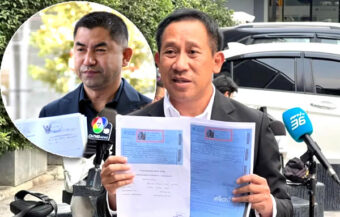
Chuwit Kamolvisit brands the People’s Party ‘childish’ and says it was spoiled by voters, blasting its September misstep in backing Anutin Charnvirakul as Prime Minister. He accused its leaders of ideological rigidity, failed judgment and repeated political blunders.
Wily and well educated in Thai politics and power, Chuwit Kamolvisit has in recent years shown a sharp grasp of events. Over the weekend and into Monday, he tore into the People’s Party over its September blunder in backing the Bhumjaithai-led government, which elevated Anutin Charnvirakul to prime minister. His attack came within hours of the party’s apology for that decision and Thursday’s dissolution of parliament. Mr. Chuwit sharply questioned the party’s political instincts, saying it was driven by ideology and lacked the flexibility and nuance needed to survive Thailand’s Byzantine power politics. The former massage parlour tycoon concluded that the “childish” party had been spoiled by voters and had ultimately failed.

This week, Bangkok businessman and political activist Chuwit Kamolvisit intensified his criticism of the People’s Party. His remarks followed the collapse of the constitutional amendment process. They also followed the abrupt dissolution of parliament. Together, these events reshaped the political landscape.
At the time, the People’s Party remained the largest bloc in the former parliament. It held 140 seats. As a result, it commanded significant leverage. Moreover, it possessed the numbers required to form a coalition government. That coalition would have included and been led by the Pheu Thai Party. Importantly, the timing in early September was favourable.
In addition, another viable option existed to support a minority government. The People’s Party could have supported former Justice Minister and Attorney-General Chaikasem Nitisiri as prime minister. A man with a legal background, in addition to being a respected upholder of democratic values, Chaikasem would have made the ideal prime minister to push constitutional change.
Multiple government formation options were open, but the People’s Party chose a minority path unexpectedly
Certainly, multiple routes to government formation were open. However, none of these options was pursued. Instead, a different, unbelievably naive strategy was chosen.
Rather than forming a coalition with Pheu Thai or backing Pheu Thai in government, the People’s Party backed another minority government. That government was led by the Bhumjaithai Party. Immediately, the decision shocked political observers. However, no clear explanation followed. The People’s Party fell back on open consultation with members as justification for its decision. Of course, that is not leadership at all. As a result, confusion dominated political commentary.
Notably, the decision raised serious questions. Bhumjaithai had consistently opposed constitutional reform efforts for years. In contrast, constitutional change was central to the People’s Party platform, and the Pheu Thai Party had always pushed that agenda. Indeed, it even came to blows with the Bhumjaithai Party earlier this year over the issue.
Furthermore, Bhumjaithai carried significant political baggage. These factors were well known before the decision.
Bhumjaithai controversies, including elections and land disputes, increased political risk for the coalition
Most prominently, significant controversy surrounds the 2024 Senate election. That election is under investigation for alleged collusion. Importantly, links have been drawn to the Bhumjaithai Party. Meanwhile, scrutiny continues without resolution despite a handful of charges. The investigation remains active.
In addition, unresolved land issues persist. Specifically, the Khao Kradong land holding in Buriram province remains disputed. The land has been linked to the Chidchob family. That family founded the Bhumjaithai Party. Consequently, political risk was already evident.
Not least, the government formed by Anutin Charnvirakul has relied on the Kla Tham Party. The People’s Party itself has linked that party to concerns about illicit funding from scam centres. At the same time, it has repeatedly called for Kla Tham’s Deputy Prime Minister Thamanat Prompow’s dismissal. Yet it was the People’s Party’s vote that put Mr. Thamanat in office.
Despite these factors, the People’s Party moved forward. However, that risk materialised quickly. Last Thursday, Bhumjaithai broke ranks in parliament. It supported entrenched Senate power over the constitutional process. As a result, the People’s Party lost leverage immediately.
Bhumjaithai defection triggered immediate collapse of People’s Party’s political strategy and leverage
Within hours, parliament was dissolved. Consequently, the People’s Party’s strategy collapsed. There was no opportunity for recovery. Undeniably, the political gamble had failed completely. The outcome was swift and decisive.
Following the collapse, criticism escalated. The party leadership faced intense scrutiny. Among critics, Mr. Chuwit was especially vocal. Over the weekend, he delivered repeated public remarks. These remarks targeted both judgment and political competence.
Notably, Mr. Chuwit used a pointed analogy. He compared the People’s Party to a lottery winner. In his example, the winner let another person collect the prize. The decision relied on a promise to share winnings later. The mirthful analogy circulated widely.
Meanwhile, the People’s Party is presently attempting to contain the fallout. Over the same weekend, it held an open-air conference. At that event, party leaders issued a public apology. However, the response failed to calm criticism. Instead, doubts have deepened.
People’s Party apology fails to address structural failings and reinforces perception of weak leadership
This wooden style of decision-making and open politics sounded almost theoretical. Indeed, it smacked of student politics. It was certainly not the power play necessary for the real world of Thai politics.
According to Mr. Chuwit, the weekend apology was insufficient. Furthermore, he said it clearly avoided responsibility. It failed to address the grievous blunder by the People’s Party and the damage done to the country. He argued that ideology lay at the heart of the failure. He also criticised the party’s emphasis on transparency. According to him, both were politically ineffective.
Additionally, Mr. Chuwit questioned the party’s compatibility with Thai politics. He said its approach lacked flexibility. Moreover, he said it ignored entrenched political realities. Consequently, he argued failure was inevitable.
Importantly, Mr. Chuwit urged voters to exercise caution. He said public trust should be reconsidered. He argued the party squandered its 2023 election mandate. That mandate delivered the highest seat total.
People’s Party support declines sharply after key decisions and electoral setbacks in September
After that election, events unfolded rapidly. First, the Senate blocked Pita Limjaroenrat. Subsequently, the Constitutional Court dissolved the Move Forward Party. As a result, the People’s Party emerged as a successor. However, it did so without prime ministerial nominees.
Since its astounding decision to support Mr. Anutin as prime minister, support has steadily declined. Notably, the decline clearly followed the September decision. That decision backed Bhumjaithai’s bid to form a government and installed the present cabinet. Presently, the People’s Party commands 27.7 percent support. At one point, the party had risen to a 47 percent support level. This marks a drop of 20 percentage points. Voters were not happy with the People’s Party’s first time exercising political power on the national stage.
At the same time, the broader political environment shifted. The Thai-Cambodian conflict reshaped voter sentiment. Consequently, uncertainty increased nationwide. Many voters became cautious and undecided.
Moreover, the conflict affected party standings. Pro-democracy parties lost ground. These included both Pheu Thai and the People’s Party. As a result, the political field widened.
Fears of election delays rise as officials warn that simultaneous nationwide voting is required for validity
Meanwhile, concerns over election timing are undoubtedly intensifying. Some observers fear elections could be delayed. These concerns followed remarks by election officials. On Sunday, a senior figure spoke publicly.
Election Commission Secretary-General Sawaeng Boonmee issued a warning. He said elections must occur simultaneously nationwide. Otherwise, results could be invalidated. Importantly, precedent exists for such invalidation.
Over a decade earlier, a similar scenario occurred. That episode followed mass protests. Those protests targeted the Pheu Thai government in 2014. Consequently, elections were disrupted.
Against this backdrop, Mr. Chuwit issued further warnings. He advised voters not to rely on the People’s Party. He described the party as inexperienced. Moreover, he said its leaders behaved like children politically.
According to Mr. Chuwit, the party seeks repeated chances. He said it would contest the next general election in the same way. However, he predicted another failure. He cited a consistent pattern of failed decisions and a lack of political nuance.
Chuwit criticizes the People’s Party leadership over border dispute and unrealistic seat ambitions
Furthermore, Mr. Chuwit intensified criticism of party leadership. He focused on Thanathorn Juangroongruangkit. He linked criticism to the Thai-Cambodian border dispute. He cited lack of experience as central. Mr. Thanathorn said this weekend that Mr. Pita Limjaroenrat, if elected prime minister, would have prevented a Thai-Cambodian war.
Additionally, he addressed electoral ambitions. Chuwit referred to the People’s Party’s target of winning more than 250 seats. He dismissed such expectations outright.
On December 15, 2025, Mr. Chuwit addressed the border issue directly. He posted comments on his personal Facebook account. In the post, he described recent developments. According to Mr. Chuwit, Cambodian forces opened fire. He said the fire crossed into Thai territory. Consequently, Thai soldiers returned fire. He said clashes occurred at several locations.
Moreover, he said Cambodian troop mobilisations followed. He claimed those forces sought territorial seizure. As a result, tensions escalated further.
Social media post sparks public debate and rejection of claims that crisis would not occur under Pita
The post generated immediate public reaction. Numerous netizens commented extensively. Many shared opinions on political leadership. Some referenced alternative prime ministerial scenarios.
The claim regarding Mr. Pita arose repeatedly in Mr. Chuwit’s online commentary. This concerned the assertion that the crisis would not have occurred under Pita Limjaroenrat. Mr. Chuwit rejected the claim directly and repeatedly. He described it as a misunderstanding.
According to Mr. Chuwit, conflict would have intensified instead. He said Thailand would have lost territory. He referred to Cambodian leader Hun Sen as “the old fox.” Mr. Chuwit then offered a comparison. He contrasted Pita Limjaroenrat with Hun Sen. He used a boxing metaphor. He described it as a lightweight facing a heavyweight.
According to him, the issue was not talent. Rather, it was experience. He said Hun Sen possessed decades of experience. He said Pita lacked comparable exposure.
He cited Hun Sen’s long battlefield history. He noted Hun Sen served as foreign minister at 27. He also referenced combat injuries and near-death experiences.
Mr. Chuwit countered that Cambodia’s Hun Sen would have outfoxed and outplayed Mr. Pita. He cited Hun Sen’s 50 years of experience at the highest level, as well as his history as a battlefield commander.
Chuwit contrasts pragmatic Hun Sen style with People’s Party rigidity and isolated political approach
Furthermore, Mr. Chuwit described Hun Sen’s political style. He characterised it as pragmatic. He said Hun Sen negotiated and adapted. He contrasted this with ideological rigidity.
In contrast, he criticised the People’s Party sharply. He described it as inflexible. He said it clung to fixed ideas. Moreover, he said it lacked manoeuvring ability.
Additionally, he said Thai politics required engagement. He described politics as a necessary game. According to him, the People’s Party refused to play. Consequently, it isolated itself.
He said isolation discouraged alliances. He said few political actors wanted cooperation. As a result, the party remained sidelined.
Mr. Chuwit also addressed negotiation during conflict. He said wartime conditions demanded firmness. He said sovereignty violations required strength. He said territory protection came first.
According to him, negotiations followed strength. He rejected win-win assumptions. He said the conflict was not transactional.
He also addressed the conflict’s origin. He said Thailand did not initiate hostilities. He linked tensions to Hun Sen’s lost benefits. He said those benefits involved scam centre compounds.
Mr. Chuwit then returned to leadership capacity. He said governing required experience. He cited strategy, force, and system knowledge. He said leaders must deploy people correctly.
People’s Party leadership failures include misplaced trust, repeated mistakes, and bizarre political decisions
He said the People’s Party lacked these elements. He cited repeated mistakes. He referenced failed government formation. He cited parliament’s dissolution.
He questioned leadership decisions directly. He asked why the largest party failed to lead. He asked why repeated betrayals occurred.
According to Mr. Chuwit, trust was misplaced. He said the party trusted Anutin Charnvirakul. He said Anutin was influenced behind the scenes. He said that trust reflected naivety.
He also criticised internal culture. He cited stubbornness and overconfidence. He said leadership ignored repeated warnings. He referenced past remarks by Thanathorn. He cited the Khao Kradong land case. He cited alleged Senate collusion. He also cited the party’s bizarre support for Anutin as prime minister.
Promises and apologies failed to demonstrate accountability, while voter support was squandered again
He recalled promises of a constitutional amendment. Those promises targeted a four-month timeline. He questioned their outcome. He said warnings were dismissed.
He also cited comments by Wiroj Lakkhanaadisorn. Wiroj described his politics as simple and straightforward. Mr. Chuwit questioned whether allies acted similarly.
Thailand moves to election mode after King approves dissolution of parliament decree request by Anutin
Constitutional crisis again as Bhumjaithai MPs vote to uphold the veto power of the Senate over reform
Finally, Mr. Chuwit addressed the party’s apology. He said it lacked clarity. He questioned whether it accepted failure. He said it simply resembled a request for another chance. He noted strong voter support previously. He said expectations were exceeded. He used an orange metaphor. He said support was discarded, then demanded again.
He closed with a blunt description. He said such behaviour would be labelled childish by adults. In short, the People’s Party lacks the power and experience to lead Thailand at this difficult time.
Join the Thai News forum, follow Thai Examiner on Facebook here
Receive all our stories as they come out on Telegram here
Follow Thai Examiner here
Further reading:
People’s Party on campaign but on guard against potential legal complaints to oversight agencies
Wealthy young People’s Party leader aims to create a technology-driven and efficient welfare state