UN investigators say Myanmar’s military unleashed more than 400 airstrikes during elections, killing at least 170 civilians, as the junta’s proxy party claimed a landslide win in a poll condemned as violent, exclusionary and neither free nor fair.
A United Nations report on Burma’s widely criticised general election has documented widespread intimidation and serious flaws in the voting process. The findings were released on Friday. They come as the junta in Nay Pyi Taw insists the elections were free and fair. The poll has been dismissed as a sham by many Southeast Asian countries. Even ASEAN, long known for its pragmatic approach, has rejected the vote.
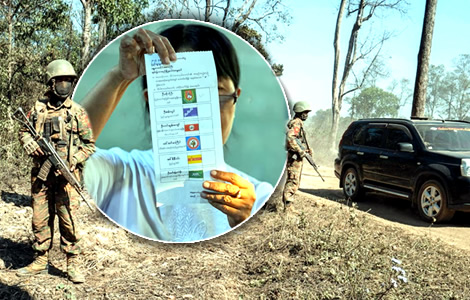
The United Nations says Myanmar’s military carried out more than 400 airstrikes during the country’s recent election period, killing at least 170 civilians. According to the UN High Commissioner for Human Rights, the attacks occurred during campaigning and voting held between December 2025 and January 2026. The findings were released on Friday, January 30, 2026, following verification by UN investigators.
According to the report, at least 408 airstrikes were confirmed through verified sources. Importantly, the strikes occurred throughout all phases of the election. The election itself was conducted in three stages between December 28, 2025, and January 25, 2026. During that same period, military aircraft repeatedly targeted multiple regions.
Meanwhile, Myanmar’s military-backed Union Solidarity and Development Party declared a decisive victory. According to state media, the USDP swept more than half of all parliamentary seats. As a result, the party secured control of both legislative chambers. The results were announced following the final round of voting in late January.
Military-backed USDP claims sweeping parliamentary victory as vote delivers control of both chambers
Agence France-Presse reported that the USDP won just over 80 per cent of the vote. Separately, Reuters reported the party captured 341 of the 420 available seats across both houses of parliament. Taken together, the figures confirmed overwhelming parliamentary dominance by the military-backed party.
At the same time, the United Nations raised concerns about the election environment. According to the UN, voting occurred mainly in areas under military control. Consequently, a large section of the population was unable to participate. Many townships were excluded entirely due to conflict.
In particular, displaced people were largely unable to vote. In addition, ethnic minorities faced systematic exclusion. Notably, the UN identified the Rohingya among those barred from participation. According to the UN, many lacked citizenship under Myanmar’s laws.
Others, however, were displaced within Myanmar or forced to flee abroad. As a result, they were physically unable to access polling stations. The UN said these exclusions affected large segments of the population.
UN says voting held under military control as displaced people and minorities excluded across country
Meanwhile, the UN documented widespread fear among voters. Volker Türk, the UN High Commissioner for Human Rights, said violence shaped electoral behaviour. He said many people acted under pressure rather than choice. “Many people chose either to vote or not to vote purely out of fear,” Türk said.
In addition to airstrikes, the UN recorded about 400 arrests during the election period. These arrests occurred alongside campaigning and voting. However, the report did not provide a regional breakdown. Investigations, the office said, are continuing.
Myanmar has been under military rule since February 2021. At that time, the armed forces seized power in a coup. The coup overthrew the elected civilian government led by Nobel Peace Prize laureate Aung San Suu Kyi.
Following the takeover, nationwide protests erupted. In response, the military launched a violent crackdown. Subsequently, unrest escalated into a broader armed conflict. Fighting has since spread across much of the country.
UN records fear, arrests and repression as post-coup military rule drives ongoing armed conflict
Indeed, many analysts see the conflict as a civil war. On one hand, there is the junta, while on the other, there is the National Unity Government. This is composed of elected representatives from the parliament voted for in November 2020. This was the election that prompted the February 2021 coup d’état. It is supported by the People’s Defence Forces (PDF), in addition to ethnic armed militias across the federation.
At the same time, the National Unity Government claims legitimacy. Meanwhile, in recent days, the ASEAN community, a 10-nation bloc in Southeast Asia, has rejected the poll.
According to the United Nations, around 3.6 million people have been displaced. Since then, airstrikes have remained a regular military tactic. Many regions remain inaccessible or unsafe due to ongoing fighting.
Despite the violence, the military proceeded with elections more than four years after the coup. Voting concluded in late January 2026. Shortly afterwards, Myanmar state media confirmed the results.
Conflict framed as civil war as the Unity government claims legitimacy and ASEAN rejects election
However, international criticism followed quickly. Human rights groups condemned the election. Several Western governments rejected the process as neither free nor fair. The United Nations accused the junta of using violence and threats to coerce participation.
Furthermore, the UN said many areas were unable to vote at all. Ongoing fighting and airstrikes disrupted polling. In many regions, voting was cancelled entirely.
Overall, voting took place in 263 of Myanmar’s 330 townships. However, some of those areas were not fully under military control. Fighting involved the military, ethnic armed groups, and local resistance forces that emerged after the 2021 coup.
Regionally, the Association of Southeast Asian Nations declined to endorse the election. The 11-member bloc said it would not recognise the process. ASEAN has struggled to reach a consensus on Myanmar since the coup.
Meanwhile, the United States responded cautiously. A State Department spokesperson said Washington was monitoring the situation closely. The second Trump administration is developing a reputation for an aggressive foreign policy despite its America First outlook.
International criticism mounts as UN, ASEAN and Western governments reject the poll as a sham
According to the spokesperson, the US would assess the junta’s next steps. These included whether violence would be reduced. They also included easing political restrictions and allowing humanitarian assistance.
Myanmar’s military government rejected the criticism. It insisted the election was free and fair and supported by the public. However, the military did not respond to Reuters requests for comment on electoral violence.
The opposition National League for Democracy did not participate in the poll. The party had been dissolved by the authorities. Dozens of other parties were also disbanded, while some declined to take part.
Under Myanmar’s political system, the military retains guaranteed power. The constitution reserves 25 per cent of parliamentary seats for the armed forces. This ensures continued influence regardless of election outcomes.
Military retains guaranteed power as proxy party structure and generals shape next cabinet
The USDP was founded in 2010 after decades of direct military rule. It was designed to serve as a proxy for the armed forces, known as the Tatmadaw. The party is chaired by a retired brigadier general and includes many former officers.
For this election, the USDP fielded 1,018 candidates. That represented about one fifth of all registered contenders. Junta chief Min Aung Hlaing is expected to remain central in the next administration.
Min Aung Hlaing defended the polls as a step toward stability. He rejected criticism from opponents and foreign governments. According to state media, he said state responsibilities would transfer to an elected government.
However, he stressed the military’s continuing role. He said the Tatmadaw would maintain responsibility for defence and security. These comments were broadcast domestically.
Turnout was reported at about 55 per cent across all three phases. That figure was lower than in previous elections. By comparison, turnout reached about 70 per cent in both 2015 and 2020.
Lower turnout underscores predictable outcome as analysts say military dominance remains unchanged
The 2015 vote brought Aung San Suu Kyi to power. The 2020 election produced similar participation. However, those results were later annulled by the junta before the coup.
Analysts said the latest outcome was expected. Bill Hayton, an associate fellow at Chatham House, said the result was inevitable. “There was only ever going to be one outcome,” he said.
He added that the military would not back down. In short, the result maintained the existing situation. He also pointed to continued deaths and instability.
Bungled detention sees murder and rape suspect deported back to Burma despite investigators’ request
Peace breakthrough as Malaysian PM Anwar Ibrahim secures prisoner releases and new ceasefire in Burma
Hayton further cited cross-border impacts. These included scam centres, drug smuggling, and irregular migration. He said the problems were spilling beyond Myanmar’s borders.
The UN report added further scrutiny to the election outcome. It directly linked airstrikes and civilian deaths to the voting period. The findings were released days after the final ballots were cast.
As Myanmar prepares to convene parliament in March, the military-backed government is set to take office in April. The civil war, however, remains ongoing.
Join the Thai News forum, follow Thai Examiner on Facebook here
Receive all our stories as they come out on Telegram here
Follow Thai Examiner here
Further reading:
Bungled detention sees murder and rape suspect deported back to Burma despite investigators’ request
Thai wife drops German husband home to his death in Prachuap Khiri Khan. Police file Murder charges
UK beauty spot may have disguised the grim murder of a Thai bride from Udon Thani for over a decade
Former Phuket expat media salesman can expect to die in a UK prison if convicted of abuse charges
57-year-old UK paedophile may have offended in Thailand as judge jails him until he is 90 years old