Thailand launches a nationwide QR crackdown on taxis after strike threats and airport boycott fears earlie this year. All cabs face real-time tracking, ID checks and tougher enforcement as ministers move from concessions to control and creating a superior service.
Thailand’s Department of Land Transport is preparing a major overhaul of the national taxi system, requiring all taxis to operate under a QR code regime alongside expanded inspections and tighter investigations. The system will regulate payments and enable real-time tracking of fares and journeys, allowing passengers to scan a QR code after a trip begins to monitor progress and calculate fares, with journey data also shareable with others. At the same time, the department is intensifying enforcement against poor service and illegal taxi operations nationwide, with a particular focus on identifying and penalising taxis that refuse passengers, an offence under the Motor Vehicle Act of 1979.
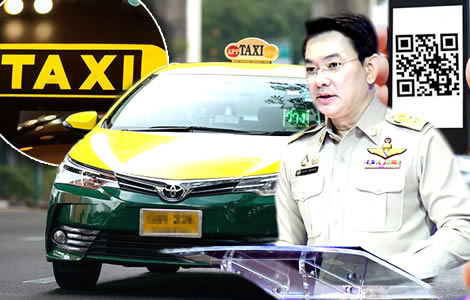
Thailand’s standard taxi service is undergoing a sweeping regulatory overhaul driven by the Transport Ministry. The move follows months of government intervention in the sector.
At the same time, pressure has mounted from competition with app-based ride services. As a result, authorities have shifted from accommodation to enforcement.
Earlier this year, tensions between taxi operators and regulators escalated sharply. In particular, drivers complained of uneven competition and declining earnings. Consequently, threats of strikes and airport boycotts emerged. These threats targeted Bangkok’s international airports.
Government steps in to defuse taxi strike threats with airport concessions and expanded state apps
In May, the government stepped in to contain the dispute. Former transport minister Suriya Jungrungruangkit led direct talks with taxi representatives. Therefore, immediate concessions were offered to prevent disruption. These measures focused on access and operational support.
Specifically, taxis were granted additional facilities at major airports. Moreover, officials pledged to expand government-backed transport applications. These applications were designed to integrate more closely with taxi services. As a result, tensions temporarily eased.
However, the ministry soon shifted to longer-term regulation. This time, the emphasis moved to oversight and compliance. Consequently, the Department of Land Transport announced a nationwide QR code system. The system applies to all licensed meter taxis.
The rollout was confirmed publicly on Thursday. Details were provided by Sorapong Paitoonpong, Director-General of the Department of Land Transport. According to him, the system has already entered its implementation phase. Importantly, it will soon become mandatory nationwide.
Transport ministry confirms nationwide QR code rollout enters mandatory implementation phase
Installation of the system began on February 2. Since then, deployment has expanded steadily. By June, officials expect coverage of more than 70,000 taxis. Therefore, nearly the entire fleet will be included.
Crucially, each taxi QR code links directly to Thailand’s national ID database. As a result, driver identity can be verified instantly. Vehicle registration data is also retrieved. This linkage forms the core of the system.
According to the department, the platform enables real-time trip tracking. In addition, it records routes, locations, and service status. Fare calculations are also displayed during trips. Consequently, operational transparency increases.
To support these functions, taxis must display three QR code stickers. Each sticker uses a different colour. Moreover, each serves a distinct regulatory purpose.
First, a purple QR code is installed in front of the driver. This code is used by the driver to verify identity. Only then can a shift begin. Therefore, unauthorised operation is prevented.
Three colour-coded QR stickers divide driver verification, passenger information access
Once verified, the system activates immediately. As a result, GPS-style tracking begins. The taxi’s location and route are monitored continuously. This data remains visible to authorities.
Second, a blue QR code is installed on the rear left passenger window. This code is intended for passenger use. By scanning it, passengers access driver information.
Specifically, the system displays the driver’s name and licence details. Vehicle registration numbers are also shown. In addition, training and registration status appear. Consequently, impersonation risks are reduced.
Moreover, the blue code allows passengers to estimate fares. It also enables service ratings after trips. Complaints and commendations can be submitted directly. Therefore, feedback becomes traceable.
All submissions are sent to the Department of Land Transport. As a result, reports are logged instantly. No intermediaries are involved in the process. Records remain centralised.
Third, a red QR code is installed on the exterior of the left rear door window. This code is reserved for urgent complaints. These include passenger refusal or misconduct.
Red QR code complaints trigger immediate review with real-time tracking and data sharing
When scanned, the red code triggers immediate review. Consequently, serious violations receive priority handling. Authorities can act without delay.
Across all codes, scanning loads system data automatically. Past service ratings are displayed. Trip status updates in real time. Therefore, transparency is continuous.
Additionally, passengers can share trip details digitally. These details may be sent to family or friends. Sharing continues throughout the journey. This function operates automatically.
The QR platform is integrated with multiple government databases. As a result, complaint processing is faster. Records are verifiable and transparent. Oversight improves.
During the transition period, alternative reporting channels remain active. Passengers may still use the 1584 taxi hotline. This applies to taxis not yet equipped. Therefore, coverage gaps are addressed.
Alongside deployment, enforcement actions have intensified. The Department of Land Transport has expanded inspections. Meanwhile, crackdowns on illegal taxis continue daily.
Daily crackdowns target illegal taxis, licence abuses and passenger refusals under motor vehicle law
Officials are targeting unregistered taxis and expired licences. Some offenders reinstall taxi signs illegally. Others operate without authorisation. Consequently, penalties are imposed.
Drivers who fail to register on required platforms are also targeted. As a result, enforcement teams are active every day. Arrests occur routinely.
On average, authorities apprehend 10 to 20 offenders daily. Immediate action follows each arrest. Penalties are applied without delay. Records are updated.
The department confirmed that refusing passengers remains illegal. The offence falls under the Motor Vehicle Act of 1979. Therefore, penalties are clearly defined. Under the law, fines may reach 2,000 baht. In addition, offences are recorded permanently. Accumulated violations affect licensing status.
The issue is a key complaint among Thai locals and foreign tourists alike.
If offences are repeated, stronger measures apply. Specifically, licences may be suspended. In serious cases, suspension is immediate.
Cases involving foreign tourists receive special attention. Authorities treat them as a high priority. Consequently, reviews are expedited.
Passenger guidance, rating incentives and tourist confidence shape next phase of taxi reform
Officials noted that such incidents affect national reputation. Therefore, enforcement decisions are made quickly. Delays are avoided.
Passengers are advised to check for QR stickers before boarding. This applies especially to interior stickers. Verification is encouraged.
Additionally, passengers are advised to save screenshots of driver details. These should be shared with trusted contacts. The department recommends this step.
Passengers are also advised to confirm destination details during trips. They should observe sticker placement. These actions are presented as precautions. Beyond enforcement, incentives are included in the programme. Taxis with high service ratings will receive rewards. Distribution occurs at the end of each tax cycle.
Ratings are calculated using system data only. Verified trips form the basis. Manual entries are excluded. According to officials, the initiative is part of a broader transport improvement programme. Public transport quality remains a priority.
Taxis are central to that strategy. Authorities emphasised the importance of taxis to foreign visitors. In Bangkok, taxis remain a primary transport option. Service reliability is therefore critical.
QR system to be national standard as Ministry rejects parallel platforms and enforces compliance
The Transport Ministry described the QR system as a regulatory upgrade. It combines identification, monitoring, and reporting. All functions operate together.
Importantly, the ministry confirmed there will be no parallel systems. The QR platform will be the single national standard. Compliance is mandatory.
Ministry placates taxis with a review of rules, new facilities and their own airport ride-hailing app
Police crack the whip on Bangkok taxis just 24 hours before showdown meeting over Airport closure threat
Government will not tolerate any attempt to blockade Suvarnabhumi Airport by taxis over ride-hailing apps
Bangkok taxis threaten to close down Suvarnabhumi Airport if Ministry does not ban ride-hailing apps
After full rollout, inspections will continue nationwide. Non-compliant taxis will face penalties. Enforcement will remain active.
Although minor adjustments may follow, the core structure is fixed. Key functions will not change. Expansion remains on schedule.
Ultimately, authorities stated that the system standardises taxi operations. It strengthens oversight nationwide. Full coverage remains the stated objective, with a new expectation for taxi cab availability and service standards.
Join the Thai News forum, follow Thai Examiner on Facebook here
Receive all our stories as they come out on Telegram here
Follow Thai Examiner here
Further reading:
Bangkok taxis threaten to close down Suvarnabhumi Airport if Ministry does not ban ride-hailing apps
Confidence and trust in Thailand damaged by Chinese VIP tourist services advertised online
Viral Chinese video says VIP arrival with a police escort can be bought when holidaying in Thailand
Royal Thai Police Sergeant Major arrested on Ko Samui, charged with the rape of female detainee