Phuket launches new property visa for foreign buyers and renters, but faces fierce backlash, political tension and enforcement fears as officials push to revive a weak property market amid rising foreign demand and local concerns.
A top Immigration Bureau officer in Phuket on Tuesday confirmed that the one-year visa scheme for the purchase and rental of certain property on the island is now operational. The scheme includes rules and screening requirements but remains straightforward. Anyone purchasing a condominium and securing ownership can apply for a renewable one-year visa once the property exceeds ฿3 million. Likewise, renting a condo or house for over ฿85,000 per month offers the same privilege, provided rent is prepaid and all agreements comply with the law. The visa is being treated as a sandbox test in Phuket and may help address Thailand’s growing glut of unsold properties and stagnant prices in parts of the market.
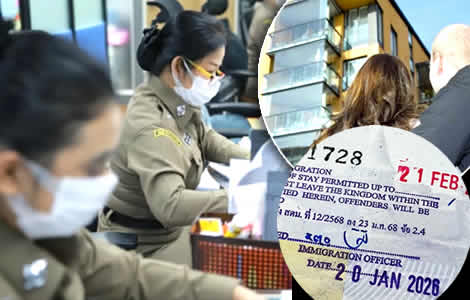
Immigration authorities in Phuket have confirmed that a new visa scheme for foreign property buyers is now operational. The programme targets condominium purchasers and long-term renters. It is designed to attract foreign capital into Thailand’s property sector.
However, the scheme has faced strong opposition since its introduction in October 2025. Local business groups and community organisations have lobbied ministries to block or revise it. As a result, the policy quickly became politically sensitive.
Indeed, several ministers publicly voiced opposition ahead of the February General Election. At the same time, immigration debates shifted toward other measures. In particular, proposals to reduce visa-on-arrival stays gained prominence.
Visa on arrival debate overshadows property scheme as officials move to clarify rules and conditions
These would cut stays from 60 days to 30 days. Consequently, the property visa often slipped from focus. Nevertheless, authorities have now moved to clarify the programme in detail. On Tuesday, Pol Col Khemmachat Wattanaphakesem outlined the scheme publicly.
He serves as superintendent of the Phuket Immigration Bureau. His remarks aimed to resolve confusion and address criticism.
Accordingly, the visa allows a one-year stay in Thailand. It is renewable annually if all conditions are met. However, it does not grant the right to work. Employment is only permitted with a valid work permit obtained separately. Furthermore, visa holders must comply with immigration rules. They must report to authorities every 90 days. Failure to comply may lead to penalties or cancellation. Therefore, compliance remains a central requirement.
In addition, all applications must undergo a structured screening process. Initially, submissions are reviewed by local property offices. These offices verify ownership and financial documentation.
Screening rules tighten as authorities require property checks and authorised agents before submissions
Only then are applications forwarded to immigration authorities. Moreover, applications must be handled through authorised agents. These agents are approved by the Tourism Authority of Thailand. Consequently, documentation is checked before formal submission.
The programme offers three main pathways to eligibility. Firstly, applicants may purchase a condominium valued at no less than ฿3 million. They must provide full ownership documentation and proof of payment. This includes taxes and transfer fees.
Moreover, purchases must comply with all legal requirements. Specifically, foreign ownership cannot exceed 49% of any development. Therefore, all transactions must adhere strictly to this cap.
Secondly, applicants may qualify through long-term rental arrangements. They must lease a condominium or house at a minimum of ฿85,000 per month. In addition, rent must be prepaid for the visa period. Applicants must submit contracts and verified payment records. Consequently, authorities can confirm financial commitment.
Three visa routes set out covering condo purchases and rentals, with strict ownership and payment rules
Thirdly, a similar option applies to houses or land-based properties. Again, rent must exceed ฿85,000 per month. It must also be prepaid in full. Therefore, documentation must confirm both contract terms and payment.
Officials have described the programme as a sandbox initiative. It is currently limited to Phuket as a pilot location. Therefore, authorities will assess its impact before any expansion. Feedback will be collected from applicants and local stakeholders.
Meanwhile, the scheme coincides with pressure in Thailand’s property market. There is a significant oversupply of residential units. Estimates suggest more than 280,000 units remain unsold. However, many of these are in lower-value segments.
As a result, policymakers are seeking to stimulate demand. The visa links residency to property investment. Consequently, it is expected to absorb some excess supply. Officials also anticipate increased tax revenue and domestic spending. However, criticism has remained persistent. Some stakeholders argue the ฿3 million threshold is too low. They warn it may attract buyers with limited financial capacity. In turn, this could increase enforcement challenges.
Local opposition grows as concerns rise over misuse loopholes, illegal business activity and housing
Similarly, tourism operators in Phuket have raised concerns. They warn about possible misuse of the scheme. For example, some individuals may operate businesses without permits. Others may exploit rental loopholes. In particular, concerns focus on subletting to short-term tourists. This could bypass hotel regulations. Therefore, enforcement has become a central issue.
Authorities have responded by stressing strict verification. Applications must pass through authorised agents and property offices. Additionally, documents are reviewed by the Department of Land. Consequently, multiple layers of checks are applied. Officials say this reduces the risk of fraud and abuse.
However, local concern remains strong. In Phuket, there is growing support for enforcement action. Residents have called for crackdowns on illegal foreign businesses. They also cite concerns about encroachment on Thai entrepreneurs.
At the same time, the government faces economic pressure. It needs to attract high-spending foreign residents. The property visa forms part of this strategy. However, officials must balance this with domestic sensitivities. This tension has emerged before. Previously, a proposal to allow foreign land ownership faced backlash. It was introduced under Prayut Chan-o-cha. However, it was later scrapped due to political opposition.
Government balances foreign investment push with public concern after past land ownership plan backlash
Therefore, current policy avoids direct land ownership rights. Instead, it focuses on condominiums and long-term leases. These structures align with existing legal frameworks. As a result, they are considered more acceptable politically.
Meanwhile, foreign residents have faced tighter controls in other areas. In particular, banking access has become more restrictive. This followed public concern over scam-related activity. Consequently, foreigners report increased scrutiny in financial services.
The timing of the visa rollout reflects these pressures. Authorities are tightening enforcement while encouraging investment. Therefore, the programme operates within a controlled framework. Its progress will be closely monitored.
Rising foreign arrivals in Phuket drive property demand while increasing scrutiny of business compliance
At the same time, Phuket has experienced a surge in foreign arrivals. Since 2022, Russian and Ukrainian long-stay visitors have increased significantly. Many have remained on the island for extended periods. Some have purchased property or entered long-term leases.
As a result, foreign demand has influenced local markets. Property transactions have increased in key areas. Rental demand has also risen. In particular, long-term stays have become more common. However, this influx has also raised concerns. Authorities have investigated alleged violations of business laws. Some foreigners have been accused of operating without permits. Consequently, scrutiny has intensified.
Foreign Minister supports cancellation of the 60 day visa while Phuket wants to scrap property visa
Land for foreign high flyers plan to be axed by cabinet as new 10-year visa draws a pretty mild response
Revenue Department preparing legislation as new Expat tax regime may link visas and tax returns
Property glut fueling visa offer schemes for foreigners with up to ฿1 trillion in unsold property
Nevertheless, foreign investment remains a major factor. Real estate firms report continued demand from overseas buyers. Key markets include Russia, Ukraine, Taiwan, and Singapore. Many buyers seek long-term residence linked to lifestyle or education.
Therefore, officials expect strong interest in the new visa. In particular, Russian long-stay visitors are seen as likely applicants. Many already have established ties to Phuket’s property market.
Authorities expect strong uptake from Russian long-stay investors as programme enters pilot phase
To address uncertainty, authorities have held joint briefings. Immigration officials and developers have participated. These sessions aim to clarify requirements and procedures. They also seek to build confidence among potential applicants.
Pol Col Khemmachat acknowledged early operational difficulties. Both applicants and officials are adapting to the system. Procedures are still being refined. However, improvements are expected as experience increases.
Importantly, not all applicants will qualify. Strict financial and legal criteria apply. Applications must meet all conditions. Otherwise, they will be rejected. Furthermore, compliance will be closely enforced. Visa holders must follow all rules. This includes reporting obligations and legal restrictions. Violations may result in revocation.
At present, the programme remains under close observation. Authorities are tracking application volumes and approval rates. They are also monitoring compliance outcomes. Therefore, adjustments may be introduced if required. For now, the visa is fully operational in Phuket. The pilot phase is underway. Consequently, its impact will become clearer in the coming months.
Join the Thai News forum, follow Thai Examiner on Facebook here
Receive all our stories as they come out on Telegram here
Follow Thai Examiner here
Further reading:
Foreign Minister supports cancellation of the 60 day visa while Phuket wants to scrap property visa
Incoming government must tackle the country’s rising public debt level and keep foreign funding open
Commerce Minister meets US trade boss Jamieson Greer in Korea. Paul Chambers case still dogs talks