US Supreme Court crushes Trump’s tariff blitz in 6–3 bombshell, scrapping a $175bn regime and rattling global markets. White House hits back with a 10% worldwide duty capped at 150 days as refund chaos looms and Thailand braces for fresh Section 301 trade probes.
Thailand’s embassy in Washington DC is closely monitoring developments after Friday’s landmark ruling effectively scrapped US President Trump’s sweeping reciprocal tariff regime, as the US leader stood on the White House lawn on Saturday fielding questions and firing back with Section 122 of the 1974 Trade Act, despite his own top officials conceding that the Supreme Court has significantly undercut his administration’s leverage, while Thai business and political leaders remain cautiously upbeat but warn that Section 301 investigations could still target the kingdom’s currency management and labour practices.
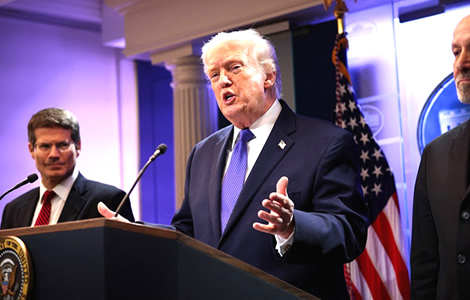
Cautious optimism spread through Bangkok on Saturday after a 6–3 ruling by the US Supreme Court. Business leaders quickly recalculated export exposure. Economists revised shipment forecasts. Former treasury officials examined the constitutional boundaries reinforced by the judgment. At the centre of attention was President Donald Trump’s reciprocal tariff regime, which the court struck down on Friday.
The court ruled that the president exceeded his authority under the International Emergency Economic Powers Act. The 1977 statute permits emergency economic measures in defined circumstances.
However, the majority held that it did not authorise sweeping global tariffs. Therefore, the reciprocal duties imposed last April were unlawful. As a result, the tariff framework constructed under IEEPA collapsed immediately.
Markets swing as $175bn tariff regime collapses and refund exposure hits Thailand and US trade
Previously, tariffs ranging from 10% to 50% were imposed on dozens of trading partners. Thailand was among those targeted. Consequently, Thai exporters in electronics, automotive parts and appliances absorbed higher costs. Meanwhile, US importers paid the duties at ports of entry. More than $175 billion was collected under the invalidated regime. Thai estimates cited exposure equivalent to roughly ฿3 trillion. Therefore, refund claims could reach historic levels.
However, the mechanics of repayment remain undefined. In addition, litigation could take years. As a result, fiscal uncertainty now shadows Washington. Financial markets reacted within minutes. US equity indexes initially surged. However, gains narrowed as investors assessed the next move. Similarly, Asian markets tracked the shift in real time. Consequently, volatility returned to global exchanges.
Within hours of the ruling, the White House moved to contain the fallout. On February 21, 2026, President Trump signed a new executive order. This time, he invoked Section 122 of the Trade Act of 1974. As a result, a uniform 10% tariff was imposed on imported goods worldwide. The rate will take effect on February 24, US time.
Trump invokes Section 122 imposing 10% global tariff capped at 150 days pending Congress review
Section 122 allows temporary tariffs of up to 15% to address balance of payments concerns. However, the authority is capped at 150 days. Therefore, the 10% rate runs until about July 2026. Any extension requires congressional approval.
Consequently, the administration now operates under a fixed statutory deadline. The White House confirmed the baseline in a fact sheet. Moreover, it framed the move as necessary to protect revenue after the court setback.
Treasury Secretary Scott Bessent acknowledged that the ruling reduced presidential leverage. Nevertheless, he stated that revenue levels in 2026 would be maintained. Furthermore, he confirmed that Section 122 would operate alongside Section 301 investigations. Existing tariffs under Section 232 and Section 301 remain in place. Therefore, the 10% rate functions as a new baseline rather than a full reset.
In parallel, the president directed the Office of the US Trade Representative to begin fresh Section 301 probes. These investigations require country-specific inquiries and public hearings. They must establish unfair trade practices before tariffs can be imposed. US Trade Representative Jamieson Greer identified potential areas of scrutiny.
These include industrial excess capacity, forced labour and pharmaceutical pricing practices. Digital services taxes and seafood trade are also on the list. Consequently, major trading partners face renewed examination, including Thailand.
Korn says 10% tariff eases pressure but flags refund risks and weak domestic demand
In Bangkok, former finance minister Korn Chatikavanij delivered a blunt assessment. “The new 10% Trump tariff: good news for Thai trade and global trade,” he wrote. Previously, Thailand had been negotiating around a 19% rate. Now, it faces 10%, aligned with other countries. Therefore, the relative burden has eased.
Korn highlighted the statutory ceiling. Section 122 permits tariffs up to 15%. “Trump chose to collect only 10% from all countries,” he noted. He suggested the decision stabilised the situation after the legal defeat. Additionally, he pointed to refund exposure in the United States. “There will be complications regarding tax refunds for importing businesses,” he stated. He cited estimates that could reach three trillion baht equivalent.
He also referenced exemptions embedded in the order. Certain food products not produced in the US are excluded. Some electronics categories are also exempt. In addition, specific pickup trucks were spared.
“Thai exports are likely to improve,” Korn wrote. However, he stressed that Thailand’s structural weaknesses remain. “Thailand’s economic problems are not so much about exports,” he said. Instead, he cited weak domestic purchasing power and extremely low lending levels. Moreover, he warned of debt default risks in both households and businesses.
FTI details sector impact as electronics, autos and tyres face 10% duty while farm goods escape
The Federation of Thai Industries offered a detailed breakdown. Its president, Kriengkrai Thiennukul, said the ruling confirmed that retaliatory tariffs were beyond direct presidential authority. However, he noted that the administration immediately pivoted to Section 122 to preserve tariff policy.
He divided Thai exports into two groups. First, are products fully subject to the 10% rate. These include hard disk drives, printed circuit boards and integrated circuits. Thailand is a major global production base for these goods.
Therefore, even a uniform 10% duty directly affects competitiveness. Automobiles and parts are also impacted. Tyres now face an additional 10% layered onto existing anti-dumping duties. Consequently, exporters confront compounded costs.
Electrical appliances such as air conditioners and refrigerators are covered. The United States remains a key market for these products. Gems and jewellery exports are likewise subject to the new rate. “These industries represent a high proportion of exports,” Mr Kriengkrai said. Therefore, the impact is immediate, especially amid a global slowdown and volatile orders.
Second are agricultural and fishery products that remain exempt. Rice is excluded. Durian and mangosteen are also exempt. Many tropical fruits remain outside the 10% measure. Mr Kriengkrai explained that tariffs on such goods would raise US domestic food prices. Therefore, inflation concerns shaped the exemptions.
Section 301 risks loom as refund questions mount and July trade deal deadline approaches
However, he warned that Section 301 remains a live risk. The United States may investigate alleged unfair trade practices. Intellectual property protection, industrial subsidies and currency movements could be scrutinised. Thailand remains monitored regarding baht fluctuations. Consequently, additional trade measures cannot be ruled out.
Another unresolved issue concerns previously collected tariffs exceeding $100 billion. If those measures are deemed illegal, refund mechanisms must be established. However, timelines remain uncertain. As a result, the issue could affect the US fiscal position and capital markets.
Commerce Minister says US Thai trade pact will be finalised in July. Business wants it done and dusted
During the 150-day window under Section 122, Thailand retains negotiation space. Bilateral talks with the United States continue. Proposals may include increased imports of US natural gas or aircraft. Success will depend on political alignment in Washington and the stance of the White House economic team.
The Thai Embassy in Washington is monitoring developments closely. It is understood to be coordinating responses. Before the ruling, Minister of Commerce Suphajee Suthumpun had indicated that negotiations would conclude by July 2026. Now, that date aligns with the expiry of the 150-day tariff authority. Therefore, legal deadlines and trade negotiations now move in tandem under a tightening clock.
Join the Thai News forum, follow Thai Examiner on Facebook here
Receive all our stories as they come out on Telegram here
Follow Thai Examiner here
Further reading:
Trade expert warns the government on barter deals with China being pursued by the Commerce Ministry
Top Commerce Ministry official warns that any US trade deal must wait for new parliament and cabinet
Asean Summit on Monday and Tuesday seen by United States as pivotal to restoring border peace
War to continue says PM Anutin. Dismisses President Trump’s ceasefire talk as a ‘misunderstanding’
Confusion after Trump’s 20 minute phone call with PM Anutin. US side claimed a ceasefire was agreed