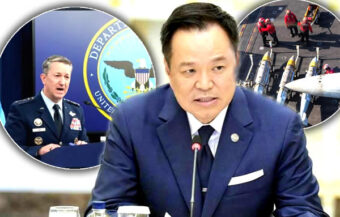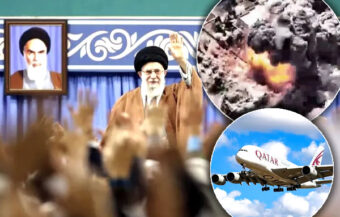
Thailand warns 77,000 nationals to evacuate the Middle East as the US-Israel war with Iran spreads. Missiles and drones hit Gulf states while Thai evacuees flee via Turkey. Bangkok scrambles flights home as airspace closures and strikes plunge the region deeper into crisis.
Thailand is advising its 77,000 nationals living and working in the Middle East to evacuate. The warning comes as the war launched on Saturday, February 28, by Israel and the United States against Iran continues to escalate. Over the weekend, rhetoric and attacks intensified on both sides as any prospect of an immediate resolution faded. Thailand’s first evacuees from inside Iran are due to arrive in Bangkok on Monday or Tuesday. The Thai embassy in Ankara is coordinating land-based evacuation routes.
Thailand has advised all its nationals in the Middle East to leave high-risk areas immediately as fighting across the region intensifies. The warning follows eight consecutive days of attacks involving the United States, Israel and Iran.
However, the confrontation has already expanded beyond those three countries. Missile and drone exchanges now involve multiple states across the region. Consequently, Thai authorities describe the situation as violent, tense and uncertain. The Ministry of Foreign Affairs issued the advisory on Sunday.
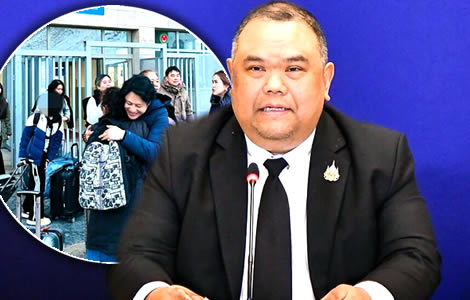
Earlier on Saturday Mr. Panidol Patchimsawat, Acting Director-General of the Department of Information and Deputy Spokesperson of the Ministry of Foreign Affairs, explained the nature of evacuation operations presently underway.
After that, Deputy Foreign Ministry spokesman Panidone Pachimsawat delivered the warning during a Sunday evening press conference. He said the security environment across the Middle East remains volatile.
Missile and drone exchanges spread across the Middle East as war widens beyond Israel Iran conflict
In particular, missile and drone exchanges are continuing across several countries. These include Iran, Israel, Bahrain, Kuwait and Lebanon. Therefore, Thai authorities consider the regional outlook unstable. In addition, attacks have occurred both from the air and at sea. As a result, military activity is spreading across multiple fronts.
Over the past eight days, missile launches and drone strikes have intensified across the region. At the same time, governments have begun evacuating civilians from affected areas. In several locations, attacks have occurred near populated zones.
Consequently, authorities across the Middle East remain on high alert. According to Thai officials, the pace of strikes has not slowed.
Meanwhile, Iran has signalled that it will not attack other regional states directly. Instead, Iranian authorities say their operations will target United States military bases. Tehran has described these actions as defensive measures.
Iran says strikes target US bases only as Washington demands unconditional surrender and war expands
Furthermore, Iran’s Foreign Ministry stated that operations will continue until attacks on Iran stop. Alternatively, Iranian officials said intervention by the United Nations Security Council could halt the fighting.
However, the United States has signalled that pressure on Iran will continue. President Donald Trump warned on Friday that there would be no agreement except “unconditional surrender.” Therefore, American forces will maintain heavy strikes against Iranian targets.
In addition, Mr Trump indicated that the list of targets could expand. Consequently, tensions between the two sides have intensified further.
Over the past 24 hours, Iranian attacks have increased in several areas. In particular, Saudi Arabia and Kuwait have faced new strikes. At the same time, regional infrastructure has come under threat. Thai authorities are monitoring reports of damage to energy and water facilities.
For example, drone strikes have reportedly targeted oil tanks in Kuwait. Similarly, another attack reportedly struck a desalination plant in Bahrain. However, Israel has denied responsibility for the Bahrain incident.
Infrastructure attacks in Kuwait and Bahrain raise fears of wider disruption to energy and water supply
Because of these developments, officials are watching infrastructure risks closely. Energy facilities and desalination plants are essential for regional supply systems. Consequently, any sustained damage could disrupt critical services. Thai authorities say these developments add to uncertainty across the region.
Despite the escalation, Thai officials say no Thai nationals have been reported injured or killed. Nevertheless, the Foreign Ministry warns that conditions remain unpredictable. Therefore, Thai citizens have been urged to leave risk areas without delay.
In addition, nationals across the Middle East have been asked to register their locations with embassies and consulates. Officials say accurate location data will allow faster assistance if needed.
Earlier government estimates indicate that roughly 77,000 Thai nationals live across the Middle East. Many work in construction, hospitality and energy industries. Others are students or long-term residents. Consequently, Thai authorities have begun preparing evacuation and repatriation operations. Diplomatic missions across the region are coordinating closely.
First Thai evacuees flee Iran through Turkey as Bangkok prepares repatriation flights and border support
The first group of Thai evacuees from Iran has already crossed into Turkey. The group travelled overland from Tehran earlier on Sunday.
In total, 62 Thai nationals are included in the convoy. Their repatriation flights are expected to reach Bangkok on Monday or Tuesday. However, evacuation operations will continue beyond this group. Another group of Thai nationals is scheduled to leave Iran on March 10.
Like the first convoy, the next group will travel by land to Turkey. Thai officials are preparing reception teams at the border crossing. Consular officers are stationed at the Kapikoy border checkpoint to assist arrivals. These officials are coordinating directly with Turkish authorities. As a result, entry procedures for evacuees can be processed quickly.
To strengthen coordination, a special consular delegation has travelled to eastern Turkey. The team is led by Bancha Yuenyongjongcharoen, deputy director-general of the Department of Consular Affairs. He joined Thai diplomats already stationed in Ankara. Together, they travelled to the Turkish side of the border to oversee the operation.
Thai diplomats coordinate with US Israel and Iran while embassy prepares temporary relocation to Turkey
Shortly before the briefing in Bangkok, Thai diplomats received an update from Tehran. The chargé d’affaires reported that the convoy of evacuees was approaching the Turkish frontier. Consequently, reception teams are prepared to receive the group. Officials expect the evacuees to cross the border shortly.
At the diplomatic level, Thailand has also coordinated with several governments involved in the conflict. These include Iran, the United States and Israel. Officials say the contacts aim to ensure that evacuation routes remain safe. Coordination is considered essential while military operations continue.
At the same time, the Royal Thai Embassy in Tehran is adjusting its operations. Beginning March 10, the mission will temporarily relocate to Van in eastern Turkey. The relocation allows diplomats to remain closer to evacuation routes.
From there, officials can assist Thai citizens leaving Iran more effectively. Nevertheless, the embassy will maintain communication with Thai nationals who remain in the country.
Thai evacuees leaving Iraq through Turkey as Ankara becomes a key regional evacuation transit hub
Evacuation efforts are also underway in neighbouring Iraq. So far, 18 Thai nationals have crossed from Iraq into Turkey. They travelled in three separate groups. After arriving in Turkey, they will depart for Thailand from Istanbul. Travel arrangements are now being finalised.
In addition, another group of Thai nationals is preparing to leave Iraq. Ten people will cross into Turkey near the town of Mardin. The Royal Thai Embassy in Ankara will receive them at the crossing point. Diplomatic staff will assist their onward travel back to Thailand.
As a result, Turkey has become a central transit hub for evacuation operations. Thai authorities are working closely with Turkish officials at several border points. This coordination helps facilitate the safe passage of evacuees.
Hundreds of Thais already assisted home as crisis monitoring centre tracks the Middle East conflict
Overall, the Thai government has already assisted 292 nationals returning from the Middle East. However, further evacuations remain underway.
According to the Centre for Emergency Situation Administration, 215 Thai nationals are currently receiving assistance to return home. Among them, 62 were recently located in Iran near the Turkish border.
The government is also monitoring the conflict through the Centre for Monitoring and Managing the Conflict in the Middle East. This unit holds daily briefings at Government House. During these sessions, officials review developments across the region. They also assess the progress of evacuation operations.
According to the centre’s latest briefing, several areas require close attention. Violence in Iraq has escalated in recent days. At the same time, Lebanon continues to experience repeated attacks. Consequently, civilian evacuations have occurred in some areas. Officials say the situation in parts of the region now constitutes a humanitarian crisis.
Regional airspace closures and attacks on US-linked sites complicate evacuation and travel routes
In addition, several attacks have targeted locations associated with the United States. These include military bases and residences of American citizens in Arab states. However, some of those attacks were reportedly repelled. Defence systems intercepted incoming missiles or drones in several incidents.
Another major complication involves widespread airspace closures. Several countries have shut their skies to commercial aviation. These include Iran, Israel, Syria and Iraq. Bahrain, Kuwait, Lebanon and Qatar have also imposed restrictions. Consequently, international flight routes have been disrupted across the region.
Nevertheless, limited operations continue in certain areas. In the United Arab Emirates, some flights have resumed. These flights are intended to relieve stranded passengers. Airlines have gradually restarted selected routes.
In addition, Qatar Airways has launched emergency operations. The airline is transporting cargo and evacuees using special flights. For example, travellers stranded in European cities are being flown to Doha. Some passengers from Bangkok are also being transported through these operations.
Flight disruptions hit nearly eighty thousand passengers as Thai authorities monitor aviation sector
However, aviation disruptions have already affected thousands of passengers. Thai authorities report that the situation has disrupted global schedules. Between February 28 and March 7, a total of 584 flights were cancelled or delayed. These disruptions affected 78,564 passengers.
Consequently, airlines have been instructed to assist travellers fully. Airports of Thailand and the Department of Airports are coordinating support measures. Ground personnel are providing updated information to passengers. In addition, waiting areas have been prepared for stranded travellers.
Airport authorities are also coordinating closely with immigration officials. Airlines must update flight information in real time. These measures aim to prevent congestion at major airports.
At the regulatory level, the Civil Aviation Authority of Thailand is monitoring airfare pricing. Airlines must comply with legal fare regulations. Cargo fees are also being reviewed to prevent abnormal increases during the crisis.
Thai government sets up a transport war room as shipping routes shift and fuel risks emerge
Beyond aviation, the government has activated a wider monitoring system across the transport sector. The Ministry of Transport has established a special operations centre. Deputy Prime Minister and Transport Minister Pipat Ratchakitprakarn ordered the creation of this war room. The centre monitors impacts across air, land, rail and maritime transport.
Government agencies must now submit daily reports to the monitoring centre. Officials are focusing on service quality, fare pricing and operational readiness. These measures aim to limit disruption for the public.
Maritime authorities are also reviewing shipping conditions. The Marine Department and the Port Authority of Thailand are monitoring freight movements closely. Domestic shipping operators must follow regulated fare levels.
At the same time, international freight costs are being tracked through market data. Shipping routes to Europe are already changing because of the conflict. Many vessels previously crossed Middle Eastern waters. However, some operators are now diverting around the Cape of Good Hope.
This alternative route adds about 15 days to the journey. Consequently, shipping costs and delivery times are increasing. Container circulation could also slow. Therefore, the Port Authority of Thailand is monitoring developments daily.
Transport sector on alert as land rail and fuel systems assessed amid widening Middle East conflict
On land, transport authorities have intensified inspections of bus and taxi services. Operators must charge fares within legal limits. These prices must align with government diesel price control measures.
At the same time, officials are assessing fuel consumption across the public transport sector. The information will support coordination with the Ministry of Energy. Authorities aim to ensure sufficient fuel supplies remain available.
Naval war in focus Thursday as US Iranian war widens further leaving Thailand’s tourism sector reeling
Anutin urged to press ahead with new government as US Iran war throws up new challenges for Thailand
Rail transport authorities are conducting similar reviews. Diesel-powered locomotives are particularly sensitive to fuel price fluctuations. Therefore, the Department of Rail Transport is assessing possible risks.
While these measures continue, evacuation operations remain active. The first group of evacuees from Iran is expected to arrive in Bangkok within days. Their arrival is anticipated on Monday or Tuesday.
Additional groups could follow shortly afterwards. Thai authorities say preparations remain ongoing. For now, officials continue to monitor developments across the Middle East closely. The outcome of the conflict remains uncertain as military exchanges continue across the region.
Join the Thai News forum, follow Thai Examiner on Facebook here
Receive all our stories as they come out on Telegram here
Follow Thai Examiner here
Further reading:
US Ambassador Seán O’ Neill briefed Prime Minister Anutin Charnvirakul at Government House on War
Visa waivers, discounted hotel stays and 2,000 baht a person per day for stranded tourists announced
Liquidity crisis or shortage of cash on the ground is shrinking Thailand’s economic growth prospects
Thai Minsters engage with US trade chief Jamieson Greer in Paris at global OECD ministerial meeting
Commerce Minister meets US trade boss Jamieson Greer in Korea. Paul Chambers case still dogs talks