Thailand’s Constitutional Court is poised to deliver a landmark ruling that could redefine emergency borrowing powers, expose ministers to further legal challenges and deepen pressure on Prime Minister Anutin’s embattled administration.
Prime Minister Anutin Charnvirakul confronts the greatest political and constitutional test of his premiership on Thursday as the Constitutional Court rules on the legality of the government’s ฿400 billion emergency borrowing decree, a landmark case that could reshape executive power, expose ministers to further legal action, redefine how future governments use emergency laws and intensify pressure on an administration already battling a widening civil service corruption scandal, damage to Thailand’s international reputation over cannabis exports and growing controversy linked to the attempted murder of a Prachachart Party MP in March.
Prime Minister Anutin Charnvirakul faces the most significant constitutional challenge of his premiership on Thursday, July 9, when the Constitutional Court rules on the legality of the government’s ฿400 billion emergency borrowing decree.
The decision will determine whether the cabinet lawfully invoked emergency powers to respond to the economic shock triggered by the US-Iran conflict. At the same time, it could redefine the limits of executive borrowing under Thailand’s 2017 Constitution and become a landmark ruling for future governments.
The case arrives as Mr Anutin confronts pressure on several fronts. His administration continues to face criticism over damage to Thailand’s foreign tourism industry and international reputation. In parallel, ministers are grappling with a widening civil service recruitment scandal that could ultimately see around 5,000 appointments revoked and criminal investigations pursued over alleged corruption.
Constitutional Court ruling comes as Anutin faces mounting political crises beyond the loan challenge
Separately, political tensions remain high following the attempted assassination of a Prachachart Party MP in the South, a case that has drawn attention to elements linked to the military. Against that backdrop, Thursday’s judgment has assumed exceptional political importance.
The petition was brought by 133 opposition MPs led by the People’s Party. Rather than challenging the government’s economic objectives, they argue ministers used the wrong constitutional mechanism to finance them.
Accordingly, they have asked the Constitutional Court to determine whether the royal decree complies with Sections 172 and 173 of the Constitution. Their challenge centres on the government’s decision to bypass the normal parliamentary budget process by relying on emergency executive powers.
The borrowing decree was approved by the cabinet in May after war between the United States and Iran sent global oil prices sharply higher. According to the government, the resulting surge in energy costs threatened household finances, increased business expenses and weakened economic growth.
Ministers argued that waiting for Parliament to approve additional borrowing through the annual budget process would have delayed urgently needed intervention. Consequently, they invoked emergency constitutional powers to authorise immediate borrowing of up to ฿400 billion.
Government says emergency borrowing was vital after war and soaring oil prices threatened the economy
Rather than funding a single programme, the package was divided equally between short-term relief and long-term investment. The first ฿200 billion was allocated to programmes supporting households and stimulating the grassroots economy.
The remaining ฿200 billion was earmarked for restructuring Thailand’s energy sector and accelerating the country’s transition towards greater energy security. Ministers maintain that both elements formed part of one integrated response to the same international crisis.
The government argues Thailand’s dependence on imported energy leaves the country particularly exposed to geopolitical instability. Therefore, it says immediate relief alone would not have solved the underlying problem.
Instead, ministers contend that protecting households and strengthening long-term energy resilience had to proceed simultaneously. They also argue that postponing investment until the next budget cycle would have prolonged Thailand’s exposure to future external shocks.
However, the opposition has deliberately avoided challenging the first part of the borrowing package. Instead, it focused almost entirely on the second ฿200 billion allocated for long-term energy investment. That strategy reflected both legal and political considerations.
Opposition targets the second loan tranche to challenge the process rather than public relief funding
Challenging emergency assistance for households risked accusations that the opposition was obstructing public relief. By contrast, questioning long-term investment allowed MPs to focus squarely on constitutional procedure rather than economic policy.
The petition argues that temporary measures responding to soaring energy costs may satisfy the constitutional definition of an emergency. However, it maintains that long-term infrastructure and energy transition projects cannot reasonably be regarded as urgent and unavoidable under Section 172.
According to the opposition, those programmes should instead have been presented through the ordinary budget process, allowing Parliament to examine borrowing plans before approving additional public debt.
That distinction lies at the heart of Thursday’s hearing. The Constitutional Court is not being asked whether Thailand should invest in energy reform. Instead, the judges must determine whether the government was constitutionally entitled to finance those investments through emergency legislation.
Consequently, the case extends beyond the present borrowing programme. It raises broader questions about the balance between executive authority and parliamentary oversight of public finances.
Constitutional judges must decide whether emergency powers can finance long-term national investment
Opposition MPs also argue that upholding the decree without qualification could weaken Parliament’s constitutional role. They warn that future governments might increasingly rely on emergency decrees to finance long-term policy objectives instead of seeking legislative approval. Accordingly, they argue emergency powers must remain tightly confined to genuine crises rather than becoming an alternative route for major fiscal decisions.
Government lawyers reject that interpretation. Instead, they argue the US-Iran conflict created exceptional circumstances requiring an immediate and comprehensive response. According to ministers, the economic consequences could not be separated neatly into short-term and long-term measures.
They maintain that protecting the economy requires both immediate financial support and rapid investment in Thailand’s future energy security. Therefore, they insist the entire decree falls within the constitutional powers granted by Section 172.
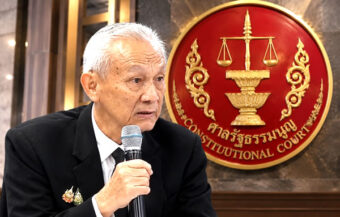
The Constitutional Court accepted the petition in May after concluding that it raised substantial constitutional questions. Both sides subsequently submitted detailed written explanations supporting their legal positions. Following a review of those submissions, the judges determined that sufficient evidence had been gathered. Accordingly, July 9 was fixed for deliberations and a final ruling.
Court prepares final ruling after reviewing legal briefs from government and opposition parties alike
The legal arguments focus primarily on Sections 172 and 173 of the Constitution. Section 172 governs the circumstances allowing the executive to issue emergency decrees instead of introducing legislation through Parliament.
According to the opposition, that power may only be exercised when an urgent and unavoidable necessity cannot reasonably wait for the ordinary legislative process. Government lawyers argue that the international energy crisis clearly met that constitutional threshold.
Section 173 deals with the consequences if an emergency decree is later found unconstitutional. Unlike ordinary legislation, emergency decrees take legal effect immediately after publication in the Royal Gazette. Consequently, the government began implementing the borrowing programme while judicial review remained underway. That sequence has become another central feature of the legal dispute.
Opposition politicians argue that if the decree is ultimately declared unconstitutional, Section 173 provides that it has no legal effect from the outset. They contend such a ruling would immediately raise questions over expenditure already authorised under the decree.
Opposition warns ministers could face further legal action if the emergency decree is ruled unconstitutional
Some opposition figures have also suggested the cabinet could face further legal scrutiny if public money had been disbursed without constitutional authority. They argue complaints could subsequently be submitted to the National Anti-Corruption Commission, alleging malfeasance in office.
Government supporters strongly reject that interpretation. Instead, they argue ministers acted lawfully while the decree remained fully effective. They maintain that the administration responded responsibly to an exceptional international emergency using powers expressly provided by the Constitution.
Furthermore, they argue that governments cannot suspend urgent economic measures every time constitutional litigation is initiated. According to ministers, the decree remained valid unless and until the Constitutional Court ruled otherwise.
Prime Minister Anutin addressed the case publicly on July 6 after confirmation that the Constitutional Court would deliver its judgment three days later. Speaking at Government House, he said the administration had already submitted every document requested by the judges. He also stressed that the government had fully explained its constitutional position. Nevertheless, he acknowledged that the final decision rested entirely with the court.
“We have already provided all the supporting documents and explanations,” Mr Anutin said.
“This clarification was given in the capacity of the government, and ultimately, it is up to the Constitutional Court’s decision.”
“Regardless of the outcome, we must accept it. It is something we must abide by.”
Anutin says the government has fully explained its case and will accept whatever ruling the court delivers
When asked whether the government had prepared contingency plans if the ruling went against it, Mr Anutin again avoided political speculation. Instead, he reiterated that the administration believed its legal submissions fully addressed the constitutional issues before the court. He also stressed that any judgment would be respected, regardless of its impact on the government.
“We expect that our explanations and clarifications will lead the court to make the correct ruling,” he said.
“Whatever the ruling, we will have to follow any guidelines or orders, regardless of the form they take, because we must respect the orders of any court.”
Asked whether he was personally confident, the Prime Minister again refused to predict the outcome. Instead, he said no government could ever be certain because the Constitutional Court alone would make the final decision. He maintained that ministers had simply carried out their responsibilities and presented the facts supporting the decree.
“We have followed policy as per our duty and provided factual information,” he said.
“As for being confident, nobody is truly confident because we are not the ones making the decision.”
Prime Minister refuses to predict outcome while insisting confidence rests with the Constitutional Court alone
His remarks reflected the uncertainty surrounding one of Thailand’s most closely watched constitutional disputes. Although the immediate issue concerns a borrowing decree, the judgment is expected to clarify the scope of emergency executive authority for years to come.
Moreover, it will determine how strictly future governments must interpret the constitutional threshold for invoking emergency fiscal powers.
Thailand’s 2017 Constitution gives the Constitutional Court broad authority to review emergency legislation. While emergency decrees take effect immediately, they remain subject to judicial scrutiny.
Consequently, the court acts as the final arbiter of whether the executive has acted within constitutional limits. That safeguard has become increasingly significant as governments have relied more frequently on constitutional litigation to resolve political disputes.
The present case also highlights the court’s continuing influence over Thailand’s political landscape. Since 2023, constitutional proceedings have already resulted in two Pheu Thai prime ministers leaving office.
Although the current petition does not automatically require Mr Anutin to resign if the decree is struck down, an adverse ruling would inevitably create fresh political pressure. Accordingly, Thursday’s decision is being followed closely throughout Government House, Parliament and the wider political establishment.
Constitutional ruling expected to define executive borrowing powers and shape government power
Political discussion has intensified ahead of the hearing. Reports within Bangkok have already referred to possible contingency arrangements should the government suffer a major constitutional setback.
Speculation has even centred on a potential replacement prime minister identified only by the initial “S”. However, no official proposal has been announced, and the Prime Minister has consistently refused to discuss hypothetical political outcomes while the case remains before the court.
Legal observers have broadly identified three possible outcomes. The first would see the Constitutional Court uphold the decree in its entirety. Under that scenario, the government’s borrowing programme would continue without constitutional uncertainty.
Moreover, Mr Anutin would emerge politically strengthened after surviving the most serious legal challenge of his administration. The ruling would also confirm that the judges considered the international energy crisis sufficient to justify emergency executive action.
Even so, such a judgment would extend beyond the present dispute. It would establish an important constitutional precedent governing future emergency borrowing. Critics argue that broad approval could encourage governments to rely more frequently on emergency decrees for major economic programmes. Government supporters reject that argument. Instead, they maintain every future decree would still have to satisfy the constitutional tests contained in Section 172.
Court may uphold decree and strengthen government while creating a landmark constitutional precedent
The second possibility would see the Constitutional Court invalidate the decree in its entirety. Such a ruling would represent a major setback for the government. Although the Constitution does not automatically require the Prime Minister to leave office, the administration would almost certainly face immediate political pressure.
Furthermore, ministers could be forced to finance part or all of the programme through the ordinary parliamentary budget process.
Questions would also arise over expenditure already made under the decree. Opposition politicians have already indicated they would consider further legal action if the legislation is struck down. Some have suggested complaints could be lodged with the National Anti-Corruption Commission, alleging malfeasance in office. Government supporters dispute that interpretation. Instead, they argue ministers acted lawfully while the decree remained constitutionally effective.
A third outcome has attracted increasing attention among legal commentators. Under that approach, the Constitutional Court could distinguish between the decree’s two separate borrowing programmes.
The judges could conclude that the first ฿200 billion allocated for emergency public assistance genuinely satisfied the constitutional requirement for urgent action. However, they could also determine that the second ฿200 billion intended for long-term energy investment should instead proceed through Parliament.
Partial ruling could preserve emergency relief while forcing energy projects back before Parliament
Such a judgment would preserve immediate assistance already delivered to households while requiring future energy projects to return to the ordinary budget process. Consequently, both sides could claim a measure of success.
The government would retain emergency relief programmes introduced during the energy crisis. Meanwhile, the opposition could argue it had protected Parliament’s constitutional authority over long-term public borrowing without obstructing assistance to the public.
Whatever the outcome, Thursday’s judgment is expected to become one of the most significant constitutional rulings on executive borrowing powers since the 2017 Constitution came into force.
Future administrations are likely to study the decision carefully whenever international events create pressure for rapid economic intervention. Equally important, the ruling will clarify how the Constitutional Court interprets the balance between emergency executive action and parliamentary oversight of public finances.
Final ruling will shape Anutin’s future and redefine emergency borrowing powers under the Constitution
For Prime Minister Anutin, however, the consequences are both constitutional and political. He enters Thursday’s hearing while already managing several serious domestic challenges. The government continues to face criticism over issues affecting Thailand’s tourism industry and international standing.
In parallel, ministers remain under pressure from the widening civil service recruitment scandal. Separately, the investigation into the attempted assassination of a Prachachart Party MP has added another sensitive issue to the administration’s agenda.
Weakening baht falls below 33 to the US dollar as industry leaders warn borrowing costs will also rise
Finance Minister defends 400 billion baht loan decree as opposition files Constitutional Court challenge
Against that broader political backdrop, the Constitutional Court’s ruling has taken on even greater significance. A favourable judgment would remove one of the most immediate legal threats confronting the government and reinforce its economic strategy.
Conversely, an adverse ruling would introduce fresh uncertainty at the centre of Thai politics. Either way, Thursday’s decision will shape not only the future of the government’s ฿400 billion borrowing programme but also the constitutional limits governing emergency fiscal powers under Thailand’s 2017 Constitution.
Join the Thai News forum, follow Thai Examiner on Facebook here
Receive all our stories as they come out on Telegram here
Follow Thai Examiner here
Further reading:
US Ambassador Seán O’ Neill briefed Prime Minister Anutin Charnvirakul at Government House on War
Visa waivers, discounted hotel stays and 2,000 baht a person per day for stranded tourists announced
Liquidity crisis or shortage of cash on the ground is shrinking Thailand’s economic growth prospects
Thai Minsters engage with US trade chief Jamieson Greer in Paris at global OECD ministerial meeting