People’s Party storms ahead in major online media poll with 41.36% support as Feb 8 election nears, Nattapong leads PM race, rivals trail badly, but constituency fights, coalition maths and vote-buying claims threaten to upend the progressive party’s poll dominance.
The latest nationwide opinion poll from a leading Thai media outlet shows the People’s Party surging as the campaign enters its final phase. On 41.36%, it commands more than triple the support of any rival. Pheu Thai trails on 13.24%, narrowly ahead of the ruling Bhumjaithai Party on 13.08%. However, the election will be decided in constituencies, not polls, making the final seat count far tighter. As in 2023, post-election coalition talks are inevitable. This time, there will be no Senate veto on a People’s Party prime minister. The choice is stark: a pro-democracy coalition led by the People’s Party or a conservative bloc led by Bhumjaithai.
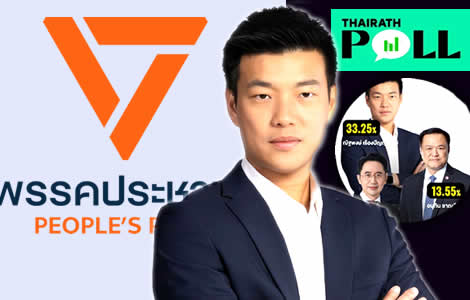
One of Thailand’s largest daily newspapers has released a new opinion poll ahead of the February 8 General Election. The poll was conducted by Thairath Online. It was published on January 10 2026. The survey reflects political sentiment during a critical phase of the campaign.
The poll was conducted between January 4 and January 9. It recorded responses from up to 40,085 participants. As a result, it ranks among the largest political surveys in this election cycle. However, the survey reflects reader participation rather than a random national sample.
According to the results, the People’s Party is gaining support rapidly. In particular, momentum has accelerated during the recent week. Consequently, the party now leads decisively in both party and leadership rankings.
People’s Party surge revives memories of 2023 election upset and confirms dominance in polling
Notably, the trend recalls the 2023 General Election. At that time, the Move Forward Party delivered an unexpected victory. Subsequently, the People’s Party emerged as its political successor.
In the party preference category, the People’s Party recorded 41.36 per cent support. By comparison, no rival party exceeded 14 per cent. Therefore, the gap between first and second place remains wide.
Pheu Thai ranked second with 13.24 per cent support. Meanwhile, the Bhumjaithai Party followed closely with 13.08 per cent. In contrast, the Democrat Party placed fourth with 10.39 per cent.
Beyond the leading parties, several others registered notable figures. For instance, Ruam Thai Sang Chart received 9.83 per cent. Similarly, the Setthakit Party recorded 4.26 per cent. Meanwhile, Thai Sang Thai followed with 2.65 per cent.
People’s Party dominance extends beyond rivals as mid-tier and smaller parties trail far behind
At the same time, the poll measured preferred candidates for prime minister. In this category, the People’s Party again dominated the field. Specifically, Nattapong Ruangpanyawut or ‘Teng’ ranked first.
Nattapong received 33.25 per cent support as the preferred prime minister. As a result, he led the field by a substantial margin. No other candidate approached his level of support.
In second place was Bhumjaithai leader Anutin Charnvirakul. He recorded 13.55 per cent support. Meanwhile, Yotsanun Wongsawat of Pheu Thai followed with 12.71 per cent.
Former prime minister Abhisit Vejjajiva ranked fourth. He received 10.40 per cent support. Together, the top four candidates captured the majority of responses.
Other candidates recorded single-digit results. For example, Pirapan Salirathavibhaga of United Thai Nation (Ruam Thai Sang Chart) Party received 8.87 per cent. Likewise, Gen Rangsi Kitiyanasop followed with 5.65 per cent. In addition, Khunying Sudarat Keyuraphan recorded 2.96 per cent.
Prime Minister polling highlights Nattapong’s lead while opposition figures tightly clustered behind
In recent days, coalition prospects have drawn increased attention. In particular, remarks from Thanathorn Juangroongruangkit clarified political boundaries. He is widely regarded as the People’s Party’s political godfather.
Thanathorn founded the now-dissolved Future Forward Party. Subsequently, he became the leader of the Progressive Movement. He remains a central figure in reformist politics.
This week, Thanathorn stated that the People’s Party would not support Anutin Charnvirakul as prime minister. He said this would apply under any circumstances. As a result, speculation about post-election cooperation was sharply reduced.
Meanwhile, the structure of the poll has prompted scrutiny. Although the sample size was large, it was heavily urban. In particular, Bangkok residents formed nearly half of respondents.
According to the survey, 48.48 per cent of respondents lived in Bangkok and surrounding areas. Consequently, urban political sentiment dominated the findings. Regional participation was uneven.
Bangkok-heavy sample raises questions over how accurately the poll reflects national political sentiment
The Central region accounted for 16.88 per cent of respondents. This included both Eastern and Western provinces. Meanwhile, the Northeastern region contributed 14.53 per cent.
By contrast, the Northern region represented 10.81 per cent of participants. The Southern region accounted for 9.29 per cent. Therefore, rural and southern voters were less represented.
Age distribution further shaped the results. Notably, middle-aged and older voters formed the majority. Younger voters participated at lower levels.
The largest age group was 46 to 59 years old. They accounted for 32.71 per cent of respondents. Meanwhile, those aged 60 and above represented 19.85 per cent.
Similarly, respondents aged 36 to 45 made up 19.55 per cent. By contrast, voters aged 18 to 25 accounted for only 10.20 percent. As a result, youth preferences had a limited impact on totals.
Older and urban voters dominate responses, leaving youth and rural preferences underreported
Despite strong polling figures, the survey measures popularity only. It does not predict electoral outcomes. In Thailand, elections often hinge on constituency dynamics.
Notably, 80 per cent of seats in the House of Representatives are constituency seats. Therefore, national popularity does not translate directly into parliamentary strength. Local contests remain decisive.
In many districts, local networks exert strong influence. As a result, outcomes can diverge from national polling trends. This pattern has been seen repeatedly.
During the current campaign, reports of vote buying have increased. Large amounts of cash have been reported in circulation. These reports have emerged from several regions.
In northeastern Thailand, one case drew particular attention. Pheu Thai Party candidate in Ubon Ratchathani, Watcharapol Chueakhong, spoke publicly. He estimated that significant funds were involved.
Constituency politics and vote buying reports highlight limits of polling in predicting final results
Specifically, he estimated that ฿1 billion was circulating locally. The estimate covered an 11-seat constituency area. According to the claim, funds targeted key localities.
Such activity can influence closely contested races. In particular, it may swing outcomes in marginal districts. These effects are not captured by opinion polls.
Past elections illustrate this disconnect clearly. For example, in the 2023 General Election, the Bhumjaithai Party secured over 14 per cent of parliamentary seats. However, it recorded only 2.99 per cent in the national party-list vote.
That result reflected strong constituency performance. It also demonstrated how local victories can outweigh national vote shares. Therefore, polling figures offer limited insight into final seat totals.
Final stretch underscores stark choice as polling strength meets hard realities of constituency politics
As February 8 approaches, the contrast remains clear. On one hand, the People’s Party dominates national polling. On the other hand, constituency races remain fluid and competitive.
Ultimately, the election outcome will be decided district by district. Coalition negotiations will follow seat counts, not polling leads. Opinion surveys provide context, not conclusions. Nonetheless, the choice in the election is between a pro-democracy coalition headed by the People’s Party and a more conservative government led by the Bhumjaithai Party.
Pheu Thai candidate calls on Election Commission to act. ฿1 billion for vote buying in Ubon Ratchathani
Poll shows there’s still a chance for a Pheu Thai People’s Party coalition but it will take a bit of luck
Significantly, the Senate in 2026 cannot block the People’s Party’s candidate for Prime Minister. However, it would be a mistake to underestimate the power of conservative elements in Thailand, who will likely resist a government formed by the progressive movement.
Join the Thai News forum, follow Thai Examiner on Facebook here
Receive all our stories as they come out on Telegram here
Follow Thai Examiner here
Further reading:
High powered, secretive meeting chaired by PM agrees robust action against Cambodian networks
Thailand and Cambodia face danger from ‘Dragon Head’ the Chinese mafia leader behind the scams
Cyber police and Money Laundering agency seek UK and US co-operation targeting Cambodian networks
United States, South Korea and United Kingdom act against Cambodian scam industry with Thai tie-ins
Ben Smith affair & allegations of links to Cambodian scam centres continues to rage in parliament