Thailand storms Davos as Finance Minister Ekniti returns with momentum on over ฿500bn in pledged investment, locking in tech, AI, industry and data centre deals while positioning Bangkok as a stable hub ahead of the IMF–World Bank Meetings 2026.
A Thai delegation to the annual World Economic Forum (WEF) summit in Davos returned last week with more than ฿500 billion in investment pledged during the three-day event, which opened on January 19 and closed on the morning of January 23. The forum was held under the theme “A Spirit of Dialogue”. The delegation was led by Deputy Prime Minister and Finance Minister Ekniti Nitithanprapas and included Commerce Minister Suphajee Suthumpun and Foreign Minister Sihasak Phuangketkeow. The mission brought together top officials to raise Thailand’s profile among global decision-makers and secure direct engagement with leading players in industry and finance.
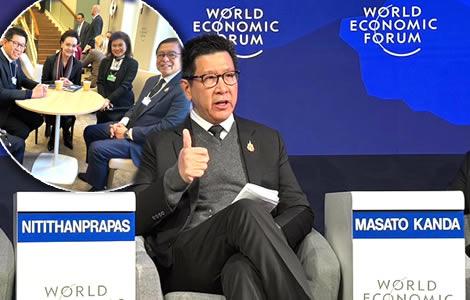
Deputy Prime Minister and Finance Minister Ekniti Nitithanprapas has concluded Thailand’s official mission at the World Economic Forum Annual Meeting 2026 in Davos, Switzerland. The visit took place from January 19 to January 22, 2026.
The Thai team of officials and ministers returned on Friday, January 23, after a series of high-level meetings with global business and finance leaders.
The trip focused on reinforcing Thailand’s economic standing and accelerating large-scale investment decisions. As a result, the delegation confirmed progress on investment plans exceeding 500 billion baht. These commitments involve global technology leaders and industrial firms with existing or planned operations in Thailand.
Davos mission boosts Thailand’s global standing while confirming over 500 billion baht in investment
According to Mr. Narut Therdsathirasak, Secretary-General of the Board of Investment, the mission delivered measurable outcomes. Confidence in Thailand among international leaders increased. At the same time, cooperation networks expanded across governments, multinational corporations, and global economic institutions.
Moreover, the delegation used the Davos platform to present Thailand’s policy direction with clarity. Officials emphasised policy continuity, long-term planning, and macroeconomic stability. As a result, Thailand was positioned as a predictable and reliable investment destination.
At Davos, Thailand was also presented as a neutral partner amid ongoing geopolitical tensions. In particular, officials highlighted readiness to serve as a base for new regional economic cooperation. Furthermore, the delegation stressed Thailand’s ability to host world-class international events, including preparations for the IMF–World Bank Annual Meetings 2026 in Bangkok.
Mr. Ekniti stated that the mission achieved three defined objectives. First, it unified government and private sector messaging abroad. Consequently, Thailand’s national image was presented consistently to world leaders and investors. Second, it pursued concrete negotiations with major corporations, focusing on advanced technology investment with clear economic returns. Third, it strengthened cooperation with global institutions, advancing Thailand’s international engagement agenda.
The second objective centred on New S-Curve industries. These industries rely on high technology and advanced systems. As a result, discussions focused on digital infrastructure, artificial intelligence, automation, and aerospace. Moreover, talks emphasised quality employment, workforce upgrading, and deeper Thai participation in global supply chains.
Talks with nine global firms review existing projects and press for faster rollout of investments in Thailand
During the forum, the Thai delegation met executives from nine leading global companies. These meetings reviewed existing investments and future expansion plans. Altogether, the combined value exceeded 500 billion baht. Importantly, the discussions aimed to sustain investor confidence during Thailand’s government transition. At the same time, companies were encouraged to accelerate project implementation.
The companies represented three strategic sectors. Six operate in the digital and artificial intelligence industries. Two specialise in intelligent automotive and aerospace technologies. One represented the global food sector. Each engagement addressed investment scale, infrastructure readiness, and skills development.
In the digital and AI group, Amazon Web Services reaffirmed its long-term commitment. The company confirmed investment plans exceeding 150 billion baht over a 15-year period, following more than 24 billion baht already invested in Thailand. Moreover, AWS reiterated support for the government’s Cloud First policy and expressed interest in the Skill Bridge human capital program.
Amazon Web Services reinforces cloud investment and skills training as cornerstone of digital push
Accordingly, AWS plans further discussions with Thai authorities to refine operational and training details. As a result, the projects are expected to support over 50,000 digital and AI professionals through training, certification, and workforce deployment. These efforts are expected to directly support cloud infrastructure expansion in Thailand.
Meanwhile, Microsoft presented AI applications for both public and private sectors. The company highlighted tools to improve efficiency in government services and outlined AI solutions for business operations. In addition, Microsoft discussed support for small and medium-sized enterprises, focusing on digital adaptation and competitiveness.
Furthermore, Microsoft explored cooperation in human resource development. The discussions addressed skills required for the digital economy. As a result, training pathways and workforce transitions were reviewed, aligning with Thailand’s long-term workforce strategy.
TikTok and DAMAC outline regional hub and data centre investments tied to energy conditions
Separately, TikTok confirmed its long-term investment plan in Thailand, exceeding 270 billion baht. The plan covers infrastructure, operations, and regional functions. At the same time, TikTok discussed ways to support Thai SMEs by expanding market access and revenue generation through its platform.
Moreover, TikTok proposed developing Thailand as a regional hub, including content development and creative operations. In addition, the company discussed regional coordination functions, aligning with Thailand’s ambition to host regional digital activities.
Meanwhile, DAMAC outlined plans to invest more than 130 billion baht in Thailand. As a global developer of data center infrastructure, the company focused its discussions on large-scale capacity development. In particular, DAMAC highlighted the importance of power grid readiness and long-term energy planning to support cloud and AI expansion.
HCL and NVIDIA focus on applied AI, government technology and long term ecosystem development
Separately, HCL Technologies discussed advanced AI applications across agriculture, manufacturing, and tourism. Each sector was reviewed with operational use cases. At the same time, HCL presented GovTech solutions aimed at raising efficiency in government services.
Moreover, HCL discussed system integration and analytics to support data-driven decision-making. As a result, efficiency gains and workforce upskilling featured prominently in discussions.
Meanwhile, NVIDIA outlined strategies to strengthen Thailand’s AI ecosystem. Discussions covered human resource development, developer communities, and long-term capability building. In addition, NVIDIA proposed developing Thai language AI models to support national industries and services.
Furthermore, NVIDIA discussed expanding Centres of Excellence to promote AI learning and research. Consequently, Thailand’s AI capabilities are expected to scale over time, supporting sustained ecosystem development.
Automotive, aerospace and food investments deepen supply chains and reinforce Thailand’s role
In the intelligent automotive and aerospace group, Hesai Technology confirmed a major investment decision. The company will invest more than 1.5 billion baht in Thailand to establish its first manufacturing base outside China. Importantly, the facility will focus on LiDAR technology for intelligent vehicle platforms.
As a result, Thailand was selected as a regional production base. At the same time, Hesai committed to workforce development by supporting robotics and AI training through the Skill Bridge program. Accordingly, Thai workers will be prepared for participation in the AI and robotics supply chain.
Meanwhile, Archer Aviation discussed urban air mobility opportunities. The company explored cooperation and joint ventures with Thai firms. Specifically, talks focused on passenger aircraft services targeting densely populated urban areas, with speed and efficiency emphasised.
In the food sector, Nestlé reviewed its long-standing operations in Thailand. The company operates four entities in the country and holds eight BOI-promoted investment projects. To date, Nestlé has invested more than 28 billion baht across food, beverage, and pet food businesses.
Moreover, Thailand serves as Nestlé’s regional office location. Expansion plans are under review, with further investment expected in the near future.
Thailand leverages Davos diplomacy to prepare for IMF World Bank meetings and expand global reach
Beyond corporate meetings, the delegation engaged global economic institutions. Mr. Ekniti met World Bank President Ajay Banga and IMF Managing Director Kristalina Georgieva. During these meetings, global economic trends, inclusive growth, and job creation were reviewed.
In addition, preparations for hosting the IMF–World Bank Annual Meetings 2026 were discussed. Thailand presented readiness across logistics, coordination, and infrastructure. Moreover, officials emphasised the strategic value of hosting as a platform for policy exchange on economic resilience, fiscal sustainability, and private sector financing.
Separately, Mr. Ekniti met leaders from several governments and organisations, including the OECD Secretary-General, ministers from Finland, Hong Kong, and Saudi Arabia, as well as representatives from the Gates Foundation and the World Economic Forum.
New cabinet to decide on Donald Trump’s Peace Board invitation says Prime Minister Anutin Charnvirakul
One of Thailand’s top business entrepreneurs calls for a halt to the economic rot and a new digital age
Prime Minister heads to Davos where Thailand will sign its first free trade pact with European countries
Meanwhile, the Thai delegation joined key WEF forums, including the Informal Gatherings of World Economic Leaders and strategic meetings on ASEAN growth and productivity. Furthermore, Thailand participated in panels examining ASEAN’s economic pace, competitiveness, and regional connectivity.
Overall, the Davos mission reinforced Thailand’s international positioning. Investment promotion was directly linked to skills development and supply chain integration. As a result, cooperation frameworks were strengthened, and Thailand’s role as a proactive economic player was reaffirmed.
Receive all our stories as they come out on Telegram here
Follow Thai Examiner here
Further reading:
Thailand invited to be part of Trump’s Board of Peace which diplomats warn cuts across the UN’s role
Foreign Minister Sihasak expresses disappointment at Trump’s remarks on border landmine incidents
War to continue says PM Anutin. Dismisses President Trump’s ceasefire talk as a ‘misunderstanding’
Confusion after Trump’s 20 minute phone call with PM Anutin. US side claimed a ceasefire was agreed
People’s Party on campaign but on guard against potential legal complaints to oversight agencies
Wealthy young People’s Party leader aims to create a technology-driven and efficient welfare state