Thailand braces for Middle East shock as US–Iran tensions rise. Officials say oil reserves cover 90 days, but economists warn growth could slide, tourism may drop to 33 million, and oil could hit $125, creating challenges for a new government that must form quickly.
Some of Thailand’s top economists are urging Prime Minister Anutin Charnvirakul to push ahead with forming his new government this month. The call comes in a week when nearly all party-list MPs were confirmed and most constituency members of the House of Representatives took their seats. Parliament is expected to meet on March 12 to elect a new House speaker. Rumblings over the February 8 general election persist, but a nationwide annulment is widely seen as unlikely.
Thailand is preparing for potential economic disruption as conflict between the United States and Iran intensifies. However, officials say the country holds more than 90 days of crude oil and energy reserves.
Therefore, authorities believe Thailand has a short-term buffer against supply shocks. At the same time, agencies are monitoring developments in the Middle East closely. The conflict is expected to last at least four more weeks. Consequently, government departments are reviewing contingency measures across transport and energy sectors.
At the same time, aviation authorities are working to reduce disruption to international flights. In particular, attention is focused on routes connecting Thailand with Middle Eastern hubs. Airlines have already begun adjusting schedules as tensions rise. Consequently, Thai authorities are coordinating closely with carriers and airport operators. The goal is to keep daily operations stable despite regional uncertainty.
Thailand rejects claims US sought U-Tapao base for Iran attacks as government monitors regional tensions
Earlier this week, Foreign Affairs Minister Sihasak Phuangketkeow addressed reports involving U-Tapao Airport. Specifically, some reports claimed the United States requested use of the base for attacks on Iran. However, Mr Sihasak firmly rejected the claims. He said no such request had been made by the United States.
Furthermore, the minister stressed Thailand’s position on the use of its territory. Thailand would not allow the base to be used to attack another country. Nevertheless, he clarified that certain routine activities remain permitted. These include humanitarian operations and aircraft refuelling missions.
Accordingly, such missions may continue under existing arrangements. However, offensive military operations launched from Thai territory would not be allowed. Officials say the government will continue monitoring developments in the region.
Attention is also turning to Thailand’s political transition after the recent general election. Parliament is expected to convene later this month. In particular, the first sitting may take place on March 12. During that meeting, the House of Representatives will elect a Speaker.
Parliament prepares for March 12 sitting to elect House speaker as political transition gathers pace
In addition, two deputy speakers will also be chosen. The vote will mark the next step toward forming a new government. Economists say a fully functioning cabinet is needed quickly.
Earlier, the Election Commission confirmed that 499 members of parliament have been certified. This total includes 399 constituency MPs and 100 party-list MPs. Consequently, the constitutional threshold for opening parliament has been met. The law requires certification of at least 95 per cent of MPs.
Accordingly, the first sitting will be chaired by the most senior MP. Pairoj Lohsunthorn of the Pheu Thai Party will preside temporarily. Mr Pairoj is 89 years old.
Political parties are therefore preparing nominations for House leadership. The Bhumjaithai Party is expected to nominate Sophon Saram as Speaker. Mr Sophon represents Buri Ram province.
Meanwhile, the First Deputy Speaker position falls within Bhumjaithai’s quota. However, the party is still discussing its candidate. At the same time, the Pheu Thai Party is expected to nominate Manaporn Charoensri as Second Deputy Speaker.
Party-list seats confirmed with People’s Party leading allocation as parliament leadership contest looms
Ms Manaporn represents Nakhon Phanom province in the House. Her nomination reflects negotiations among major parties following the election. The outcome will shape the leadership structure of parliament.
Earlier, the Election Commission also confirmed the distribution of party-list seats. The People’s Party secured the largest number of proportional representatives. It received 32 party-list MPs.
Bhumjaithai followed with 19 proportional seats. Pheu Thai secured 16 party-list MPs. The Democrat Party obtained 11 seats through the proportional system.
Several smaller parties also gained representation. The Economic Party received three seats. Ruam Thai Sang Chart secured two party-list MPs.
Similarly, the Pheu Chart Thai Party obtained two seats. The Kla Tham Party also secured two proportional MPs.
In addition, numerous smaller parties obtained one seat each. These include the United Thai Hearts Party and the Prachachart Party. Thai Sapthawee also secured one seat. Likewise, the New Democracy Party and the New Dimension Party each gained one seat. Thai Bhakdi secured one proportional MP. Thai Sang Thai obtained one party-list seat.
Full party-list distribution finalised as Election Commission confirms smaller parties also take seats
Furthermore, the People’s Power Party and the Liberal Thai Party secured one seat each. The New Alternative Party also gained representation. The Thai United Power Party received one seat. Finally, the Palang Pracharath Party secured one party-list MP. These results complete the proportional allocation confirmed by the commission.
At the same time, all 399 constituency MPs have already been certified. Bhumjaithai secured the largest share of constituency victories. The party won 172 seats nationwide. The People’s Party followed with 88 constituency MPs. Pheu Thai secured 58 constituency seats. Kla Tham obtained 56 constituency MPs.
Meanwhile, the Democrat Party secured 10 constituency seats. Thai United Power Party obtained five seats. Palang Pracharath and Prachachart each won four constituencies.
In addition, Thai Sang Thai secured one constituency seat. The New Opportunity Party also gained one seat through the constituency system.
However, one constituency result remains unresolved. The Election Commission has not certified Suphan Buri Constituency 2. Officials cited suspected irregularities involving polling station conduct.
Election commission investigates Suphan Buri poll irregularities while economists warn over delays
Earlier, Acting Lieutenant Colonel Phasakon Siriphakayaporn addressed the issue. He serves as deputy secretary-general of the Election Commission. Investigators are examining evidence related to polling station procedures.
Earlier this week, the commission certified three additional constituency MPs. These included Phayao Constituency 1. Chanthaburi Constituencies 1 and 2 were also confirmed.
In addition, Mr Phasakon addressed questions concerning National Election Commission volunteers. He said the volunteers remain valued by the commission. Once appointed, they are considered officials under the Criminal Code.
Therefore, they possess legal authority to perform their duties. However, they must act strictly according to the law. Volunteers assisting any political party will face legal consequences.
At the same time, economists are urging the rapid formation of a new government. They warn delays could complicate economic management during global uncertainty.
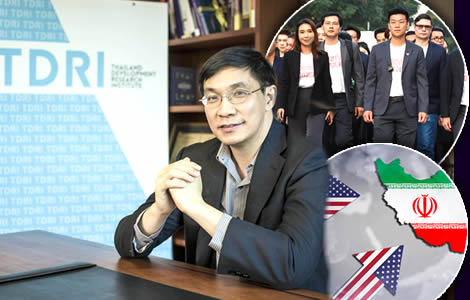
Somkiat Tangkitvanich raised these concerns at a forum organised by the Thai Journalists Association. Mr Somkiat is president of the Thailand Development Research Institute. His keynote speech examined challenges facing the next government.
Economists warn Thailand faces global pressures from geopolitics, climate change and technology
According to Mr Somkiat, Thailand faces several global pressures simultaneously. First are geopolitical tensions and international trade conflicts. Second is climate change affecting economic competitiveness. Third is rapid technological advancement.
Thailand also faces structural domestic challenges. Economic growth has remained relatively low. In addition, the country’s population is ageing rapidly. Corruption remains another persistent concern.
At the same time, Thailand must confront immediate uncertainty from conflict in the Middle East. Mr Somkiat said the duration of the violence remains difficult to predict. Some reports suggest the fighting could end within weeks.
However, the risks to global stability may not disappear quickly. Consequently, the conflict could affect the global economy.
Rising energy prices could increase production costs worldwide. As a result, trade activity may slow. Tourism flows may also be affected by economic uncertainty.
Economist warns fuel subsidies and political uncertainty could strain finances after election
Mr Somkiat warned that short-term responses could clash with long-term policy goals. Governments may try to stabilise fuel prices through subsidies. However, such policies could strain public finances.
He also addressed political uncertainty following the election. Public scepticism remains about whether the vote was fair and transparent. Nevertheless, he believes the election is unlikely to be annulled.
Therefore, political parties are continuing negotiations to form a government. Public confidence will depend heavily on cabinet appointments. Key ministries should be led by widely accepted individuals.
These ministers must demonstrate transparency and avoid scandals. Mr Somkiat also urged the next government to prioritise essential spending. Large projects with uncertain outcomes should be avoided.
Danucha Pichayanan delivered similar warnings during the forum. He serves as secretary-general of the National Economic and Social Development Council.
NESDC urges economic restructuring and stronger resilience against geopolitical and climate shocks
According to Mr Danucha, Thailand must strengthen resilience against external shocks. These include geopolitical tensions, military conflicts and climate change. Global economic volatility also remains a major risk.
Therefore, the country must restructure its production system. Improving competitiveness will be essential. Developing new economic sectors will also be necessary.
At the same time, restoring confidence will be a key task for the next government. Both Thai citizens and international investors must regain trust.
Investors must be assured that governance meets international standards. Consequently, stable economic management will be essential.
The NESDC has also prepared economic scenarios linked to the Middle East conflict. The first assumes the conflict ends within one month. This estimate follows remarks by US President Donald Trump.
Prolonged Middle East conflict could push oil to $125 and slow Thailand’s growth to 1.3 per cent.
Under that scenario, Thailand’s economic growth could slow from about two per cent to roughly 1.6 per cent. However, a longer conflict would create deeper economic effects.
Growth could decline further to around 1.3 per cent. At the same time, global oil prices could rise sharply.
Prices could reach about US$125 per barrel under a prolonged conflict. However, if fighting ends quickly, prices may remain closer to US$100 per barrel.
Therefore, Mr Danucha said rapid government formation is essential. Budget decisions require stable leadership. Delays could complicate economic management.
The tourism industry is already experiencing early effects of the conflict. Chai Arunanondchai addressed the issue during the same discussion. Mr Chai serves as president of the Tourism Council of Thailand. According to him, several airlines have begun reducing flights to Thailand.
Tourism arrivals may fall short of 36 million target as airlines cut flights amid global tensions
Consequently, tourism targets may become difficult to achieve. Thailand initially aimed to receive 36 million visitors this year. However, industry estimates now suggest arrivals may reach around 33 million.
Mr Chai also highlighted instability in tourism leadership. Thailand has had four tourism and sports ministers during the past year.
Analysts urge the government to prepare for higher oil prices as top bank predicts 33 baht to dollar rate
US Ambassador Seán O’ Neill briefed Prime Minister Anutin Charnvirakul at Government House on War
Therefore, industry leaders say consistent leadership will be important. For now, attention remains focused on the opening of parliament. The election of a House Speaker will mark the next step toward forming Thailand’s new government.
Join the Thai News forum, follow Thai Examiner on Facebook here
Receive all our stories as they come out on Telegram here
Follow Thai Examiner here
Further reading:
US Ambassador Seán O’ Neill briefed Prime Minister Anutin Charnvirakul at Government House on War
Visa waivers, discounted hotel stays and 2,000 baht a person per day for stranded tourists announced
Liquidity crisis or shortage of cash on the ground is shrinking Thailand’s economic growth prospects
Thai Minsters engage with US trade chief Jamieson Greer in Paris at global OECD ministerial meeting