New NIDA poll delivers a political shock as Nattapong Ruangpanyawut overtakes Prime Minister Anutin Charnvirakul and the People’s Party opens a commanding national lead, despite Bhumjaithai’s grip on parliamentary power.
The People’s Party has regained the political initiative after a new National Institute of Development Administration (NIDA) poll placed leader Nattapong Ruangpanyawut, or ‘Teng’, ahead of Prime Minister Anutin Charnvirakul as Thailand’s preferred prime minister and gave the opposition a commanding lead as the country’s most popular party. However, the survey also exposes a stark political contradiction. Despite dominating national opinion, the People’s Party still struggles to convert popularity into parliamentary power, as constituency networks, provincial political dynasties and the ruling Bhumjaithai Party’s powerful “Big House” machine continue to determine control of the House of Representatives, while a looming Constitutional Court case and criminal investigations threaten to reshape the opposition’s future leadership.
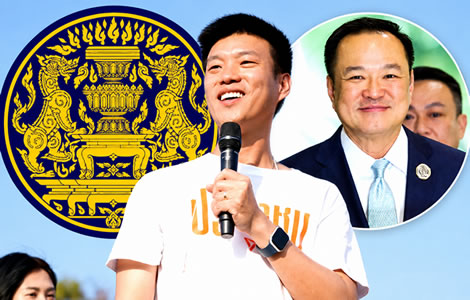
The latest National Institute of Development Administration (NIDA) poll has delivered a striking verdict on Thailand’s political landscape. People’s Party leader Nattapong Ruangpanyawut has emerged as the country’s preferred choice for prime minister.
Likewise, the People’s Party remains Thailand’s most popular political party by a commanding margin. However, the findings also expose the widening gap between national popularity and parliamentary power.
The survey, released on Sunday, comes at a critical time for the opposition. Recent local election results have placed the People’s Party under renewed scrutiny. In particular, defeats in the Bangkok and Chonburi mayoral elections raised questions over its electoral strength.
Those losses were widely attributed to experienced local candidates with strong name recognition and well-established constituency organisations. Even so, the latest NIDA figures suggest the party’s national appeal remains firmly intact.
Nida poll restores People’s Party momentum despite recent setbacks in Bangkok and Chonburi elections
NIDA conducted the survey between June 29 and July 2. Researchers interviewed 2,500 respondents aged 18 and above. The sample covered every region, occupation, education level and income group.
As part of the methodology, the institute used probability sampling from its Master Sample database. It then carried out telephone interviews using a multi-stage sampling process. Consequently, the results provide one of the broadest measures of current political sentiment.
Asked who they would support as prime minister today, 26.08% chose People’s Party leader Nattapong Ruangpanyawut. Prime Minister Anutin Charnvirakul of the Bhumjaithai Party followed on 21.68%.
Although the margin was relatively narrow, the opposition leader retained first place. Behind the leading pair came former prime minister and Democrat Party leader Abhisit Vejjajiva with 11.80%. Deputy Prime Minister and Higher Education, Science, Research and Innovation Minister Yodchanan Wongsawat of the Pheu Thai Party secured 11.64%.
Poll ranks prime ministerial contenders as Nattapong edges Anutin while established figures trail behind
Elsewhere, 10.24% of respondents remained undecided. Thai Pakdee Party leader Dr Warong Dechgitvigrom followed with 4.08%. Khunying Sudarat Keyuraphan of the Thai Sang Thai Party received 2.72%. General Rangsi Kitiyanasap of the Economic Party secured 2.56%. Police General Seripisut Temiyaves of the Seri Ruam Thai Party recorded 2.16%, while United Thai Nation Party leader Peerapan Salirathavipak attracted 2.04%. Pheu Thai’s Julapan Amornvivat followed on 1.32%.
Another 3.68% selected other political figures. Those included former Prime Minister General Prayut Chan-o-cha, Captain Thamanat Prompow of the Kla Tham Party and Bangkok Governor Chadchart Sittipunt. The group also included People’s Party MPs Rangsiman Rome, Parit Wacharasindhu, Rakchanok Srinok and Dr Wayo Asavarungruang, together with several other senior politicians.
Support for political parties produced an even clearer outcome. The People’s Party topped the survey with 34.80%. The governing Bhumjaithai Party followed on 17.00%. Pheu Thai ranked third with 16.84%, while the Democrat Party secured 12.68%. Meanwhile, 5.32% of respondents said they had not yet found a suitable political party.
People’s Party opens commanding lead in party support as governing coalition trails well behind
Support dropped sharply beyond the four largest parties. The United Thai Nation Party received 2.96%, followed by the Thai Pakdee Party on 2.76%. The Economic Party secured 2.04%, ahead of the Thai Sang Thai Party on 1.92%. The Seri Ruam Thai Party followed with 1.60%. Separately, another 2.08% selected smaller parties, including the Kla Tham Party, Palang Pracharath Party, Opportunity Party, Prachachat Party and Thai Ruam Palang Party.
Notably, the survey arrives only months after the February 8 General Election dramatically reshaped Thailand’s political map. Despite repeatedly leading national opinion polls, the People’s Party failed to emerge as the country’s governing force. Instead, the Bhumjaithai Party consolidated control of the House of Representatives through a powerful constituency performance.
That contrast reflects one of the defining features of Thai politics. National opinion polls measure popularity. General elections determine parliamentary seats. Those outcomes are frequently driven by constituency networks rather than nationwide sentiment.
Constituency networks continue to outweigh national popularity in determining House seats
Across much of provincial Thailand, local political families continue to dominate elections. Long-established patronage networks remain highly influential. Candidates with deep community roots often outperform nationally recognised parties. As a result, parliamentary strength is built constituency by constituency rather than through national vote share alone.
The latest survey again illustrates that political divide. The People’s Party continues to command the broadest national support.
Nevertheless, it still faces difficulty converting that support into constituency victories outside Bangkok and major urban centres. The recent mayoral defeats in Bangkok and Chonburi reinforced those organisational challenges.
On another front, the poll also highlights the significance of the Kla Tham Party. Formerly known as the Thai Economic Party, it is led by former Deputy Prime Minister Captain Thamanat Prompow, one of Thailand’s most influential provincial political operators. The latest NIDA survey gives the party just over 2% support. Yet its parliamentary strength remains considerably greater.
Kla Tham demonstrates how provincial influence can outweigh modest nationwide electoral support
At the February 8 General Election, Kla Tham secured only 1.79% of the party-list vote. Even so, it returned 58 MPs to Parliament. In practical terms, that equated to 11.79% of parliamentary representation. The result underlined the electoral value of strong constituency organisations across the provinces.
Similarly, the ruling Bhumjaithai Party benefited from the same political dynamic. Its parliamentary dominance rests heavily on influential provincial networks often described as “Big House” organisations. Those alliances continue to shape election outcomes across large parts of Thailand. Therefore, national opinion polling often tells only part of the political story.
In response to that electoral landscape, conservative figures linked to the Bhumjaithai Party have proposed constitutional changes.
Their proposals would increase the proportion of constituency MPs. At the same time, they would reduce the influence of the party-list system. Such changes would favour parties with extensive provincial organisations while limiting the electoral advantage enjoyed by nationally popular parties.
Constitutional reform proposals could further strengthen constituency politics over party-list votes
In parallel, the People’s Party faces continuing legal uncertainty. The Constitutional Court is expected to rule on the future of 44 present and former party MPs.
The cases relate to parliamentary support for amendments to Thailand’s highly sensitive lèse-majesté provision in the Criminal Code. Those decisions could have significant political consequences.
Separately, several People’s Party MPs have become involved in criminal investigations. The latest case concerns party-list MP Pawut Pongwitayaphanu. He has been implicated in a foreign exchange fraud investigation led by the Department of Special Investigation. The inquiry represents another challenge for the opposition despite its continued strength in national polling.
People’s Party figures urge caution after prosecutors declined to pursue case against former candidate
People’s Party piles pressure on Senate President with video and new questions over rigged 2024 election claims
Taken together, the latest NIDA survey presents a sharply divided political picture. The People’s Party remains Thailand’s most popular party. Nattapong Ruangpanyawut remains the country’s preferred prime ministerial candidate. Yet parliamentary control continues to depend on constituency strength, local organisation and provincial political networks rather than national popularity alone.
Join the Thai News forum, follow Thai Examiner on Facebook here
Follow Thai Examiner on Google here
Receive all our stories as they come out on Telegram here
Follow Thai Examiner here
Further reading:
People’s Party candidate in Bangkok arrested on Monday over links to money laundering network