Protests spread from Chiang Mai to Bangkok as campaigners blame Chinese-backed mining in Myanmar for poisoning northern rivers, with Beijing responding, MPs demanding action and pressure mounting on Thailand over a growing pollution crisis.
Northern Thailand’s river pollution crisis has developed into a major diplomatic and political dispute after protests spread from the Chinese Consulate in Chiang Mai to the Chinese Embassy in Bangkok, with campaigners blaming Chinese-backed gold and rare earth mining in Myanmar’s conflict zones for contaminating key waterways, demanding investigations into both the pollution and police conduct, prompting a formal response from Beijing and increasing pressure on the Thai government as concerns grow over heavy metal contamination, public health and the future of some of the kingdom’s most important river systems.
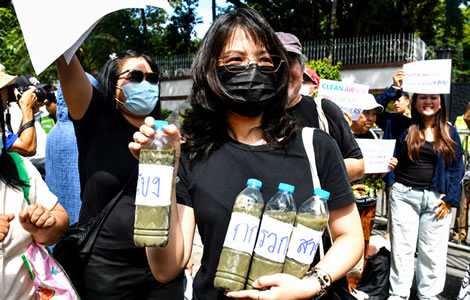
Activists intensified pressure on China and the Thai government this week as protests over cross-border river pollution spread from Chiang Mai to Bangkok. Demonstrators blamed Chinese-backed mining enterprises operating in Myanmar for contaminating rivers flowing into northern Thailand.
They demanded faster action, greater accountability and formal investigations into both the pollution and police conduct during earlier demonstrations.
Earlier this week, protesters gathered outside the Chinese Consulate in Chiang Mai to condemn pollution they say is entering Thailand from mining operations across the border. The demonstration marked a sharp escalation in public anger over deteriorating river conditions.
Protesters blame Chinese-backed mining in Myanmar’s Shan State for pollution in northern rivers
Protesters accused Chinese-backed businesses of financing large-scale gold and rare earth mining in conflict zones across Myanmar’s Shan State. They argued that the operations have expanded rapidly despite years of civil war and limited environmental oversight.
Two protesters were injured during a confrontation with police before provincial officials accepted a petition for onward submission to the Chinese Consulate.
In response, campaigners widened their campaign by taking their demands directly to the Chinese Embassy in Bangkok on Tuesday. The rally was organised by the NGO Coordinating Committee (NGO-COD) together with several civil society organisations.
Protest leaders submitted a petition urging Beijing to help address pollution affecting northern Thailand’s river systems. They also demanded an investigation into police conduct during the Chiang Mai demonstration.
During the protest, organisers poured water, which they said had been collected from affected rivers, over a map of Thailand and Myanmar. The symbolic act highlighted contamination concerns across the Kok, Sai, Ruak and Mekong river basins.
Bangkok protest demands inquiry into police conduct and stronger Chinese action on river pollution
Later, several demonstrators wore masks depicting activist Wisarut Srichan, who was injured during the Chiang Mai protest. They called for accountability and demanded a transparent investigation into allegations of excessive force. At the same time, protest leaders urged the House of Representatives to establish a formal fact-finding inquiry.
Lertsak Kamkongsak, chairman of NGO-COD, read a statement addressed to the Chinese government. He urged Beijing to make resolving cross-border pollution an immediate priority.
The statement cited reports of contaminants detected in waterways flowing into northern Thailand. It also called for an investigation into businesses linked to mining projects in Myanmar’s Shan State. Lertsak said cross-border investment should proceed alongside environmental protection and corporate responsibility towards affected communities.
The protests have been driven by the People’s Network to Protect the Kok, Sai, Ruak and Mekong Rivers. The network argues that toxic heavy metals are entering Thailand through waterways originating in Myanmar.
Campaigners say pollution has become increasingly visible in rivers supporting communities across Chiang Rai and Chiang Mai. Consequently, concern has spread well beyond environmental groups to residents, farmers and local politicians.
Campaigners say civil war and weak oversight fuel unchecked mining across Myanmar’s border regions
Protest leaders maintain that Chinese-backed mining operations have expanded rapidly in territories beyond the effective control of Myanmar’s military government.
Instead, they point to areas controlled by powerful ethnic armed organisations, including the United Wa State Army and other groups operating across Shan State. They argue that the ongoing civil war has enabled mining activity to expand with little effective regulation. As a result, responsibility has become divided between private operators, local armed authorities and competing administrations.
Campaigners also argue that no effective system exists to enforce environmental standards in those areas. They say that leaves communities downstream with little prospect of accountability when pollution occurs.
Moreover, they contend that Chinese finance, mining expertise and purchasing networks have helped sustain the rapid expansion of gold and rare earth extraction despite the unstable security situation.
The issue extends beyond local environmental concerns. Rare earth minerals have become strategically important because they are essential for electric vehicles, wind turbines, advanced electronics and defence industries.
Northern communities fear heavy metal pollution as rare earth mining expands across Myanmar’s frontier
China dominates global rare earth processing and has increasingly relied on supplies from neighbouring Myanmar. According to campaigners, the combination of rising global demand and Myanmar’s conflict has accelerated mining activity across remote border regions.
Residents in Chiang Rai and Chiang Mai fear contamination from arsenic, lead and other heavy metals. Community groups say deteriorating water quality threatens drinking water supplies, fisheries, agriculture and tourism.
In parallel, they warn that irrigation systems supporting thousands of farming families depend on rivers flowing from Myanmar. Scientists and environmental organisations have also raised concerns. They warn that unregulated upstream mining presents a growing transboundary risk across the Mekong basin.
Political pressure has also intensified. Opposition MPs representing northern provinces, including Phattarapong Leelaphat, have raised the issue in Parliament and demanded stronger government intervention.
They have criticised what they describe as a slow official response despite months of concern over deteriorating water quality. Meanwhile, local communities continue pressing for stronger diplomatic engagement with both China and Myanmar.
Government panel set up as political pressure grows over pollution flowing into northern Thailand’s rivers
As part of its response, the Thai government has established a special panel bringing together relevant ministries and agencies. The panel is coordinating scientific monitoring, diplomatic engagement and environmental assessments.
However, campaigners argue that progress has been limited because the suspected pollution sources remain outside Thailand’s jurisdiction. They also note that many mining operations are located in territories where there is little effective state control.
Following the Bangkok demonstration, the Chinese Embassy in Thailand issued a statement saying Beijing had been closely monitoring reports of heavy metal contamination in tributaries of the Mekong River.
The embassy said China understood growing public concern over possible environmental and health impacts. It also said Beijing attached great importance to the issue and had followed reports of contamination in affected waterways.
The embassy stressed that the rivers concerned are transboundary waterways shared by Thailand and Myanmar. Therefore, it said the source of contamination should be determined through investigations based on facts, scientific evidence and responsibility.
China also expressed support for stronger communication and coordination between Thailand and Myanmar. It backed a joint investigation as soon as possible to identify those responsible and resolve the issue appropriately.
China backs joint probe and pledges closer Mekong cooperation over cross-border river contamination
For its part, the embassy said protecting the Mekong River ecosystem is a shared responsibility among all countries in the basin. It added that China stands ready to strengthen cooperation on water resource management and environmental conservation to safeguard the river’s ecological security.
Nevertheless, campaigners remain unconvinced that existing measures go far enough. They argue that pollution originating beyond Thailand’s borders requires sustained diplomatic pressure and closer international cooperation. They also maintain that responsibility for mining activities must be clearly established if contamination is confirmed.
Two injured in a public protest outside Chinese consulate in Chiang Mai over poisoning of local rivers
Chiang Mai MP raises alarm about government stasis in the face of a chronic arsenic river poisoning crisis
With demonstrations now held in both Chiang Mai and Bangkok, the issue has become one of Thailand’s most prominent environmental disputes. Pressure is continuing to build on both Bangkok and Beijing as campaigners seek answers over the source of contamination, responsibility for upstream mining and the future protection of northern Thailand’s river systems.
Join the Thai News forum, follow Thai Examiner on Facebook here
Receive all our stories as they come out on Telegram here
Follow Thai Examiner here
Further reading:
River Kok in Chiang Rai poisoned with arsenic from Wa state-controlled gold mining across the border
Rangsiman Rome MP calls for stiffer response to Myanmar’s junta over the jailing of Thai sailors
Myanmar Junta meltdown threatens to end Bangkok’s condominium sales boom as Kyat currency fails
Tyrant of Nay Pyi Taw’s days are numbered as Karen soldiers burn the hated Myanmar flag in Myawaddy