Anutin’s shock landslide hands Bhumjaithai sweeping power as provincial voters dominate, nationalism rises and barter trade moves to the heart of Thailand’s security-driven trade agenda.
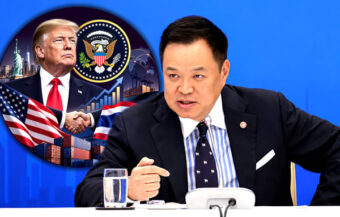
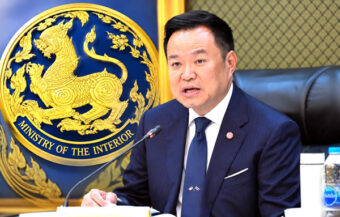
A visibly relaxed Prime Minister Anutin Charnvirakul on Monday told Thai TV audiences he was pleasantly surprised by the scale of Sunday night’s victory. As a result, analysts have begun scrutinising what a full-term government led by Anutin and the Bhumjaithai Party will deliver. There will be a renewed focus on nationalism, security, and stability. One defining feature of Anutin’s government since late last year has been its push for barter trade at an international level. This sharpens questions over Thailand’s trade priorities and the US–Thai trade deal, which remains a top item on the agenda of any new cabinet.
As the election result settled on Sunday night, the scale of Bhumjaithai’s victory reshaped the political landscape. Prime Minister Anutin Charnvirakul emerged with a commanding mandate.
As a result, attention shifted quickly from counting votes to interpreting their meaning. In particular, the outcome highlighted the power of provincial voters and the policy direction they endorsed.
On Monday, Mr Anutin publicly admitted surprise at the result. Speaking on a Channel 3 news programme, he said the scale of support exceeded expectations. Previously, the party had projected a far narrower victory. Instead, the final numbers delivered a decisive landslide.
Election result exceeds expectations as Bhumjaithai landslide delivers Anutin commanding mandate
Mr Anutin said Bhumjaithai had expected between 140 and 170 seats. At the time, that figure was considered sufficient to form a coalition. However, as counting progressed, the party’s position strengthened dramatically. According to unofficial Election Commission figures, Bhumjaithai is expected to secure at least 194 seats.
That total includes 175 constituency seats and 19 party-list seats. Consequently, the party finished well ahead of its nearest rival. By contrast, the People’s Party is expected to win about 116 seats. As a result, it is set to become the main opposition force.
The increase was stark when compared with the previous election. In 2023, Bhumjaithai won just 71 seats. Of those, only three came from the party list. This time, the party nearly tripled its representation. Therefore, the result marked a decisive shift in voter alignment.
In response, Mr Anutin described the outcome as more than a landslide. Instead, he framed it as a clear mandate. According to him, voters had endorsed the party’s direction. Consequently, he said Bhumjaithai would pursue its policies with confidence.
Provincial voters emerge as a decisive force as Bhumjaithai secures dominance beyond Bangkok
Central to that mandate was the provincial vote. While the People’s Party performed strongly in Bangkok, the provinces delivered Bhumjaithai’s majority. On Monday, Associate Professor Dr Olar Thinbangtiao addressed this point publicly. He is a political science lecturer at Burapha University.
In a social media post, Dr Olar urged urban voters to reassess assumptions. Specifically, he warned against underestimating provincial voters. Moreover, he emphasised their decisive role in national elections. According to his assessment, this result was secured outside major cities.
The voting pattern reinforced that conclusion. While the People’s Party won outright in Bangkok and provinces such as Nonthaburi, Bhumjaithai dominated across large rural regions. As a result, provincial concerns moved firmly to the centre of national policy.
Those concerns shaped the campaign itself. Throughout the race, Bhumjaithai focused on security, sovereignty, and economic protection. In particular, the party appealed to voters living near borders and in agricultural areas. According to Mr Anutin, that strategy proved decisive.
Border security messaging resonates as nationalist themes mobilise rural and provincial voters
Many analysts had questioned this approach before polling day. They argued that patriotic sentiment had faded following the ceasefire with Cambodia. However, Mr Anutin rejected that view. Instead, he said border communities continued to feel exposed.
According to him, residents along the border remained concerned about security conditions. Additionally, they feared economic disruption from border closures. Consequently, these voters responded strongly to promises of protection and stability.
That context is critical to understanding Bhumjaithai’s trade agenda. Under Mr Anutin, trade is not treated as a purely economic issue. Instead, it is framed as an extension of national security. As a result, barter trade has become a central policy tool.
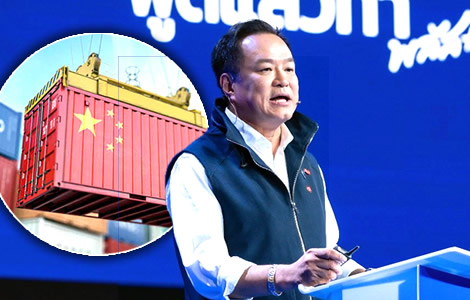
During Mr Anutin’s outgoing minority government, the Commerce Ministry promoted barter arrangements. At that time, Commerce Minister Suphajee Suthumpun led negotiations focused on China. Under those proposals, Thailand would exchange agricultural products for foreign goods.
Barter trade positioned as security instrument linking agriculture exports with defence procurement
These goods included military equipment such as fighter jets, submarines, and frigates. Notably, the transactions bypassed conventional currency settlement. Instead, goods were exchanged directly. As a result, reliance on foreign currency, especially the US dollar, was reduced.
Within Bhumjaithai’s platform, this model has been refined and expanded. Barter trade is embedded within the party’s “secure agriculture” policy. Under the proposal, major state procurement must include reciprocal agricultural purchases.
The targeted products include rice, rubber, cassava, and maize. According to the party, this approach absorbs surplus production. It also links agricultural stability to national procurement decisions. Consequently, defence purchases become tools of rural economic management.
On the other hand, the government will be called upon to finalise US–Thai trade talks that have been left running from last year. Indeed, this is a priority for the Thai business sector. The United States remains Thailand’s biggest market.
US–Thai trade negotiations face friction as barter practices challenge dollar-based international norms
However, barter trade is seen increasingly by the United States in an unfavourable light. For instance, it is used extensively by Russia to evade US sanctions. In addition, it bypasses the international trading market, which is dominated by the US dollar.
Supporters argue the policy strengthens bargaining power. By tying large purchases to farm exports, Thailand gains leverage. Moreover, it ensures state spending delivers visible domestic benefits. For provincial voters, this linkage is politically significant.
However, economists and trade experts have raised repeated warnings. Ath Pisalvanich has been among the most prominent critics. He has warned that barter trade risks political fallout. He has also said it damages competitiveness.
According to him, swapping farm goods for weapons will not lift farm-gate prices. Instead, he argues, it distorts pricing and market signals. Furthermore, he has warned that the model could entangle trade policy with geopolitical risk.
Despite these warnings, the policy aligns closely with Bhumjaithai’s electoral base. The landslide victory was driven largely by provincial voters. Many of them depend on agriculture and border trade. For these voters, state-managed trade offers predictability.
Nationalist trade framework aligns with provincial base prioritising stability, security and managed markets
Within the party’s messaging, barter trade is presented as protection. It is framed as shielding farmers from volatile global markets. It is also positioned as reducing exposure to foreign pressure. As a result, the policy fits within a broader nationalist narrative.
That narrative also shapes foreign alignment. Barter arrangements tend to deepen ties with specific partners. In Thailand’s case, these include China and, indirectly, Russia. Consequently, critics have raised concerns about strategic balance.
At the same time, barter trade diverges from standard international trading practices. Most global trade relies on currency settlement and open markets. By contrast, barter depends on negotiated equivalence. This limits flexibility and transparency.
Nevertheless, within Bhumjaithai’s security framework, these concerns are secondary. The party consistently links trade to border control and internal stability. Illegal imports and smuggling are treated as security threats. Therefore, state-directed trade is presented as a defensive measure.
Barter trade reinforces border control policy as economic management merges with national security
This approach connects directly to the party’s “building a wall” policy. While often described in physical terms, the wall also has economic dimensions. It includes blocking illegal imports that depress farm prices. It also includes tighter control of trade channels.
Under this logic, barter trade complements border security. State-to-state deals bypass informal markets. They also reduce opportunities for grey capital and smuggling. From the party’s perspective, this reinforces economic order.
Trade expert warns the government on barter deals with China being pursued by the Commerce Ministry
Anutin declares victory and attributes it to hard work and being close to voters in the constituencies
Meanwhile, the unfinished Thai–US trade deal highlights a competing model. That framework reflects conventional liberal trade norms. By contrast, Bhumjaithai’s approach prioritises reciprocity and control. Negotiations are expected to resume after government formation.
Taken together, the election result clarified both political power and policy intent. Mr Anutin’s surprise reflected the scale of provincial support. That support carried clear expectations. Trade policy, particularly barter trade, now sits at the centre of a nationalist stability agenda driven by provincial voters.
Join the Thai News forum, follow Thai Examiner on Facebook here
Receive all our stories as they come out on Telegram here
Follow Thai Examiner here
Further reading:
Trade expert warns the government on barter deals with China being pursued by the Commerce Ministry
Top Commerce Ministry official warns that any US trade deal must wait for new parliament and cabinet
Asean Summit on Monday and Tuesday seen by United States as pivotal to restoring border peace
War to continue says PM Anutin. Dismisses President Trump’s ceasefire talk as a ‘misunderstanding’
Confusion after Trump’s 20 minute phone call with PM Anutin. US side claimed a ceasefire was agreed