Thailand unveils tight 2027 budget as Anutin Charnvirakul caps growth at 0.2%, boosts defence and readies ฿500 billion borrowing amid Middle East war fallout, rising debt and impeded GDP fears.
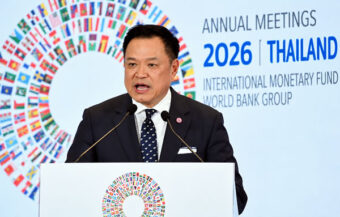
The government moved on Monday to issue an emergency decree to borrow about ฿500 billion as public debt rises. Ministers are blaming the Middle East war between the United States, Israel and Iran for the move. At a conference centre on the outskirts of Bangkok on Monday, Prime Minister Anutin Charnvirakul and senior ministers outlined a ฿3.28 trillion budget for 2027. Despite the crisis, spending is set to rise by just 0.2%. It points to a tougher financial climate ahead as the government faces mounting external pressures. The aim is to navigate the oncoming storm while maintaining, if possible, growth and economic stability.
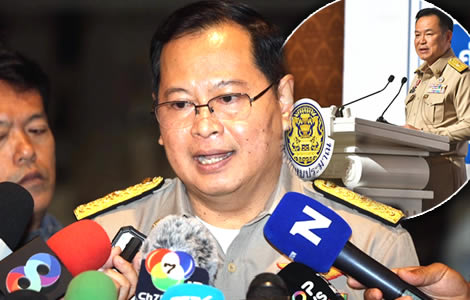
At a series of speeches on Monday at IMPACT Muang Thong Thani, the government outlined its fiscal strategy for 2027 in direct and controlled terms. There, Prime Minister Anutin Charnvirakul confirmed that spending growth will remain tightly constrained.
Overall, the plan reflects rising external risks and tightening domestic finances, with defence and crisis preparedness taking priority under current conditions.
The proposed fiscal 2027 budget stands at 3.78 trillion baht. However, this represents an increase of only 7.4 billion baht from the previous year. In percentage terms, that equals just 0.2 per cent growth. Therefore, economic analysts described the increase as negligible despite rising fiscal obligations.
Tight fiscal stance limits spending growth as 2027 budget rises marginally despite mounting pressures
At the same time, mandatory expenditures continue to increase steadily across sectors. As a result, fiscal flexibility has narrowed further, and discretionary spending faces stricter limits.
Accordingly, Prime Minister Anutin ordered agencies to cut non-essential spending across the board. In addition, he imposed firm limits on new funding requests from ministries. Specifically, any increase must not exceed 20 per cent of previous allocations.
Moreover, such increases must be strictly limited to investment expenditure. Meanwhile, government spokeswoman Rachada Dhnadirek confirmed that this year’s process differs significantly from previous cycles.
She said global volatility has reshaped fiscal planning, particularly due to the ongoing conflict in the Middle East. As a result, agencies must urgently review programmes and eliminate inefficient or misaligned projects.
At the same time, the prime minister stressed that the budget must be precise and targeted in execution. He said all allocations must align with the government’s “10 Plus” policy framework. Accordingly, the framework is designed to guide Thailand through instability while supporting long-term development. In addition, it aims to help the country move beyond middle-income constraints through structural adjustment and policy discipline.
Government enforces strict spending controls while aligning policy with long term reform framework goals
The government identified five core policy pillars to guide spending decisions. These include the economy, foreign affairs and security, society, disaster and environment, and public administration.
First, economic policy will prioritise income distribution and restructuring. Additionally, trade, agriculture, and tourism will receive targeted support measures. Next, in foreign affairs and security, Thailand aims to strengthen its global role. In particular, it seeks accession to the Organisation for Economic Co-operation and Development by 2028. At the same time, border security and public safety systems will be strengthened.
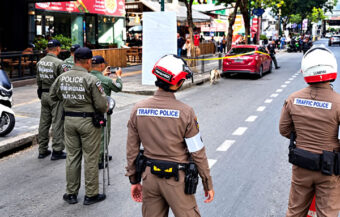
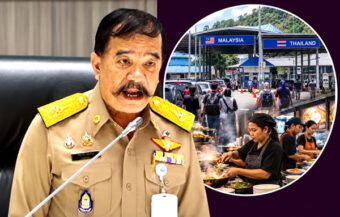
The ongoing tensions with Cambodia make this a necessity. At the height of last year’s conflict, the government was forced to allocate emergency provisions. At this time, there are plans for a border wall and augmented capabilities for the army at all of Thailand’s borders. This is especially true for the country’s border with Cambodia and Malaysia.
Meanwhile, social policy will focus on improving education and healthcare delivery. Programmes such as “Ageing Plus” and “Equal Education Plus” will be expanded. These initiatives aim to support families and communities facing demographic shifts.
Security tensions and economic reforms shape five pillar strategy guiding budget priorities and direction
In parallel, disaster and environmental policy will be reinforced. Specifically, water management systems will be upgraded, and response mechanisms strengthened. Furthermore, the government reaffirmed its commitment to achieving net-zero emissions by 2050 under the “Green Economy Plus” policy.
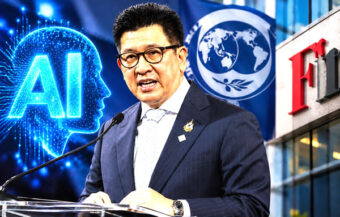
Similarly, public administration reforms will target efficiency gains and legal improvements. In addition, anti-corruption measures will be strengthened through initiatives such as “AI Plus” and “Thailand Plus.”
Energy policy also remains central to the fiscal framework. Accordingly, the government will promote clean energy adoption across agencies. This includes electric and hybrid vehicles in the public sector. In addition, solar rooftop installations will be expanded across government buildings to address long-term energy challenges.
Environmental reform energy transition and efficiency drive structural policy agenda forward
However, defence policy has emerged as a central priority within the 2027 budget. Prime Minister Anutin stressed the need for strong military readiness under current global conditions. He said equipment and capabilities must be fully prepared and operational.
Furthermore, he warned that Thailand must not appear vulnerable to potential external threats. Therefore, the armed forces have been instructed to coordinate closely with the Budget Bureau. This ensures careful planning and effective allocation of defence resources.
This emphasis reflects broader global instability and rising geopolitical tension. In particular, the Middle East conflict has disrupted energy markets and economic forecasts worldwide. Consequently, fiscal planning has become more uncertain and risk-sensitive.
A spokesman for the PM confirmed that the budget is being prepared under volatile conditions. Notably, the United States–Iran ceasefire is nearing expiration. As a result, the likelihood of renewed hostilities is increasing.
Recent developments have reinforced these concerns. For instance, the United States fired on the Iranian cargo vessel Tousca, causing damage to its engine room. Subsequently, US Marines boarded the vessel and seized both it and its cargo.
Notably, the cargo included components linked to missile propulsion and launching systems. These events have intensified global tension and contributed directly to economic uncertainty.
Defence spending rises amid global instability as conflict risks and ceasefire tensions increase sharply
Meanwhile, Thai authorities report increasing domestic fiscal pressure linked to external shocks. Public debt levels have risen in recent periods. At the same time, GDP growth projections have weakened significantly. Specifically, growth is expected to decline in 2026 under current forecasts.
Indeed, officials describe this pattern as part of a broader global trend affecting multiple economies. Accordingly, financial institutions such as the World Bank and the International Monetary Fund have raised concerns about rising debt levels and economic instability worldwide.
Within Thailand, fiscal constraints are becoming more pronounced as pressures accumulate. Public debt currently stands at about 66 per cent of GDP. However, the legal ceiling remains fixed at 70 per cent. Therefore, available fiscal space is increasingly limited under current regulations. Projections had already indicated a rise to 69 per cent in the coming years. Consequently, policy adjustments are now under active consideration by fiscal authorities.
Rising debt and slowing growth intensify fiscal pressure as Thailand nears legal borrowing limits
At the same event, Deputy Prime Minister Pakorn Nilapraphan confirmed that the government is preparing an emergency decree to borrow up to 500 billion baht. He said the measure is necessary to address overlapping crises affecting the country. These include high energy prices, low treasury reserves, and rising external risks. In addition, he highlighted environmental pressures, particularly the expected super El Niño event.
Deputy Prime Minister Pakorn said the government faces urgent challenges on multiple fronts simultaneously. He warned that the super El Niño is expected to affect agricultural production across large areas. As a result, the broader economy could face significant disruption in the near term.
Therefore, reserve funding is required to respond quickly and effectively to emerging risks. He explained that the emergency decree is permitted under Article 172 of the Constitution. This provision allows action in urgent cases involving national security or economic necessity. However, the decree must be submitted to the House of Representatives for consideration as soon as possible after issuance.
At the same time, he clarified that actual borrowing may fall below the 500 billion baht ceiling. However, legal requirements mean the debt ceiling must be raised to cover the full authorised amount. Therefore, the Ministry of Finance will determine a revised ceiling level.
Emergency borrowing plan targets crisis response as government readies decree under constitutional powers
Fiscal space is already tightening, requiring careful calibration of policy decisions. Finance Minister Ekniti Nitithanprapas has indicated that the ceiling could be increased if necessary under current conditions.
In parallel, a Budget Transfer Act may be issued to provide additional liquidity. This would allow rapid reallocation of funds in response to emerging crises. Deputy Prime Minister Pakorn also addressed the Fuel Fund, confirming that its legal status remains under review. A proposal is being considered to allow the Ministry of Finance to guarantee a loan of 150 billion baht for the fund.
He explained that the Fuel Fund was originally intended as a short-term stabilisation mechanism for energy prices. Ideally, it would hold between 20 and 40 billion baht.
However, prolonged subsidies have significantly expanded their role beyond their initial purpose. As a result, the fund has accumulated debt exceeding 100 billion baht. Therefore, further legal and structural adjustments may be required depending on future energy costs and economic conditions.
Fuel fund strain and fiscal limits drive review of borrowing powers and financial stabilisation tools
The borrowing plan reflects earlier emergency measures taken during the pandemic period. However, current risks are broader and more complex in scope. They include geopolitical conflict and climate-related disruptions occurring simultaneously. Deputy Prime Minister Pakorn stressed the need for preparedness under these conditions. He said risks are emerging from multiple directions and require coordinated and immediate responses.
Meanwhile, strict fiscal discipline remains in force across all government operations. Prime Minister Anutin has imposed a “golden rule” requiring value-for-money spending.
In addition, a zero-based budgeting approach will be applied to all expenditures. This means every item must be justified from the beginning rather than carried forward. Agencies must demonstrate necessity, urgency, and alignment with national priorities.
Spending on study visits will be reduced under the new framework. New office construction will also be scaled back significantly to conserve resources. Instead, agencies are encouraged to lease facilities where appropriate. Investment projects should rely on public-private partnerships where possible. In addition, the Thailand Future Fund may be used for financing. However, projects must remain limited to essential and necessary investments only.
The budget process follows a clearly defined and fixed timeline. The draft budget will be submitted to the cabinet on June 23 for approval. It will then be forwarded to the House of Representatives for deliberation. Parliamentary debate is scheduled to take place from July 1 to July 3. The new fiscal year will begin on October 1 as planned.
Fiscal discipline tightened as government enforces strict rules and prepares a budget timeline for approval
Earlier projections indicated an 8.37 per cent reduction in the budget deficit compared with the current fiscal year. However, officials caution that external conditions remain highly uncertain.
The Middle East conflict continues to influence global energy markets and economic stability. At the same time, environmental risks are increasing due to climate-related factors.
Budget Bureau warns Finance Minister that Thailand’s economy faces acute crisis with rising public debt
Anutin apologises as the economy is throttled by the Iran US war leaving ministers struggling to cope
Prime Minister Anutin emphasised the need for coordination across all sectors of government. He said agencies must work together to maintain national stability under pressure. He reaffirmed that government policy is guided by core principles. These include protecting the nation, religion, and monarchy. In addition, democratic governance must be upheld alongside fair and consistent law enforcement.
Overall, the fiscal outlook remains constrained and increasingly risk-sensitive. External developments continue to shape economic conditions and policy responses. Therefore, the 2027 budget reflects a controlled and disciplined approach under pressure. It limits spending growth while prioritising security and crisis preparedness. At the same time, authorities are attempting to manage rising risks within increasingly tight fiscal space.
Notably, as the government moves to organise its finances, the locus of concern for the Thai economy appears to be Washington DC, where the US President Donald Trump is contemplating letting Wednesday’s ceasefire with Iran expire.
A key concern for the government behind the scenes is the prognosis of the world to ratings agencies as the present storm unfolds. Two, Moody’s and Fitch, have already given Thailand a negative outlook, while S&P has retained a stable outlook. A downgrade of the kingdom’s sovereign debt status is one problem the government of Anutin Charnvirakul is anxious to avoid.
Join the Thai News forum, follow Thai Examiner on Facebook here
Receive all our stories as they come out on Telegram here
Follow Thai Examiner here
Further reading:
60-day visa regime to be ended confirms Minister responding to rising industry security concerns
Tourism boss warns Thailand it is facing a Chinese blacklist if another security controversy erupts
Visa waiver scheme questioned with another China Crisis for foreign tourism driven by security fears