Thailand freezes response to Trump’s Peace Board as PM Anutin cites caretaker limits ahead of February election, deferring any decision to the next government while economic risks mount, growth slows below 1% and tourism weakens. Doubts grow over the US-led initiative’s scope, cost and potential impact on global order.
Thailand’s Prime Minister Anutin Charnvirakul on Friday said the government would give no response to President Donald Trump’s Peace Board invitation at this time, stressing that only a newly sworn-in government could take such a decision as his administration remains in a caretaker role. His comments came as the Siam Commercial Bank’s Economic Intelligence Centre (EIC) warned that GDP growth would fall below 1% in the first half of 2026, with the bank’s think tank saying a new government is unlikely to emerge until May, following the February 8 election.
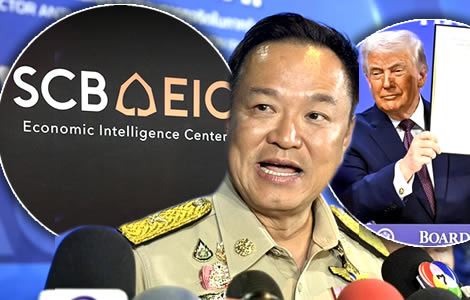
Prime Minister Anutin Charnvirakul on Friday ruled out any immediate response from Thailand to a United States peace initiative proposed by President Donald Trump. The decision was delivered amid growing international attention on the newly announced Board of Peace. At the same time, Thailand faces domestic political limits tied to its caretaker status.
Thailand was one of more than 60 countries invited to join the initiative. However, Mr Anutin said the government could not proceed further. As a result, Thailand has formally deferred any decision. Instead, the proposal will be passed to the next administration.
The government has acknowledged receipt of the proposal. Specifically, it received both the Comprehensive Plan to End the Gaza Conflict and the invitation to join the Board of Peace. Nevertheless, the response was limited. According to Mr Anutin, caretaker conventions prevent binding commitments.
Election timing leaves caretaker Thai government unable to decide on US peace board invitation
Thailand is currently in the middle of a general election campaign. Consequently, the government’s authority is restricted. The national vote is scheduled for Sunday, February 8. Until then, major foreign policy commitments remain off the table.
Mr Anutin said any decision must be taken by the next elected government. Therefore, the current cabinet will take no further action. Instead, the proposal will be forwarded for later consideration. That review, he said, must be based on Thailand’s national interests.
Despite deferring the decision, Mr Anutin outlined potential benefits. For example, participation could support peacebuilding efforts. Moreover, it could promote regional and global stability. In addition, it could strengthen Thailand’s international networks.
However, he also highlighted the financial burden. Participation would require major funding commitments. Therefore, costs must be carefully assessed. According to Mr Anutin, any investment must deliver broad returns. Importantly, it must not serve a single country’s interests.
Anutin says caretaker status prevents commitments as Thailand defers response to invite
For now, Mr Anutin said his role is limited. As such, he cannot commit future governments. Instead, he stressed continuity and procedure. Consequently, Thailand’s position remains unchanged until after the election.
Mr Anutin also addressed questions about timing. He said the invitation was not directed at Thailand alone. Rather, it was part of a wider outreach. According to him, the proposal had no link to any dispute involving Thailand.
More than 60 countries received similar letters. Some countries accepted the invitation. Others are still reviewing it. Meanwhile, several have declined outright. Thailand, by contrast, has chosen to wait.
The Board of Peace was formally unveiled last week. The announcement took place at the World Economic Forum in Davos, Switzerland. There, President Trump signed documents establishing the body. At the ceremony, officials from 19 other countries were present.
Those countries included Argentina, Qatar, Azerbaijan, Indonesia, Hungary, Morocco, Bahrain, Pakistan, and Saudi Arabia. Notably absent were several major European powers. Scandinavian countries were also missing. Their absence drew immediate attention.
Trump unveils board in Davos with partners as major European and Scandinavian states demur
The board’s charter spans 11 pages. However, it does not mention Gaza once. This omission has been widely noted. Consequently, questions have emerged about the board’s true mandate.
Originally, the board was conceived to oversee Gaza’s reconstruction. This followed more than two years of war in the territory. Over time, however, the initiative expanded. According to President Trump, its scope now extends far beyond Gaza.
During the Davos event, Mr Trump said the board could address other global crises. He suggested it could act broadly. In effect, this overlaps with roles traditionally filled by the United Nations.
Mr Trump said permanent members must contribute US$1 billion each. That figure equals roughly 31 billion baht. As chairman, he would oversee the body’s direction. He described the initiative as historic.
In a press statement, Mr Trump said the board could be one of the most consequential bodies ever created. Moreover, he said it marked a turning point for global security. According to him, the initiative offered a chance for lasting peace.
Trump promotes the board as historic while critics warn it could undercut the UN’s authority
He said the board could help end decades of suffering. He also said it could stop generations of conflict. In his words, it could help forge a lasting peace in the Middle East.
At the same time, concerns have grown among some governments. Specifically, critics fear the board could undermine the United Nations. These concerns were raised soon after the announcement.
Mr Trump addressed these fears directly. He said the board would work with other institutions. Notably, he mentioned the United Nations by name. However, he also criticised the UN’s performance.
Mr Trump said the UN has great potential. Nevertheless, he said that potential has often gone unused. His remarks suggested dissatisfaction with existing structures.
He also praised US officials involved in the initiative. According to him, they helped secure a ceasefire in Gaza. He claimed peace had been achieved in the Middle East. He added that few believed such an outcome was possible.
Despite those claims, uncertainty remains. The absence of Gaza from the charter has raised doubts. Furthermore, the board’s expanded mandate has unsettled some states. As a result, concerns about institutional overlap persist.
Domestic political limits force Thailand to wait as the economy faces prolonged uncertainty
Thailand’s position, meanwhile, will be shaped by domestic realities. The caretaker government lacks authority for long-term commitments. Therefore, Mr Anutin said restraint was required. Any future involvement must wait.
At the same time, Thailand presently faces economic uncertainty tied to the political transition. The Economic Intelligence Centre at Siam Commercial Bank has issued new forecasts. These projections point to delays and slower growth.
According to the EIC, a new government may not form until May 2026. That timeline reflects risks surrounding the election process. As a result, economic momentum could weaken.
The EIC said government formation could take up to five months after the vote. Several factors could slow the process. These include election-related litigation. In addition, border tensions with Cambodia remain a risk.
Moreover, the think tank expects coalition constraints. No party is likely to secure a clear majority. Consequently, policy implementation could be limited. This mirrors conditions following the 2023 election.
Budget delays and coalition constraints seen weighing on growth outlook and public spending plans
As a result, fiscal legislation may be delayed. The EIC expects the 2027 budget bill to face a one to two-month delay. Therefore, budget disbursements could slow. Public spending would be affected. These delays would weigh on economic growth. Accordingly, the EIC forecasts growth below 1% in the first half of 2026. For the full year, growth is projected at around 1.5%.
Some support will come early in the year. Specifically, accelerated disbursements by the outgoing government may help. In addition, high levels of outstanding commitments remain. However, this support is expected to fade. As the transition drags on, momentum could weaken. Consequently, overall growth would slow.
Private sector sentiment showed a brief improvement late last year. This followed stimulus measures by the government. However, the EIC expects this optimism to fade. Labour income growth remains weak. Household debt levels are high. At the same time, financial conditions remain tight. Bank lending continues to contract.
Exports are also expected to decline this year. This follows strong performance in 2025. According to the EIC, US import tariffs will become clearer. Global competition is also intensifying. Together, these factors will weigh on external demand. As a result, export growth is expected to turn negative.
Tourism supports the economy despite an uneven recovery, with arrivals forecast sharply lower
Tourism remains a relatively bright spot, according to the Economic Intelligence Centre (EIC). Foreign arrivals continue to recover gradually. Growth is led by Europe, India, and the United States. Meanwhile, Chinese arrivals are showing early recovery signs. New flight routes have supported this rebound. However, the recovery remains uneven.
Significantly, last week the Ministry of Tourism and Sports revealed that foreign tourist arrivals in January 2026 would be 18% down on the 2025 figure. Nevertheless, tourism continues to support the economy. It is intrinsic to any revival in growth in the short term.
The EIC also expects monetary easing. It forecasts a policy rate cut by the Bank of Thailand. Specifically, it expects a 25 basis point cut to 1% in the first half of the year. After that, rates are expected to remain steady through 2026. This reflects weak growth and political uncertainty. It also reflects a broad contraction in private credit.
Rising debt and fiscal strain add pressure as Thailand defers peace decision and awaits new government
Fiscal pressures are also mounting. Public debt is nearing the statutory ceiling. Consequently, fiscal space is narrowing. The EIC warned of potential credit rating risks. Political parties continue to campaign on cash handouts. At the same time, they propose structural reforms. These include household debt, infrastructure, and competitiveness.
Thailand invited to be part of Trump’s Board of Peace which diplomats warn cuts across the UN’s role
Other proposals address environmental risks and demographics. Labour quality and inequality are also cited. Social welfare and governance reforms are included. However, the EIC said these reforms require major funding. Clear plans for revenue reform remain absent. Therefore, fiscal risks persist.
Against this backdrop, Thailand’s response to the US peace initiative remains frozen. The caretaker government has taken no position. Instead, the decision has been deferred. For now, Thailand will wait. The next government will decide. Until then, no commitment will be made.
Join the Thai News forum, follow Thai Examiner on Facebook here
Receive all our stories as they come out on Telegram here
Follow Thai Examiner here
Further reading:
Thailand invited to be part of Trump’s Board of Peace which diplomats warn cuts across the UN’s role
Foreign Minister Sihasak expresses disappointment at Trump’s remarks on border landmine incidents
War to continue says PM Anutin. Dismisses President Trump’s ceasefire talk as a ‘misunderstanding’
Confusion after Trump’s 20 minute phone call with PM Anutin. US side claimed a ceasefire was agreed
People’s Party on campaign but on guard against potential legal complaints to oversight agencies
Wealthy young People’s Party leader aims to create a technology-driven and efficient welfare state