Thai troops and police raided a Surin border compound, uncovering fake police stations and offices used in a long-running transnational scam hub. Authorities say the cybercrime base exploited a key Thailand-Cambodia crossing. This is now under investigation.
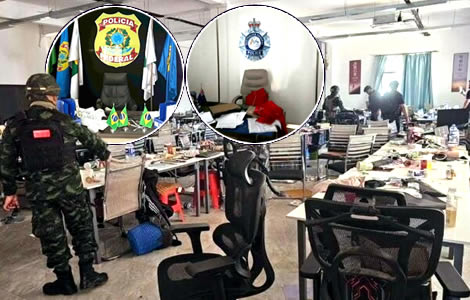
An extensive scammer compound was raided by Thai army and police units on Friday along the Thailand–Cambodia border in Surin province after intelligence sources identified the site as an international scam operations base. Inside multiple buildings, the joint army-police team uncovered a highly organised network of facilities used to deceive online victims, including studio sets designed to replicate online interviews with international police forces such as Chinese, Australian, and Brazilian authorities, along with evidence of a sophisticated fraud centre refined for efficiency and believed to have operated for a prolonged period.
The Thai military and Central Investigation Bureau (CIB) operatives on Friday last uncovered extensive evidence of organised online fraud during a coordinated raid in northeastern Thailand. The operation focused on a suspected scammer compound in the Chong Chom–Our Semet area. The site sits at a permanent border crossing in Kap Choeng district, Surin province.
The site previously was situated on one of eight key permanent border crossings between Thailand and Cambodia. In short, these were tended areas used for trade and commerce between the two countries. The Thai–Cambodian border last year saw all these crossings close. Martial law was declared across the border zones as the military took over.
The joint army-police raid took place on January 23, 2026. At that time, Thai military and police units moved into the area. According to officials, the inspection followed prior intelligence assessments. As a result, the location had been flagged as a cybercrime hub.
Army intelligence and cybercrime commanders jointly direct coordinated inspection of centre
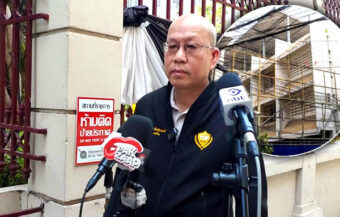
The operation was jointly led by senior security officials. Specifically, Lieutenant General Theeranant Nanthakhwang directed the military side. He serves as Director of the Army Intelligence Department. Meanwhile, Police Major General Witthaya Sriprasertphap commanded the police component. He heads the Cyber Crime Investigation Bureau.
In addition, officers from the Central Investigation Bureau joined the mission. The area falls under the authority of the Suranaree Task Force. Therefore, military units familiar with the terrain supported the inspection. Coordination between agencies was conducted on-site.
Authorities said the inspection targeted buildings linked to technology-based crime. Initially, officers secured the perimeter. Then, search teams entered several structures. Subsequently, investigators documented evidence inside multiple rooms.
Inside the compound, officials discovered extensive physical evidence. Most notably, several rooms were staged as police stations. Other rooms were designed to resemble government offices. According to investigators, the replicas copied agencies from several foreign countries.
Fake police stations and foreign government offices discovered as part of organised scam complex
The mock facilities included desks, insignia, and wall signage. In some rooms, office layouts mirrored real law enforcement offices. Meanwhile, other spaces imitated administrative government departments. Authorities said the detail level was deliberate.
According to officials, the staged rooms were used to deceive victims. Specifically, the spaces supported impersonation scams. During online calls, suspects posed as officials. As a result, victims were misled into believing the calls were legitimate.
Investigators said the environments were not decorative. Instead, they formed part of the fraud process. The rooms were operational tools. Consequently, they enhanced credibility during digital interactions.
Authorities reported that the compound showed a clear organisational structure. For example, room placement followed a functional pattern. Moreover, movement between areas suggested controlled workflows. Officials described the setup as systematic.
Evidence of a centralised and transnational scam network operating in a border grey area
The management of the space indicated centralised planning. In addition, evidence showed coordinated control. As a result, investigators assessed the operation as large-scale. Officials said it exceeded isolated scam activity.
According to the findings, the operation bore transnational characteristics. Specifically, foreign police and agency designs were used. This suggested cross-border targeting. Therefore, investigators linked the compound to an international network.
Officials did not release the number of suspects involved. However, they confirmed the scale was significant. Equipment volumes indicated sustained use. Furthermore, signs of long-term occupation were visible.
Authorities confirmed the site was not linked to any legitimate agency. In contrast, all inspected rooms were fabricated. No government authorisation existed for the facilities. As such, the compound functioned solely for criminal purposes.
Strategic border crossing location provided logistical advantages for long-running scam operation
Investigators stated that border locations remain attractive to such networks. In particular, permanent crossings offer logistical advantages. These areas allow movement of people and equipment. Consequently, they can support extended operations.
The Chong Chom–Our Semet crossing holds regional importance. It connects transport routes across borders. Therefore, authorities said the location had strategic value. This made it vulnerable to exploitation.
During the inspection, officials secured all identified rooms. Subsequently, evidence was catalogued. Items included office fittings and staging materials. Digital components were also identified for further analysis.
The Cyber Crime Investigation Bureau confirmed follow-up investigations. Specifically, seized materials will undergo forensic examination. Digital data will be analysed for communication trails. Financial links will also be traced.
Prosecutions due as wider investigations continue and border enforcement measures intensify
Meanwhile, the Central Investigation Bureau will assist case development. Officers will support forensic and financial inquiries. In addition, coordination with other agencies will continue. Authorities said no arrests were announced at the site.
Officials stated that legal proceedings will follow. Relevant fraud and cybercrime laws will be applied. Accordingly, suspects identified through evidence will face prosecution. Cross-border cooperation may be required.
The Royal Thai Army said intelligence-led operations will continue. As part of this effort, border monitoring will intensify. Military units will support further inspections. Coordination with police agencies remains ongoing.
Authorities described the findings as a serious security concern. Not only did the operation involve fraud. It also undermined institutional trust. As a result, officials categorised it as a national security issue.
Sophisticated digital deception methods reflect evolving scam tactics now under scrutiny
Officials further noted the role of technology in the operation. Online platforms were central to the scams. Therefore, physical staging supported digital deception. This combination increased operational effectiveness.
Investigators said such methods are increasingly observed. Criminal networks now use realistic environments. Accordingly, impersonation becomes harder to detect. The Chong Chom site reflected this trend.
Massive raid by Immigration on Muang Thong Thani romance scam centre sees 13 Africans arrested
Cambodian scam compound murder boss ‘Mr. Ham’ nabbed by Thai and South Korean cops in Pattaya raid
Cambodian tycoon arrested by Phnom Penh and sent back to China in chains. Regime moves to clean house
Rangsiman Rome, MP says he has new information on Cambodian scammer funds flowing into Thailand
The agencies involved emphasised continued enforcement. Preventive measures will be expanded. Surveillance of suspected locations will increase. Border inspections will remain active.
Officials concluded that the raid disrupted a major scam base. However, the investigation remains ongoing. Additional evidence may lead to further law enforcement operations. Authorities said updates will follow as inquiries progress.
Significantly, the raid and occupation by the army police task force of the scam centre comes only days after another scam centre was smashed just outside Bangkok. This one used rented condominium units in the Muang Thong Thani area of Bangkok. That Nigerian-run romance scam racket was smaller and organised, whereas the border scam centre was on a larger scale and aimed at fraud linked to government officials.
Join the Thai News forum, follow Thai Examiner on Facebook here
Receive all our stories as they come out on Telegram here
Follow Thai Examiner here
Further reading:
Cambodian scam compound murder boss ‘Mr. Ham’ nabbed by Thai and South Korean cops in Pattaya raid
Thailand and Cambodia face danger from ‘Dragon Head’ the Chinese mafia leader behind the scams
Cyber police and Money Laundering agency seek UK and US co-operation targeting Cambodian networks
United States, South Korea and United Kingdom act against Cambodian scam industry with Thai tie-ins
Ben Smith affair & allegations of links to Cambodian scam centres continues to rage in parliament
Defiant Rangsiman Rome warns he’s not just fighting a defamation case but for the future of Thailand
Ben Smith money fixer to the elite in Thailand lines up ฿100M defamation case against Rangsiman Rome